Compression Boots: What Does the Science Say About Recovery?
Les bottes de compression pneumatique intermittente réduisent la sensation de jambes lourdes et les courbatures perçues, avec un effet documenté sur le ressenti plus que sur la performance. Les données disponibles ne montrent pas d'amélioration significative des marqueurs objectifs de récupération. Leur intérêt en centre tient au confort perçu et à l'attractivité de l'offre.
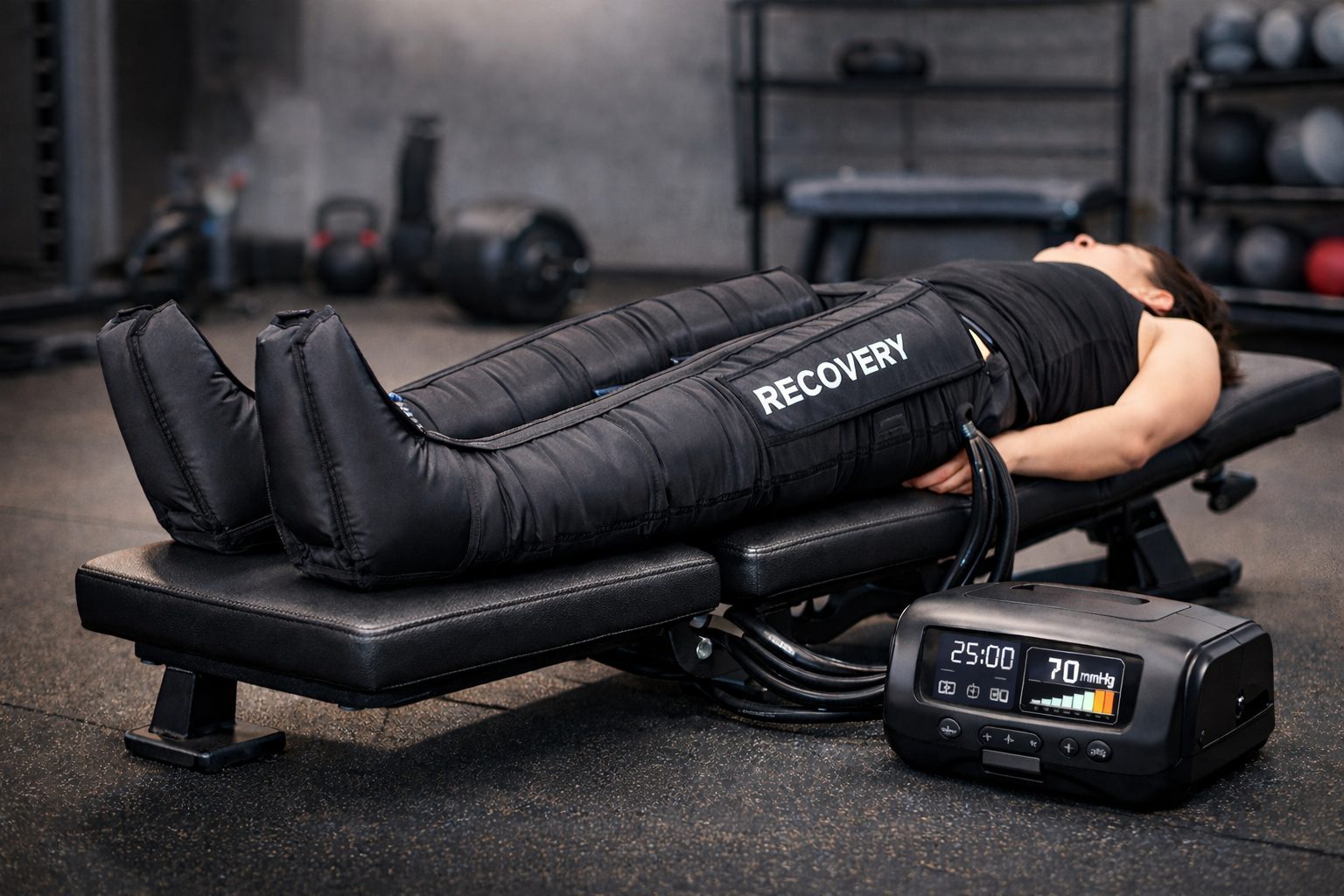
Compression boots are gaining interest in sport. They use intermittent pneumatic compression (IPC), also called pressotherapy. They may ease heavy-leg sensations and reduce perceived muscle soreness. Evidence for changes in biological markers or performance is limited. Effects on delayed-onset muscle soreness (DOMS) are modest. No clear advantage over other recovery methods has been shown. This guide explains what the science supports.
What “mechanical lymphatic drainage” means in practice
IPC works on a simple principle: inflatable sleeves surround the limbs and alternate cycles of pressure and release, promoting venous and lymphatic return towards the trunk.
It differs from manual lymphatic drainage in important ways. Manual drainage starts at the neck to open the lymphatic terminus and requires long, rigorous training. Pressotherapy applies sequential pressure from the extremities towards the trunk and can be used with minimal prior training. Sports systems generally operate between 20 and 80 mmHg, with standard sessions of 20–30 minutes.
Plausible mechanisms after exercise
External compression applies mechanical pressure that counteracts gravitational pooling of blood and lymph, supporting their return to the heart. Several hypotheses have been proposed for the observed benefits:
- Compression may increase local blood flow and accelerate metabolite clearance.
- It may limit oedema by restricting the space available for tissue swelling.
- Some researchers suggest a possible reduction in pain perception via effects on microcirculation.
These mechanisms remain largely theoretical. The physiological effects measured in studies are small: venous return improves, but objective biological changes are often marginal.
What trials and meta-analyses show
| Study type | Protocol | Main finding |
|---|---|---|
| 2024 meta-analysis, 17 studies (Maia et al., Biology of Sport) | Mostly 20–30 min at around 80 mmHg | Trivial-to-small improvement in muscle function; moderate reduction in perceived soreness, with high between-study variability |
| Randomised controlled trial, U19 footballers | 30 min at 200 mmHg | No improvement in neuromuscular or biochemical recovery versus placebo — questioning the value of high pressures |
| Crossover trial, manual massage vs IPC | Post-exercise sessions | Creatine kinase fell slightly more with IPC but not significantly; no strength or power improvement in either group |
The heterogeneity of the trials makes generalisation difficult, and performance results remain too variable to support firm conclusions.
Who it can help — and who it will not
IPC can be worthwhile for athletes under heavy training loads. It mainly targets subjective comfort and reduced DOMS; people with heavy-leg sensations after exercise may also feel a benefit. Keep expectations realistic: perceived comfort does not equal improved performance, and pressotherapy does not replace active recovery, good nutrition or adequate hydration — the classic methods remain the foundation of effective recovery. See our guides to hydration and recovery for training facilities and sports compression garments for the wider picture.
For people with chronic conditions — lymphoedema, post-surgical recovery, vascular disease — the situation is different: use must be supervised by a healthcare professional.
Contraindications and warning signs
International consensus on compression identifies formal contraindications:
- Severe peripheral arterial disease (ankle-brachial index below 0.6 or ankle pressure below 60 mmHg)
- Compression over an arterial bypass
- Severe or uncontrolled heart failure (NYHA stage IV)
- Allergy to compression materials
- Severe diabetic neuropathy
Stop a session if you feel unusual pain. Local redness or warmth can be a warning sign, including of deep vein thrombosis. Skin infection, unexplained swelling or breathlessness also require prompt medical advice. Do not continue using the boots while these signs are unexplained. More common side effects include skin irritation or itching, which often settles quickly.
A minimalist practical protocol
Studies commonly use sessions of 20–30 minutes at around 80 mmHg, but this does not establish one best protocol for every user. Follow the device instructions and any advice from your healthcare professional. Start with low pressure and increase only within those instructions and your tolerance. Never continue through pain or unusual discomfort. Seek medical advice if you are unsure about your health or a suitable protocol. The 2024 systematic review by Maia and colleagues explains the limits of the evidence.
Compression boots in a club setting
For gym operators, compression boots are a popular, low-footprint addition to a recovery area — valued by members for comfort even though the performance evidence is modest. Our guides to pressotherapy in fitness centres and recovery rooms for clubs cover equipment selection and integration. For a recovery-zone project, request a free quote from Light In Fitness.
How compression boots compare with other recovery tools
Compression boots have a specific place among recovery tools. Compression garments apply low, steady pressure for hours. Boots apply higher pressure in cycles during a short session. Both mainly offer comfort and relief from perceived soreness, with little proven performance change. Compared with massage, boots need less staff time and use a set programme.
Trials show no clear winner. Cold-water immersion has stronger evidence for short-term soreness relief, but is less comfortable and harder to organise. Used straight after lifting, it may also reduce long-term strength gains. Sleep, nutrition and load management remain the priorities. Get these basics right before adding devices for comfort.
Buying considerations
For individual athletes, entry-level and premium boots differ mainly in chamber count, maximum pressure and build quality. A mid-range device can cover the commonly studied settings of 60–80 mmHg for 20–30 minutes. Clubs should also check daily-use capacity, wipe-clean surfaces, replaceable liners, warranty and spare parts. Do not choose a device only for its maximum pressure. Higher pressure is not a proven route to better recovery.
The bottom line for athletes
Compression boots are a comfort tool, not a miracle recovery treatment. Some users find their legs feel better after hard training. They can fit into a recovery routine when used according to device instructions and individual health advice. Evidence does not establish a reliable next-day performance benefit. They do not replace sleep or food. More expensive models have no clear proven advantage for standard recovery use. Buy them with realistic expectations.
FAQ — Compression boots
Do compression boots improve sports performance?
No reliable evidence shows a performance benefit. The demonstrated effects concern perceived soreness and comfort, which may indirectly support training consistency — but the boots themselves do not make you faster or stronger.
What pressure and duration should I use?
Studies often use 20–30 minutes at around 80 mmHg. These are research settings, not a universal prescription. Follow your device instructions and seek medical advice where needed. Very high pressure, such as 200 mmHg, has not shown a clear extra recovery benefit.
Are compression boots safe for everyone?
No. They are contraindicated in severe peripheral arterial disease, uncontrolled heart failure, severe diabetic neuropathy and some other conditions. Anyone with a cardiovascular or circulatory condition should seek medical advice before use.
Are they better than massage or active recovery?
Comparative trials show no clear superiority. They are a convenient, staff-light complement to — not a replacement for — sleep, nutrition, hydration and active recovery.