How to Choose a Playground Equipment Supplier
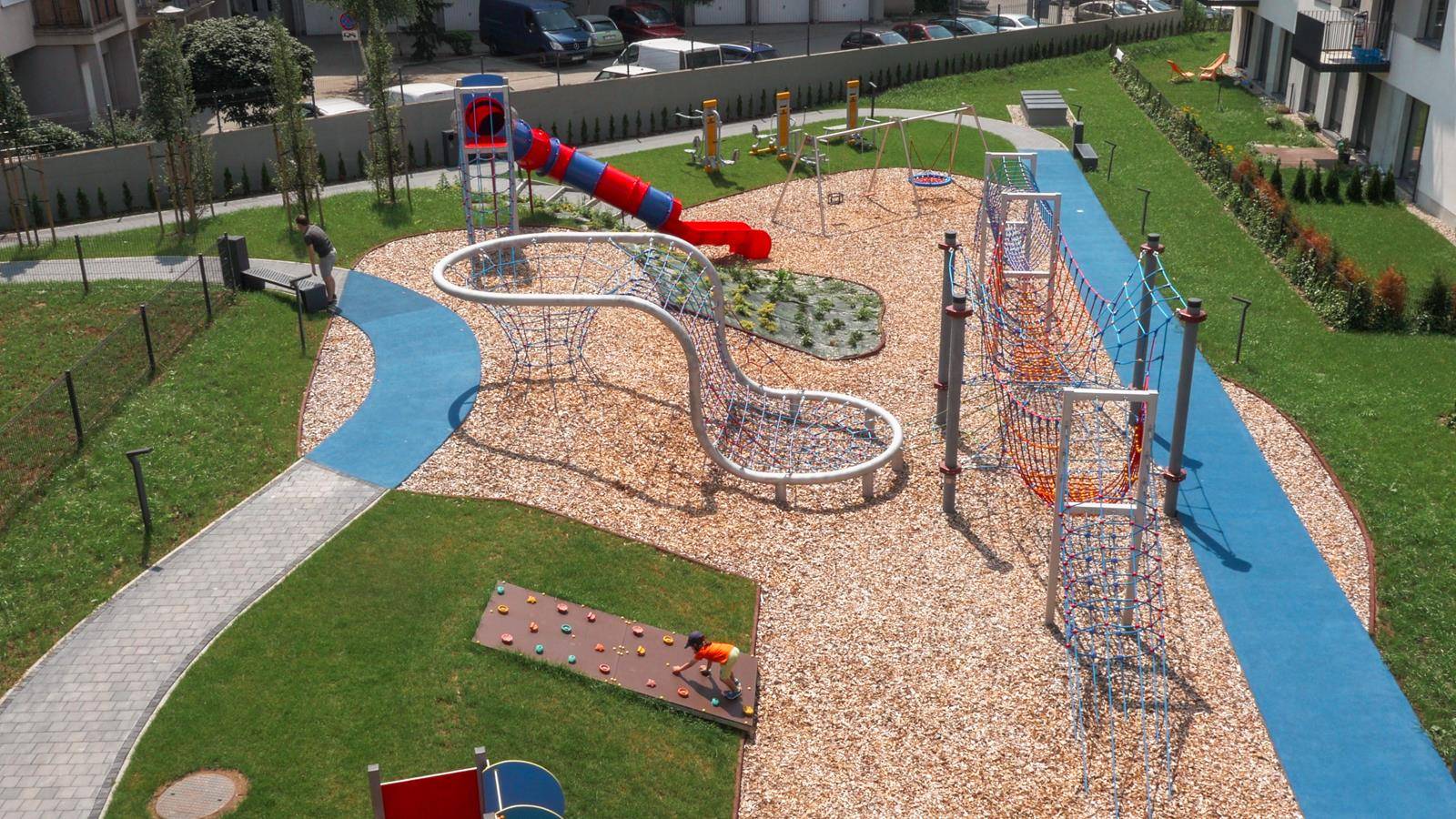
Choosing a playground equipment supplier is less about the catalogue photographs than about four things: the standards the equipment is certified to, the materials it is built from, how wide an age range it covers, and whether the supplier is still involved after delivery. Plenty of manufacturers can supply a slide. Far fewer can take a municipality, a school or a campsite from a site survey to a compliant, installed and maintained playground.
Light In Fitness has been equipping professional and public facilities since 2013, and playgrounds are one of the ranges we design, supply and install ourselves. Here is what we would tell any buyer to check, whoever they end up buying from.
Start with the standards, not the price list
Play equipment for public and collective use is governed by two separate standards, and they are not interchangeable. The equipment itself is covered by EN 1176-1, the general safety requirements for playground equipment. The impact attenuating surfacing underneath it is covered by EN 1177. A structure certified to EN 1176-1 installed over a surface that does not meet EN 1177 is not a compliant playground, and the reverse is equally true.
Ask any supplier to state both, in writing, for the specific reference you are buying. Our full playground equipment range is built to EN 1176-1, and our playground surfacing is specified to EN 1177 for the free fall height of the equipment above it. Note that EN 16630, which covers permanently installed outdoor fitness equipment, applies to adult equipment and never to children’s play structures. A supplier who blurs those two is a supplier to avoid.
Cover the whole age range, not just the middle of it
A playground that only works for one age band empties out quickly. The toddler end needs equipment scaled to early motor development, together with sand play and similar features that support imaginative play. Older children need height and challenge: large slides, play towers, multi activity structures, climbing areas and zip lines.
Our range covers both ends, and it extends into complementary equipment such as swing sets, trampolines, multi sport courts and inflatable structures. That breadth is what lets a single site serve small children, older children and, in the case of multi sport surfaces, teenagers and adults from the same budget line.
Materials decide the maintenance bill
Safety and durability come from the material specification, not from the finish. Our wooden structures use solid timber, autoclave treated for better resistance to weather and to insects, which is what keeps a structure serviceable through years of outdoor exposure rather than a couple of seasons.
Some of our products are manufactured from FSC labelled timber, certifying responsible forest management. We also offer wooden playgrounds with timber roofs, which integrate more naturally into green spaces and public gardens than a purely metal structure. For a municipality with a landscape brief to satisfy, that matters as much as the play value.
Judge the service, not just the product
The difference between a supplier and a partner shows up after the order is signed. We handle the complete fit out of a playground, from design through installation to maintenance, and we stay involved throughout, taking account of the constraints of the site and the needs of the users.
That matters because a playground is rarely a flat, empty rectangle. Slopes, existing trees, access for installation plant, drainage under the surfacing and the position of sight lines for supervising adults all change the layout. Those decisions are made on site, not in a catalogue.
Frequently asked questions
Which standard applies to a public playground?
EN 1176-1 applies to the play equipment itself. EN 1177 applies to the impact attenuating surfacing beneath it, and the required performance depends on the free fall height of the equipment installed above. Both are needed. EN 16630 is a separate standard for outdoor fitness equipment for adults and does not apply to children’s play equipment.
Who are these playgrounds for?
Nursery and primary schools, municipalities and public open spaces, campsites and holiday villages, play parks and residential developments. The specification changes with the setting, but the applicable standards do not.
Do you supply the surfacing as well as the structures?
Yes. Structures and impact attenuating surfacing are specified together, because the surfacing performance has to match the free fall height of the equipment above it. Buying them from two suppliers is how sites end up non compliant on handover.
Talk to us about your site
Send us the site, the age groups you need to serve and any landscape or budget constraints, and we will come back with a layout and a specification that covers both the equipment and the surfacing. Request a quote and we will put a costed proposal together.
Sources et références
- Décret n° 96-1136 du 18 décembre 1996 – prescriptions de sécurité relatives aux aires collectives de jeux (Légifrance)
- NF EN 1176-1 – Équipements et sols d’aires de jeux, partie 1 : exigences de sécurité et méthodes d’essai générales (AFNOR)
- NF EN 1177 – revêtements de surface amortissants : détermination de la hauteur de chute critique (AFNOR)