The Best Professional Strength Machine for Real Results
Operators asking for the best professional strength machine are rarely looking for a single miracle product. They are looking for the machine that produces the most training, for the most members, in the least floor space, with the lowest maintenance burden over a ten-year horizon. Framed that way the question becomes answerable, and for most commercial floors the answer is a well-specified multi-station backed by a small number of targeted single-purpose machines.
What best actually means on a commercial floor
A machine that is excellent in a private studio can be the wrong purchase for a club. The criteria that decide it are commercial, not emotional:
- Throughput. How many members can train on it per hour, and does it create a queue at peak?
- Coverage. How many movement patterns does one footprint deliver?
- Durability. Frame, bearings, cables and upholstery under several hundred sessions a week.
- Supervision load. Can a member use it correctly after a short induction, or does it need constant coaching?
- Cost per user over the life of the asset, not the purchase price in isolation.
Rank a shortlist against those five points and the field narrows quickly.
The multi-station: the most training per square metre
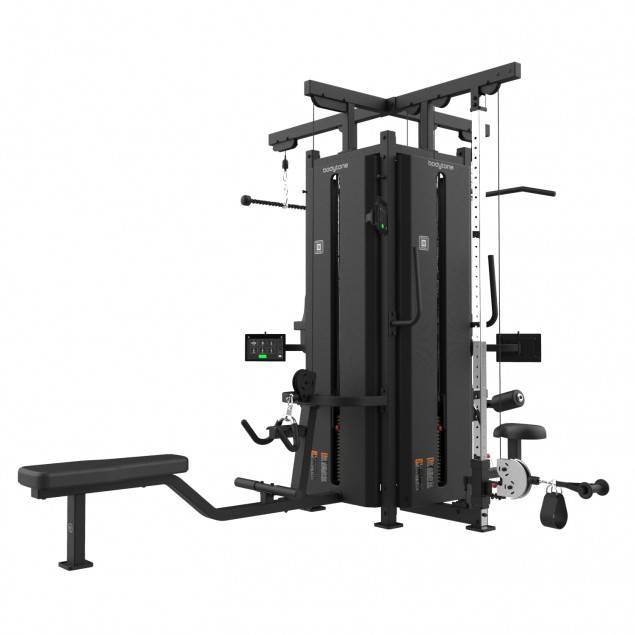
A multi-station concentrates several workstations into one frame with a shared weight stack architecture. In practice that means four members training simultaneously on different movement patterns inside the footprint that two isolated machines would occupy. For hotel gyms, corporate rooms, residential facilities and municipal halls where floor area is fixed and capital is scarce, this is the single highest-yield purchase available.
A four-station unit such as the Bodytone FC4S V2 covers pulling, pressing, leg and cable work from one structure, which is why it so often forms the spine of a compact floor. Compare the options across the multi-station range before committing, because station count, stack weights and cable geometry differ significantly between models.
Complete the floor with targeted machines
A multi-station is a spine, not a whole skeleton. Two or three targeted machines close the gaps that shared frames handle poorly, typically lower back, dedicated leg work and a heavy pressing station. Selectorised ranges such as the Bodytone Forza FH line are built for this role: one movement, correctly loaded, with a guided path that a member can use safely without a coach standing next to them.
The mistake to avoid is buying breadth before depth. A floor with twelve mediocre stations serves members worse than one with a strong multi-station, four excellent single-purpose machines and a properly sized free-weight area.
Safety and the supervision burden
Guided load paths, controlled ranges of motion and secure weight retention are not marketing features on a commercial floor. They are what allows a facility to operate with the staffing level it can actually afford. Ergonomic geometry keeps joints in a sensible line even when a member is tired or distracted, and integrated safety mechanisms limit what can go wrong when technique deteriorates in the last repetitions of a set.
This is also a liability question. In an unsupervised environment, a hotel or residential gym for example, the equipment specification is effectively the risk-control policy. Machines that force a safe movement path do far more for that than any signage on the wall.
Matching the machine to your membership
The right specification follows the member profile, not the catalogue. A general-population club with a wide age range benefits from generous adjustment ranges, clear starting positions and moderate stack increments. A performance-oriented facility needs heavier stacks, plate-loaded options and space to work. A rehabilitation setting needs fine load increments and easy transfers on and off the machine.
Because the same construction standard runs through the ranges, a facility can serve two profiles on one floor: the difference between a beginner circuit and a performance area lies in loading system and adjustment range, not in build quality.
Frequently asked questions
Is one multi-station enough to open a small gym?
For a compact hotel, residential or corporate room, a multi-station plus cardio and a small free-weight area is a viable opening configuration. For a membership club it is a starting point that will need targeted machines added as usage grows.
How much space should I allow around each machine?
Allow for the working envelope of the movement plus a circulation route, not just the machine footprint. Clearances depend on the specific model and on your access and evacuation routes, so they are set during the layout study rather than from a generic figure.
Does a multi-station suit experienced members?
For accessory and volume work, yes. Experienced members training heavy compound movements still need racks, benches and free weights, so plan both areas rather than treating one as a substitute for the other.
What is the honest lifetime of this equipment?
With correct installation and routine maintenance, professional steel-framed machines are long-life assets. Light in Fitness offers warranties of up to 20 years on steel structures and a lifetime warranty on stainless steel, which indicates the intended service horizon.
Get a specification for your floor
The most useful next step is not a product page but a layout. Send your room dimensions, ceiling height, member profile and expected peak traffic through the quote request page, and you will receive a proposed machine mix, a floor plan and a price for the full configuration.