How to Choose the Right Sports Equipment for Your Facility
Choosing sports equipment for a facility is a different exercise from choosing it for yourself. You are not buying for one body and one goal, but for everyone who will walk through the door over the next ten years, in a room with fixed dimensions, under a budget that has to cover installation and maintenance as well as the equipment itself. The choices that go wrong are almost never about brand. They are about a user profile that was never written down, a floor plan that was never measured, or a usage class that was never checked.
Why the right equipment matters more in a shared facility
In a private setting, badly chosen equipment is an annoyance. In a shared facility it is a liability: a machine that does not fit the average user is a machine that sits unused, and a frame built for occasional use becomes a safety problem when it is loaded fifty times a day. The right choice reduces injury risk, keeps supervision requirements manageable and protects the resale and residual value of the installation. The wrong choice shows up as breakdowns during opening hours, complaints and equipment that has to be replaced years before it should have been.
The main equipment families
Cardiovascular equipment
Treadmills, cross trainers, rowing machines, indoor bikes and stair climbers. This is the family that carries beginners, weight-management programmes and warm-ups, and the one that takes the heaviest hourly use. Look at the motor or resistance system, the running surface or stride length, the console and, above all, the serviceability. Our professional cardio equipment range is built for continuous duty rather than for occasional sessions.
Strength equipment
Selectorised machines, plate-loaded machines, benches, racks and free weights. Guided machines are the safest option where supervision is light; free weights give the widest range of movements per square metre and the lowest cost per training station. Most facilities need both, in a proportion set by their membership. Start from our strength training machines and build outwards.
Functional and accessory equipment
Bands, medicine balls, kettlebells, mats, skipping ropes, storage. Individually inexpensive, collectively decisive: this is what turns an empty corner into a class area. Budget for storage at the same time, or the accessories will end up on the floor.
Outdoor and flooring
Outdoor installations follow their own standards and their own weather constraints. Flooring is not an accessory: it protects the slab, controls noise between floors and defines where heavy lifting is allowed. Choose the rubber gym flooring thickness against the loads you actually plan to drop, not against a catalogue average.
The factors that decide the specification
The user profile
Write down who trains and when. A student residence, a rehabilitation centre, a fire station and a competitive club need four different equipment lists even at identical surface areas. Beginner-heavy populations need guided load, low starting weights and small increments; experienced populations need bars, racks and space.
The usage class
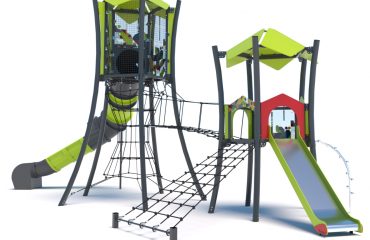
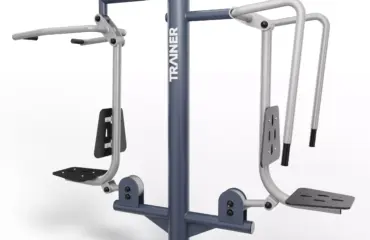
Indoor equipment for collective use must be certified to EN ISO 20957-1 class S. Class S is the professional and commercial class. Class I is also a professional class and covers inclusive access; it is not a higher intensity level than class S. Outdoor adult fitness equipment follows EN 16630. Children’s play equipment follows EN 1176-1, with impact-attenuating surfacing under EN 1177. These are not interchangeable, and a supplier who blurs them is telling you something.
Budget and lifetime cost
Set the budget before the shortlist, and split it between equipment, delivery and installation, flooring, and a maintenance reserve. Then compare on lifetime cost rather than purchase price: a frame that lasts twice as long and can still be repaired in year eight is cheaper than a frame that cannot.
Sizing, fit and clearances
Equipment that does not fit the user is equipment that does not get used. Check the adjustment range of seats, pads and levers, and confirm that a short user and a tall user can both reach a correct position. Then do the same for the room: every machine has a footprint plus a safety clearance, and circulation between stations has to survive peak hour. Ask for dimensioned drawings before you order, and plan the layout on paper. Retrofitting a room after delivery costs far more than measuring it beforehand.
Brands, advice and where to buy
Reputable manufacturers earn their reputation on frames, bearings, cables and upholstery rather than on console features. Consult specialists rather than reviews written for private buyers: the questions that matter to a facility, such as spare-part lead times and service coverage, never appear in a consumer test. A specialist supplier can survey the room, propose a layout, install the equipment and service it afterwards. A general online marketplace will be cheaper on the line item and will leave you alone with the installation, the standards file and the first breakdown.
Maintenance and service life
Professional equipment lasts as long as it is looked after. Set a written schedule: daily wipe-down, weekly checks of cables, fasteners and adjustment pins, periodic lubrication of guide rods and belts, and a documented annual inspection. Keep the records; they are what an insurer or an inspector asks for. Common mistakes are easy to avoid: leaving cables frayed, ignoring a noise that has just appeared, storing equipment in unheated or damp spaces, and delaying a small part replacement until it becomes a frame repair.
Frequently asked questions
Should I buy a full line at once or build up gradually?
Build the muscle-group coverage first, then add specialised stations. A complete but modest line serves more members than a partial line of premium machines.
How do I compare two quotes fairly?
Put them on the same basis: same usage class, same weight-stack ranges, delivery and installation included or excluded on both, and the same warranty terms. Line-item prices are only comparable once the scope is.
Can I mix brands?
Yes, and most facilities do. Keep the mix deliberate: one supplier for the strength line makes ergonomics consistent, while cardio and accessories can come from elsewhere without any downside.
What paperwork should the supplier provide?
Certificates of conformity for the applicable standard, dimensioned drawings, assembly and user instructions, and a maintenance schedule. Ask for them at quotation stage, not on delivery day.
Get the specification right the first time
The best sports equipment is the equipment that matches your users, your room and your opening hours, and that can still be repaired in five years. Tell us who trains with you and send us the dimensions of the space. Request a quote and we will come back with a layout and a costed equipment list.