Five Innovative Ways to Master the Bench Press
The bench press is one of the most popular and most effective strength exercises there is, working the chest, the shoulders and the triceps in a single movement. It is also the lift where members stall the longest. If you run a gym, a strength area or a training group, the plateau on the bench is a recurring conversation, and it is rarely solved by adding a plate. Here are five approaches that move the lift forward, and what they mean for the equipment on your floor.
The fundamentals of the bench press
Before the refinements, the movement itself. The bench press is a compound lift performed lying on a flat bench with a loaded barbell above the chest. The hands sit slightly wider than shoulder width, palms facing away from the lifter. The bar is lowered under control towards the chest with the elbows working through their range and constant tension held in the working muscles, then driven back up mainly through the pectorals and triceps. The back stays in position and the feet stay firmly planted for maximum stability.
Everything that follows assumes that base. A lifter who cannot hold that position under a working load does not need a new programme; they need a lighter bar and a bench that does not move.
1. Hold the technique under load
The first key is keeping the technique intact for the whole set, not just the first two repetitions. That means a stable back position, no excessive bounce off the chest, and control on both the descent and the drive. Poor technique does more than raise the injury risk: it caps the strength and size gains the lift can produce, because the load stops going through the muscles you are trying to train.
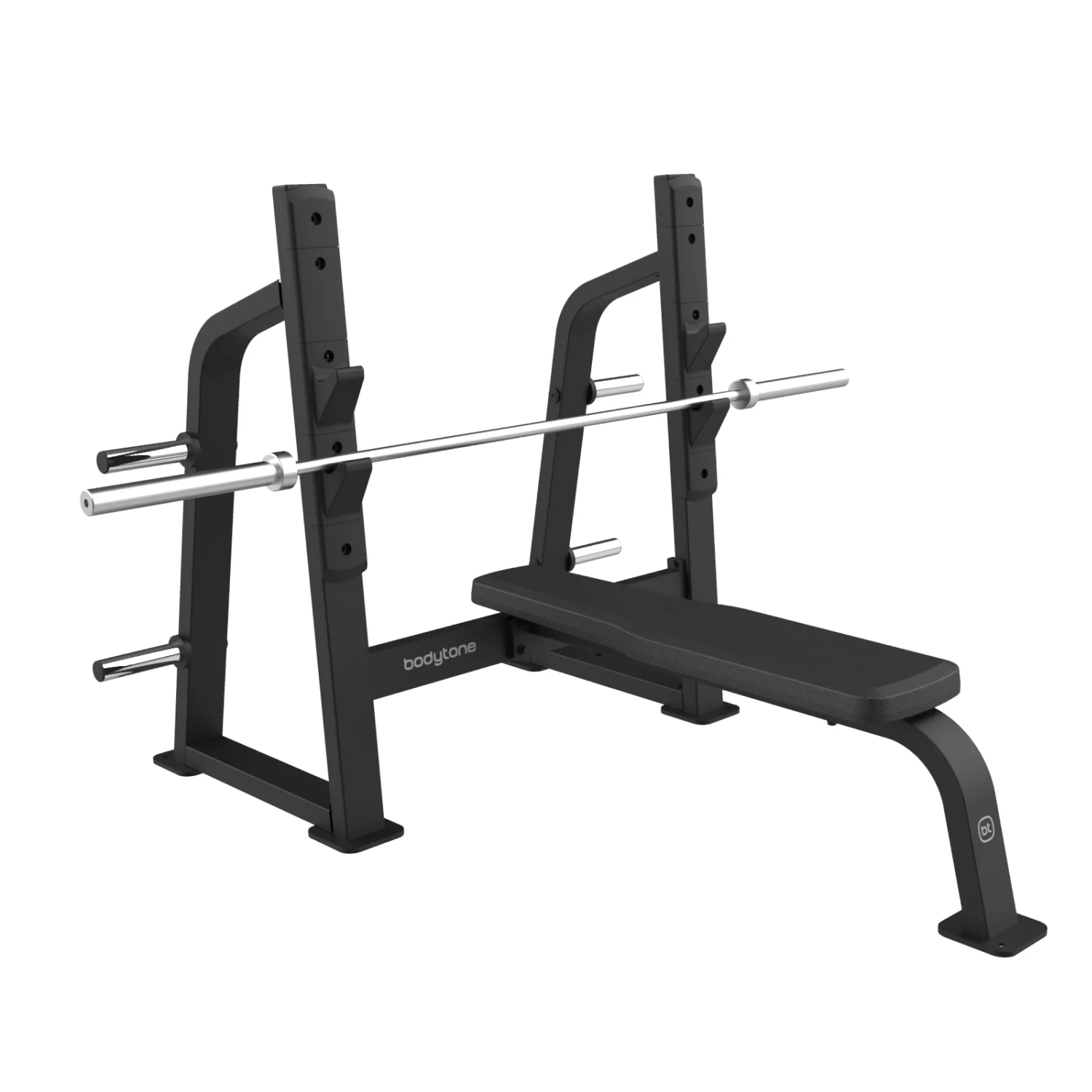
Concentrate on contracting the chest and triceps throughout the movement, avoid locking the joints into excessive strain, and breathe with the lift, exhaling on the drive and inhaling on the descent. On a commercial floor, the equipment does part of this work: a rigid, non-flexing weight bench is what allows a lifter to keep position under a heavy set.
2. Increase the training frequency
Most people bench once a week and wonder why they stall. Moving the lift to two or three sessions a week gives the pattern far more practice and lets the muscles adapt more quickly, which is where the progression comes from.
The counterpart is recovery. When the frequency goes up, sessions need to be spaced so that the tissue has time to rebuild and strengthen, with at least 48 hours between heavy bench sessions. In a facility, this is a scheduling question as much as a coaching one: three bench sessions a week per member only works if there are enough stations at peak hours, which is why the ratio of racks to floor area matters more than the total number of machines.
3. Use variations
Adding variations targets different angles and recruits the muscles differently. The incline press puts more emphasis on the upper chest, the decline press works the lower chest harder, and dumbbell pressing forces each side to work independently. Push-ups remain an excellent complementary exercise: they strengthen the stabilising muscles and improve coordination, and they cost nothing in floor space.
For an operator, this is an argument for adjustable benches rather than fixed flat benches, and for enough barbells that a variation session does not depend on one bar being free. Our olympic barbells range covers the bar specifications used in commercial strength areas.
4. Work on mobility and flexibility
If a lifter struggles to bring the bar down to the chest, or feels excessive tension through the shoulders, the limiting factor is joint mobility rather than strength. Dynamic stretching, shoulder rotations, upper-body stretches and arm swings all help to open up the range of motion. Soft-tissue work on the chest with a foam roller or a ball releases tension and improves flexibility, and five minutes of it before a session changes what the lifter can achieve in it.
A mobility corner near the strength area is one of the cheapest additions a gym can make and one of the most used.
5. Prioritise recovery and nutrition
Progress happens between sessions, not during them. Rest days belong in the programme deliberately, not as the days someone happened to skip. On nutrition, adequate protein supports muscle growth and carbohydrate provides the energy the sessions demand, while proper hydration before, during and after training protects performance.
What this means for your strength area
A bench press station that supports genuine progression needs three things: a bench that stays rigid under load, a rack with reliable safety catches so a lifter can train close to failure alone, and a bar that is straight and knurled properly. Equipment for commercial use is built to EN ISO 20957-1 class S, the professional class for equipment in supervised facilities open to the public. Our squat racks and power racks cover the pressing and squatting stations that anchor a strength floor.
Frequently asked questions
How often should the bench press be trained?
Two to three times a week produces faster adaptation than once, provided heavy sessions are at least 48 hours apart.
Why has my bench press stalled?
Usually one of four reasons: technique breaking down under load, insufficient frequency, no variation in the pressing angles, or a mobility restriction at the shoulder. Recovery and nutrition sit underneath all of them.
Do variations replace the flat bench press?
No. They complement it. The incline, decline and dumbbell versions build the qualities that let the flat press progress.
How many bench stations does a gym need?
Enough that no member waits at peak hour. The correct number depends on membership and peak attendance rather than on floor area, and it is worth measuring before it is worth guessing.
Equipping your pressing area
Every lifter is different, and so is every facility. Tell us the floor area, the membership profile and the peak-hour load, and we will propose the benches, racks and bars to match. Request a quote and our team will put together the specification.