The Three-Day Strength Training Split, Session by Session
Un programme à trois séances hebdomadaires couvre l'ensemble des groupes musculaires avec une récupération suffisante entre les séances. La répartition classique associe poussée, bas du corps et tirage, ou trois séances complètes selon le niveau. La progression repose sur l'augmentation planifiée des charges, pas sur le nombre d'exercices.

The three-session week is the most widely used strength structure in commercial gyms, and for good reason. It covers every major muscle group, it leaves enough recovery between sessions for members who also work and sleep, and it is short enough that people actually complete it. For an operator, it is also the structure that determines which machines are busy at six in the evening and which stand idle.
A three-session week covers the whole body with enough recovery between sessions. The classic split pairs pushing, lower body and pulling, or runs three full-body sessions depending on the level of the member. Progress comes from planned increases in load, not from adding exercises.
Why three sessions is the right default
Three is enough to train each muscle group with adequate volume and to leave at least forty-eight hours before it is loaded again. Fewer sessions make it hard to accumulate the volume needed for adaptation; more sessions, in a member who is not conditioned for them, accumulate fatigue instead.
The commercial argument matters too. A three-day structure fits around work, and a member who can complete their programme keeps their membership. The training culture that treats discomfort as the measure of a session works against this: sessions taken consistently to failure produce fatigue that spills into the next session and, eventually, into the decision to stop coming.
Day one: chest, biceps and trunk
The pushing session is built around a horizontal press. A chest press machine gives a guided path that suits members who are still learning the pattern, and a bench press with free weights gives the loading range that experienced members need. Most floors need both, because they serve different populations at the same hour.
Biceps work follows the pressing, using incline curls, cable curls and a barbell curl to finish. Cable variations keep tension through the full range, which is why a cable station near the free-weight area is worth its footprint.
Trunk work closes the session: a timed plank, controlled crunches and a rotational movement such as the Russian twist. The coaching point that matters here is load selection. A beginner who chooses a weight that forces a breakdown in position learns the wrong pattern and takes it into every session that follows.
Day two: thighs, glutes and calves
The lower-body session opens with a deadlift, which loads the posterior chain more completely than any machine alternative. The squat follows, and between them these two patterns account for most of the lower-body adaptation a member will make.
Leg extensions then isolate the quadriceps, and calf work closes the session with seated and standing variations. The seated version emphasises one part of the calf complex and the standing version another, which is why programmes that include only one leave part of the job undone.
The practical constraint on a gym floor is equipment availability. A lower-body session that requires a rack, a platform and two machines in sequence will not survive a busy evening unless the layout allows a member to move through it without waiting. This is a floor-planning question as much as a programming one.
Day three: back, shoulders and triceps
The pulling session opens with rows at a low pulley and lat pulldowns at a high pulley, and adds pull-ups for members who can perform them. The pulldown and the pull-up are not interchangeable, and having both available is what allows one session to serve a mixed floor.
Shoulders follow with lateral raises, a seated dumbbell press and a reverse fly. Triceps close the session: a pushdown at the high pulley as a warm-up, dumbbell extensions and a lying barbell extension to finish.
One rule applies across the session and deserves to be posted on the floor: pain stops a set. Training through joint pain is not perseverance, and a facility that communicates this clearly loses fewer members to injuries that could have been avoided.
Recovery is where the adaptation happens
Muscle does not grow during a session. It grows in the hours and days afterwards, provided sleep, hydration and protein intake support it. A member who trains hard three times a week and recovers badly will progress more slowly than one who trains moderately and recovers well.
Overtraining shows up as stalled progress, persistent fatigue and injury. It is also, in commercial terms, one of the more common reasons a motivated member stops attending. Stretching and relaxation work belong in the plan for the same reason the sessions do, and a facility that provides space for them makes the whole structure more likely to hold.
What a three-day split demands from the floor
Programming a three-day split tells you exactly what a gym floor needs, station by station. Each session needs one heavy compound station, two or three guided machines and one cable position, and the three sessions taken together define the minimum viable equipment list for a strength floor.
Everything installed in a supervised commercial facility is specified to EN ISO 20957-1 class S, the class intended for professional use. It is the specification that decides whether a machine survives ten years of evening traffic or three, and it is not the place to economise.
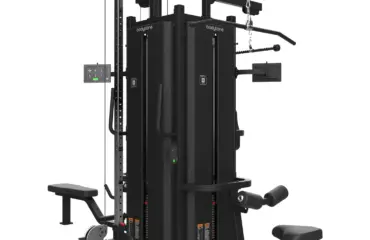
Our strength training machines cover the guided stations each of the three sessions relies on, weight benches and squat and power racks carry the compound work, and cable stations supply the constant-tension variations that the arm and shoulder blocks depend on. For the loading itself, Olympic barbells are the reference for the deadlift and the bench press.
Frequently asked questions
Is three sessions a week enough to build muscle?
For most members, yes. Three sessions allow adequate volume for each muscle group with at least forty-eight hours of recovery between exposures, which is the condition adaptation depends on.
Should the split be by muscle group or full body?
Full-body sessions suit beginners, because each pattern is practised three times a week. A split suits members with more training history, who need more volume per muscle group in a single session.
How is progression managed on a three-day plan?
Through planned increases in load, not by adding exercises. The exercise list stays stable for several weeks while the weight rises; only then is the selection changed.
What equipment is essential for a small strength floor?
A rack, a bench, barbells and plates, a cable station and a small number of guided machines covering pressing, pulling and legs. That set runs the whole three-day structure.
Planning your strength floor
Tell us the floor area, the membership you serve and the busiest hours you have to cover, and we will propose an equipment list and layout with a quotation. Request a quote and our team will come back with a configuration that runs a three-day structure without queues.