Professional Strength and Fitness Equipment for Your Facility
Light In Fitness supplies professional strength and fitness equipment to facilities that have to open their doors every morning and answer for what is on their floor: commercial gyms, cross-training boxes, hotels, campsites, residential developments, schools, sports clubs, local authorities, rehabilitation centres and armed forces facilities. We have been doing it since 2013. This page explains what we supply, how the ranges differ, and how to build a specification that fits the facility you actually run rather than the one in a brochure.
What professional equipment actually means
The word gets used loosely, so it is worth pinning down. For indoor stationary training equipment, the reference is EN ISO 20957-1, class S. That class covers equipment intended for use in a supervised or commercial environment, and it defines the structural and safety testing the machine has been through. If a facility is open to members, guests, staff, pupils or the public, that is the class to specify, and it is the class an insurer or a safety inspector will ask about.
Outdoor equipment sits under a different reference: EN 16630 for outdoor fitness equipment intended for adults. Children’s play equipment is different again, covered by EN 1176-1 for the equipment and EN 1177 for the impact-attenuating surface underneath it. These are not interchangeable, and a supplier who blurs the line between them is telling you something useful about how they work.
Beyond the certificate, professional equipment differs in the things you only notice after two years: frame section and weld quality, the grade of the bearings and cables, the durability of the upholstery under continuous use, and whether wear parts can be replaced by your own maintenance team without a service visit.
The ranges and what each one is for
Selectorised machines
A selectorised machine has a fixed weight stack and a pin. The movement path is guided, the load changes in a second, and there is no handling of loose plates. That combination makes selectorised equipment the backbone of any floor that serves a mixed membership: it is the fastest strength modality to induct a new member on, the safest to leave unsupervised, and the easiest to programme around. Our selectorised machines cover the full muscular map, from leg press and leg curl through to chest press, lat pulldown and rotational work.
Plate-loaded machines
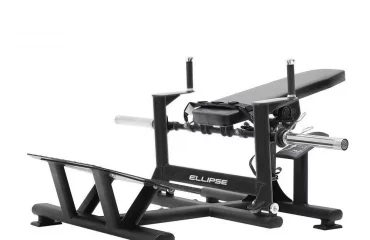
Plate-loaded equipment uses standard discs on a loading pin rather than a stack. The movement is still guided by the frame, but the resistance curve behaves differently and experienced users get a wider range of motion and more freedom in how they load each side. Facilities with a strong-training or athletic population usually want both ranges on the floor rather than one. See the plate-loaded machines range.
Cardio equipment
Treadmills, upright and recumbent bikes, indoor cycling bikes, cross trainers, rowers and ski ergometers form the other half of most floors and, in hotels and residential gyms, often the majority of it. The cardio equipment range is built to run continuously rather than in the short sessions a lighter machine is built for, which is where the difference in specification actually shows up: motor duty cycle, deck and belt life, and the serviceability of the console.
Racks, rigs and functional equipment
Squat racks, power racks, cross-training rigs and functional training structures serve facilities where members train in groups or follow a programmed session. They occupy more floor area per user but carry far more users per hour when the programming supports them.
Choosing the right mix for your facility
The specification question is not which machine is best in the abstract, but what your membership does at your busiest hour.
Commercial gyms and clubs. The classic failure is a floor that is deep in one modality and thin in another, so that a queue forms in one corner while machines sit idle twenty metres away. Build the mix from your peak occupancy and your class timetable, not from a catalogue page count.
Hotels, campsites and residential developments. The constraint is floor area and the absence of supervision. Multi-function stations and selectorised machines earn their place here because they cover many exercises in a small footprint and can be used safely without an instructor present.
Schools, clubs and local authorities. Robustness and documentation matter more than variety. Equipment used by young people or by the public needs to survive misuse and needs a paper trail that satisfies whoever signs off on the facility.
Rehabilitation centres and armed forces facilities. Fine load increments, clear access around each station and a mix that supports both reconditioning and full-intensity work. Cable and selectorised equipment usually carry the weight of the programme here.
Building the specification
Four questions decide whether an equipment plan works.
- How many people are on the floor at peak? This sets the number of stations, and it is the figure most often replaced by a guess.
- What is the working envelope of each machine? Not the base dimensions, but the space a user occupies while training. Floors laid out to base dimensions alone have to be rearranged after installation, if they can be rearranged at all.
- What surface is going underneath? Choose the flooring at the same time as the equipment. It affects noise, load distribution, machine stability and the life of the equipment on top of it.
- Who maintains it, and with what parts? A machine out of service is a machine that has stopped earning. Confirm parts availability and service access before you order.
Why equipment quality shows up in your accounts
Equipment is not a cost line that ends at the invoice. It shows up again in three places. Downtime removes capacity at exactly the hours when your floor is full. Replacement cycles that are four years rather than ten change the whole shape of your capital planning. And churn is the quietest of the three: members leave facilities where the equipment they came for is out of service, worn out or absent, and they rarely say so on the way out.
The corollary is that the cheapest quotation is frequently the most expensive purchase. What matters is the cost over the life of the floor, and the class of equipment you specify is the single largest lever on it.
Frequently asked questions
What standard should professional gym equipment meet?
Indoor stationary training equipment for professional use falls under EN ISO 20957-1, class S. Outdoor fitness equipment for adults falls under EN 16630. Children’s play equipment falls under EN 1176-1, with EN 1177 covering the impact-attenuating surfacing beneath it.
What is the difference between selectorised and plate-loaded machines?
A selectorised machine carries its own weight stack and the load is set with a pin. A plate-loaded machine takes standard discs on loading pins. Selectorised equipment is faster to use and easier to induct members on; plate-loaded equipment gives experienced users a different resistance profile and more freedom in loading. Most complete floors carry both.
How much equipment does a facility need?
It follows from peak occupancy and programming rather than total membership. A club with a heavy class timetable needs a different mix from one where members train alone. We size this from your floor plan and your busiest hour.
Can you help with the layout as well as the equipment?
Yes. Layout, working envelopes, flooring and equipment selection are one decision, not four, and treating them separately is what produces floors that have to be reworked after opening.
Talk to us about your project
Send us your floor plan, your peak occupancy, the population you serve and the budget you are working to. We will come back with an equipment mix, a layout and a costed proposal, and we will tell you where we think the plan is thin. Request a quote to start.