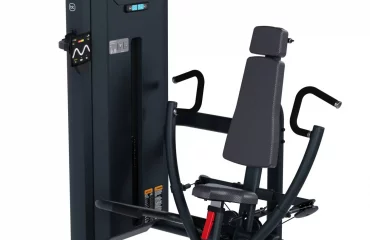
Pec Deck Machine with Guided Load: Efficiency and Safety for Chest Development

The pec deck is one of the few machines that earns its footprint in almost any commercial strength layout. Built around a guided load and a fixed arc, it isolates the pectorals with a precision that free weights cannot match, and it lets a member train hard without a spotter. This guide covers what the machine does mechanically, what to look for in the build, where it fits in a facility, and how to specify one.
What guided load actually buys you
Effective muscle isolation
The pec deck exists to isolate the pectoralis major. The anterior deltoid and the triceps contribute, but only as secondary movers, because the elbow angle is largely fixed and the movement happens at the shoulder. That is the point: a member can take the chest close to failure without the set being limited by a weaker link elsewhere, which is what makes the machine useful both for hypertrophy blocks and for supervised return-to-training work.
A controlled range of motion
Because the frame defines the path, form holds up even when the member is tired. On a fly performed with dumbbells, technique degrades under fatigue and the shoulder takes the difference. On a guided pec deck, the arc does not change on the last repetition of the last set. For an operator, that is fewer incidents on the floor and less coaching time spent on a single movement.
Training safely without a spotter
Guided load removes the need for a second person. The stack cannot land on anyone, and there is no bar to unrack or fail under. Combined with adjustable seat height and adjustable handle positions, that lets one machine serve a very wide range of body sizes without putting anyone into a shoulder position they should not be in.
Build and technical specification
Frame and materials
Commercial pec decks are built on heavy steel frames, because the whole value proposition depends on the machine not flexing under load. What separates a club machine from a lighter one is section thickness and weld quality, sealed bearings rather than plain bushings at the pivots, and aviation-grade steel cable with correctly sized pulleys. Those are the parts that fail first when they are underspecified.
Resistance system
A selectorised weight stack with a pin gives instant load changes, which matters at peak hours when several members share the station. The stack should step finely enough at the bottom end for rehabilitation and beginner work, and go high enough at the top that advanced members do not run out of machine.
Ergonomic adjustment
Adjustable seats and adjustable handles are what make one machine work for a whole membership. The seat sets shoulder height against the pivot; the handles set starting stretch. Both need to be adjustable from the seated position, with clear detents, or in practice members will simply not adjust them.
Where the machine fits
Commercial gyms and clubs
In a commercial gym the pec deck is a core station in the strength zone. Its intuitive design means new members can use it correctly with minimal instruction, which is exactly what you want early in a guided circuit. It pairs naturally with the pressing stations in our chest press machines range.
Hotels, corporate and residential facilities
Where floor space is limited and there is no permanent supervision, a guided pec deck delivers meaningful chest work in a small footprint with no loose weights to manage. That combination is why it appears in almost every hotel and corporate specification that includes strength equipment at all.
Rehabilitation and recovery
Rehabilitation centres use guided pec decks to help patients rebuild shoulder and chest strength and mobility. Precise control over both load and range of motion is what makes this possible: a clinician can prescribe a narrow, low-load range and know the machine will hold it.
Specifying and buying
Standards and material quality
For indoor stationary training equipment installed in a facility open to users, the applicable reference is EN ISO 20957-1 class S, the class intended for supervised commercial and institutional environments. Beyond the standard, ask about steel section and finish, bearing type, cable and pulley rating, and upholstery specification. Warranty terms on the frame, moving parts and upholstery are the clearest signal of what a manufacturer actually expects the machine to survive.
Adjustment range
Look for models with a genuinely wide range of seat and handle adjustment. A machine that only fits average-sized users will be avoided by the rest of your membership, which is an expensive way to lose a station.
Space and circulation
Check both the machine footprint and the clear space it needs around it for access, adjustment and stack changes. In a circuit layout, that clear space determines throughput as much as the machine itself does. Where the full strength zone is being planned, the wider selectorised machines range shows how the stations fit together, and the Gold Line selectorised range covers the heavier club specification.
Frequently asked questions
What muscles does a pec deck work?
Primarily the pectoralis major, with the anterior deltoid and triceps as secondary contributors. The fixed arc keeps the emphasis on the chest rather than distributing it across the pressing muscles.
Pec deck or dumbbell flyes?
The machine gives a guided path, consistent tension and safe training to failure without a spotter. Dumbbells demand more stabilisation. In a club programme the two are complementary rather than competing.
Is a pec deck suitable for rehabilitation?
Yes, under professional supervision. The ability to set a precise load and a restricted range of motion is exactly why rehabilitation centres specify guided machines over free weights for early-stage shoulder and chest work.
What should a commercial pec deck be built to?
Indoor stationary training equipment for supervised commercial and institutional use falls under EN ISO 20957-1 class S. Ask for the declaration alongside the technical specification.
Specifying a pec deck for your facility
The right machine depends on your membership profile, your floor area and how the station sits in your circuit. Send us your plan and your requirements and we will come back with a configuration and a costed proposal: request a quote.