Outdoor Trail Courses with Obstacle Modules: Design and Equipment
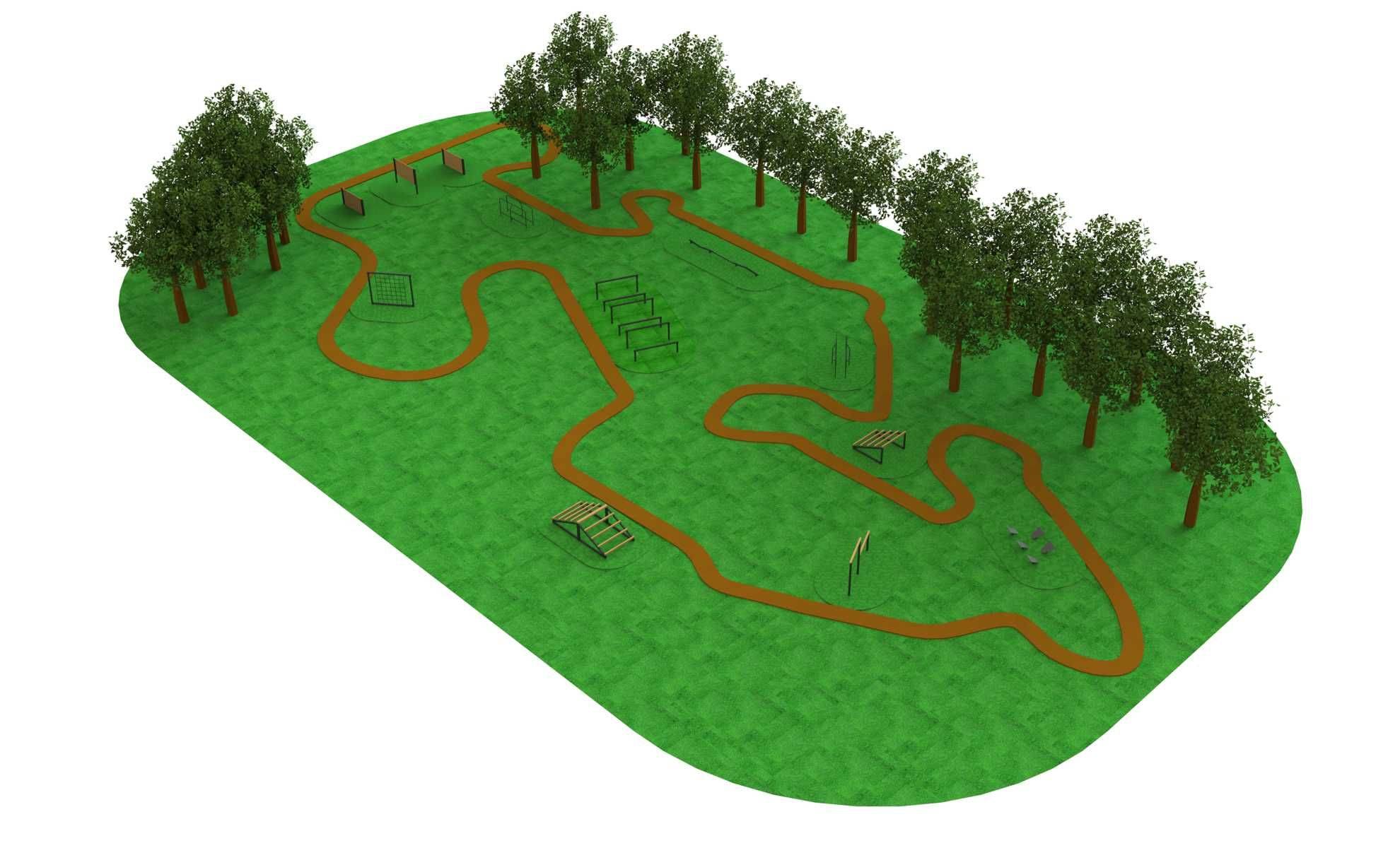
Trail running has moved from the mountains to the edge of town. Parks, campsites, schools and sports clubs are adding permanent obstacle modules along a running loop, turning a plain footpath into a course that people come back to. For the organisation that owns the ground, this is an equipment project like any other: a layout to draw, a surface to specify, standards to meet and a maintenance routine to plan.
What an outdoor trail course with obstacle modules actually is
The principle is simple. A running loop is punctuated by fixed structures that break the rhythm and demand something other than leg endurance: climbing walls, hanging ropes, monkey bars, balance beams, low crawls, suspended bridges, warped walls. Runners alternate between fast sections on the trail and short bursts of upper-body and whole-body effort at each station.
For the operator, that changes the nature of the installation. A trail course is not a running track with decoration: each module is a piece of sports equipment with its own free space, its own fall height and its own inspection requirements. The running surface between modules can stay natural; the ground under and around a module usually cannot.
Why demand has grown
Three things converged. Obstacle course racing turned an activity that used to belong to military training into a mainstream leisure format, which created a public that already knows what a warped wall is. Outdoor training became a durable habit rather than a seasonal one, and local authorities looked for facilities that serve residents without staffing costs. And operators of holiday sites, campsites, hotels and residential developments discovered that a signature course is a stronger differentiator than an extra swimming pool.
Compared with a conventional fitness trail, the obstacle version has one commercial advantage: it works for a much wider age and ability range, because the same structure can be crossed, climbed or walked around depending on the user.
What the course does for the people using it
Running on flat ground trains a narrow set of muscles. Adding obstacles brings the arms, shoulders, back and trunk into the session, which produces a more balanced workload and improves coordination and balance rather than only aerobic capacity. It also breaks the monotony that makes people stop training: each lap has a small challenge in it, and clearing an obstacle you avoided last month is a visible, measurable progression, which is exactly what keeps a public facility in use.
The same course serves several audiences at once. Clubs use it for interval sessions, schools for coordination work, holiday sites for organised group activities and residents for informal training.
Standards and surfacing: the part that decides the project
Two separate frameworks apply, and they must not be mixed.
Outdoor fitness and training equipment for adults falls under EN 16630, which covers permanently installed outdoor fitness equipment and its installation. Children’s play equipment falls under EN 1176-1, with impact-attenuating surfacing specified separately under EN 1177. A module intended for children is never covered by EN 16630, and a piece of adult training equipment is not made compliant by putting a playground surface under it.
In practice this means the layout has to state, module by module, which audience it is for. Where a course is open to families, the usual answer is two clearly separated zones rather than one ambiguous one. Free space around each structure, fall heights and the surfacing under them are then specified accordingly.
You can review the available structures in the obstacle trail modules range, the complete OCR obstacle courses and the outdoor fitness trail section.
Materials, siting and maintenance
Outdoor structures live under permanent weather load. Galvanised steel and stainless steel are the two sensible answers for a permanent public installation, with stainless steel becoming the obvious choice near the coast, near a pool or anywhere salt and chlorine are in the air. Timber structures have their place where the site calls for it visually, provided the specification accounts for the maintenance they need.
Siting matters as much as the hardware. Modules should sit on ground that drains, be reachable for inspection and mowing, and be spaced so that a runner arriving at speed has room to stop. Signage at each station, stating the intended use and age range, is part of the installation rather than an accessory.
Plan the inspection routine at the same time as the purchase: a visual check on a short cycle, an operational check on a longer one and an annual main inspection, with a written log. It is the cheapest part of the project and the one that determines how long the course stays open.
Frequently asked questions
Which standard applies to an outdoor obstacle trail course?
Outdoor fitness and training equipment for adults falls under EN 16630. If the course includes play equipment for children, that equipment falls under EN 1176-1 and its impact-attenuating surfacing under EN 1177. The two frameworks are separate and must be applied to the right modules.
How much space does a trail course with obstacle modules need?
There is no single figure: each module has its own free space and fall zone, and the total depends on how many stations you install and how they are distributed along the loop. The layout is drawn from the actual plot, which is why the site plan is the first thing we ask for.
Can the same course be used by children and adults?
Yes, provided the zones are separated and signed. Adult training modules and children’s play structures follow different standards and different surfacing requirements, so a mixed course is designed as two adjacent areas rather than one shared one.
Which material should be specified for a permanent public installation?
Galvanised steel is the standard answer inland. Stainless steel is specified for coastal, poolside and other corrosive environments. Timber is possible where the setting calls for it, with a maintenance plan to match.
Planning your course
Send us the site plan, the audience you want to serve and the ground conditions, and we will come back with a layout, the applicable standards module by module and a costed proposal: request a quote.
Réalisations documentées
- Parcours ninja sur mesure, Rennes – îlot des Hautes-Ourmes
- Double mur ninja extérieur, Sallanches – Haute-Savoie