FIBA-Approved 3x3 Basketball Court Flooring: The Complete Guide
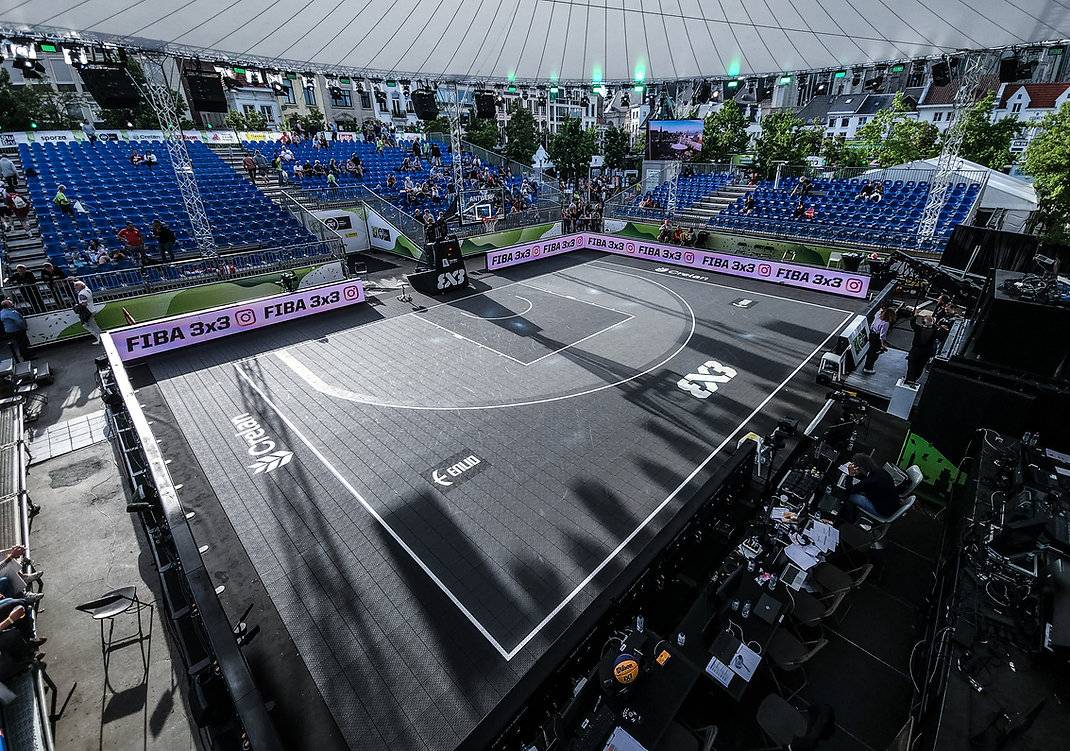
3×3 basketball has moved from the playground to the Olympic programme, and with it the surface underneath the players has become a specification item rather than an afterthought. A FIBA-approved 3×3 court floor is a defined product category: a sports surface that has passed the International Basketball Federation testing programme for ball rebound, slip resistance, shock absorption and dimensional stability. If you are a local authority, a club, a school, a hotel or a developer planning a half-court, this is the decision that determines whether the court plays well, stays safe and survives ten winters. This guide covers what the approval means, how to choose a system and what to budget for.
What is a FIBA-approved 3×3 court floor?
3×3 is played by three players per side on a half-court with a single basket. The format is fast, played in short bursts, and almost always outdoors or in a convertible indoor space. FIBA runs an equipment approval programme under which flooring systems are tested and listed. An approved surface has been measured against the federation’s requirements for playing performance and player safety, which is what makes it usable for sanctioned competition.
In practice, almost every outdoor 3×3 court built today uses a modular tile system. Polypropylene interlocking tiles clip together over a prepared base, drain through their open structure, and can be lifted and replaced tile by tile if one is damaged. That modularity is why they have displaced poured surfaces on outdoor courts: no curing time, no weather window for installation, and a repair that costs one tile rather than one court.
Why the approval matters
Playing performance
Ball rebound and grip are measured properties, not marketing claims. A surface that returns the ball inconsistently changes how the game is played, and a surface with the wrong friction coefficient either grabs the shoe and loads the knee or lets it slide. An approved system has been tested for both.
Player safety
3×3 concentrates a lot of hard stopping and landing into a small area. Shock absorption reduces the load transmitted through the joints over a long session, and a controlled slip resistance limits falls. On an outdoor court the same surface has to keep those properties wet as well as dry.
Durability outdoors
Outdoor courts take UV, rain, frost and thermal cycling on top of the wear from play. A quality modular surface is formulated with UV stabilisers and designed to expand and contract without buckling. This is where cheap tiles fail first: they chalk, warp at the joints and start lifting within a few seasons.
Access to competition
If you intend to host sanctioned tournaments, the approval is not optional. Building an unapproved court and hoping to upgrade later means paying for the surface twice.
How to choose the right system
Check the certification, not the description
Ask for the certificate and the reference of the tested product, and check that it matches the exact item being quoted. Approval attaches to a specific system, not to a manufacturer’s whole catalogue, and a colour or thickness variant is not automatically covered.
Match the surface to the location
An outdoor court needs drainage, UV stability and freeze-thaw resistance. An indoor or covered court can use a different construction and will care more about acoustics and about how the surface behaves under other activities, since most indoor halls are shared. If your court will host more than basketball, look at modular multi-sport courts rather than a basketball-only build.
Get the base right
Most court failures are base failures. A modular tile system follows the surface it is laid on: a slab that ponds water or has a bump will produce a court that ponds water and has a bump. Specify the levelling tolerance and the falls in the groundworks contract, not in the flooring order.
Plan for installation and for maintenance
Modular systems are quick to lay, but line marking, edge ramps and the fixing detail at the perimeter still reward an experienced installer. Maintenance is deliberately simple: sweep or blow off debris regularly, wash down with water and a mild cleaner suitable for the material, and avoid aggressive solvents and abrasive tools that damage the surface texture.
Frequently asked questions
What does an approved 3×3 floor give me that a standard surface does not?
Tested and documented playing performance, tested safety properties, a construction designed for outdoor service life, and eligibility for sanctioned competition. On a standard surface all four are assumptions rather than measured values.
How much does a 3×3 court floor cost to install?
It depends on the court area, the system chosen, the condition of the existing base and the installation works required, so a figure quoted without a site survey is meaningless. The reliable approach is to put the same specification and the same drawings in front of several specialist suppliers and compare like for like.
Can the same system be used indoors?
Yes. Modular tile systems are installed both outdoors and indoors, which is one reason they suit multi-use halls and covered courts. The base preparation and the perimeter detailing change, not the principle.
How long does a 3×3 court floor last?
A quality surface, correctly installed and maintained, typically lasts in the range of ten to fifteen years, and often longer. Intensity of use, climate and how seriously the cleaning routine is followed are what move the figure within that range.
Where do I find approved suppliers?
FIBA publishes information on its equipment approval programme, and specialist sports surfacing suppliers will provide the certification for the systems they sell. Ask other court operators in your area what they installed and how it has aged, which tells you more than any brochure.
Specifying your court
Send us the court dimensions, the location, whether the court is outdoors or covered, the condition of the existing base and whether you intend to host sanctioned play. We will come back with a specified system, a tile layout and an itemised price. Explore our 3×3 basketball court tiles or request a quote for your project.