Which Flooring for FIBA and FIBA 3x3 Basketball Courts?
FIBA, the international basketball federation, and its 3×3 discipline govern the sport worldwide and set the requirements that official competition venues have to meet. For a sports hall operator, a municipality, a school or a club, the practical question is narrower and more expensive to get wrong: which floor do you install so that the court plays correctly, survives its programme and satisfies the competition level you intend to host. Grip, ball rebound, shock absorption and wear resistance are the criteria; the material is only the means.
Start from the competition level, not the material
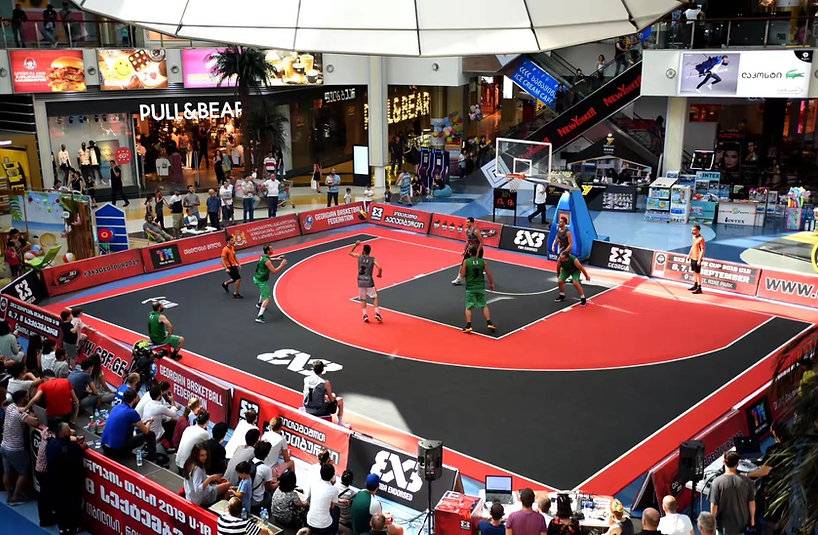
FIBA and FIBA 3×3 set specific requirements for official competitions covering wear resistance, grip, ball rebound and shock-force reduction, together with court dimensions and line marking. A floor specified for a regional club programme and a floor specified to host sanctioned events are not the same purchase. Decide first what you will actually host, then check the current requirements published by the federation for that level, and only then choose the surface. The same logic applies to 3×3, which is played on a half-court and very often outdoors, and therefore has a different material answer from the indoor game.
Solid hardwood: the reference for indoor competition
Solid wood is the classic competition surface. It gives excellent ball rebound, a consistent and predictable grip, and very good resistance to wear when it is maintained. It is the surface most professional halls are built around, because it delivers the smooth, uniform plane that lets players move fast and change direction precisely.
The trade-offs are real. Hardwood is expensive to maintain, it requires a controlled hygrometry, it needs periodic sanding and re-marking, and it is sensitive to impact and to dropped loads. A hall that hosts basketball on Saturday and free-weight training on Tuesday will destroy a hardwood floor unless the zones are physically separated.
PVC sports flooring: the workhorse of multi-use halls
PVC is a synthetic surface that is both hard-wearing and easy to maintain, which is why it dominates multi-purpose halls. It resists abrasion, it cleans quickly, and its surface treatment can be specified for the grip level the sport needs. A rubber surface layer can be added to increase adhesion and reduce slipping.
PVC is available as rolls, which are welded to give a seamless, fully marked surface, and as interlocking tiles, which are far quicker to lay and allow a single damaged area to be replaced without touching the rest of the court. For halls with a mixed programme and a maintenance team rather than a specialist contractor, that replaceability is often the deciding argument. Our sports court rolls cover the roll-laid option.
Vinyl surfaces
Vinyl is a flexible, resilient surface that combines good shock absorption with correct ball rebound. It can be bonded or laid in rolls, which gives considerable freedom in design and in installation method, and it is available in a wide range of colours and finishes for custom court graphics and club identity. Where a venue wants a strong visual identity without compromising play, vinyl is usually the easiest specification to satisfy.
Modular tiles for 3×3 and outdoor courts
3×3 is largely an outdoor, urban discipline, and outdoor courts are a different engineering problem: UV exposure, rain, frost and drainage all matter, and a surface designed for a sports hall does not belong outside. Modular polypropylene tiles are the standard answer. They drain, they tolerate temperature cycling, they are laid over a prepared, level base without adhesive, and individual tiles can be swapped after damage or vandalism. They also make it straightforward to combine basketball with other sports on the same footprint. See our basketball court tiles and, for shared urban facilities, our modular multi-sport courts.
The layer nobody sees: underlay and acoustics
Whatever the finish, the build-up underneath decides how the floor performs and how the building behaves. An underlay in cork or rubber absorbs impact and reduces vibration, protecting players when they dribble, land and jump, and cutting the structure-borne noise that makes a first-floor sports hall unusable for everything below it. Acoustic performance is the most commonly forgotten requirement in a refurbishment brief and the most expensive one to retrofit. Our acoustic underlays are specified alongside the finish rather than after it.
Substrate, flatness and drainage
No sports surface corrects a bad base. Indoors, the slab has to be flat, dry and stable within the tolerances the flooring manufacturer specifies, and residual moisture is the leading cause of failed installations. Outdoors, falls and drainage govern whether the court is playable after rain. Budget for base preparation from the outset: it is the line item most often cut at tender stage and the one that determines whether the floor lasts ten years or three.
Marking, dimensions and future use
Court dimensions and line marking have to comply with the international requirements for the level you host, and a hall that carries basketball, volleyball, badminton and handball markings needs a marking plan agreed before installation, not after. Agree colours, priorities and the marking hierarchy with the user clubs at design stage. Re-marking a bonded floor is a straightforward job; re-marking a printed tile court is not.
Frequently asked questions
Can one floor cover basketball and free-weight training?
Not well. Sports surfaces are specified for ball rebound and player movement, not for dropped loads. Separate the free-weight zone physically and give it a floor designed for impact.
Are modular tiles suitable for indoor competition?
Modular tiles are primarily an outdoor and multi-use solution. For indoor sanctioned competition, check the requirements applicable to your competition level with the federation before specifying.
How long does an installation take?
It depends on the surface, the base condition and the size of the court. Tile systems are the fastest to lay; bonded rolls and hardwood need curing and acclimatisation time. We confirm the programme once we have seen the base.
Can the court carry club or sponsor graphics?
Yes on vinyl and PVC, and on tile systems within the constraints of the tile grid. Agree the graphics before ordering, as they affect production lead time.
Specifying your court
The right basketball floor is the one matched to the competition level you host, the programme the hall actually runs and the base you are building on. Send us the hall dimensions, the intended competition level, the sports sharing the space and photographs of the existing base, and our technical team will propose a build-up from substrate to line marking. Request a quote and we will come back with a costed specification.
Réalisations documentées
- Dalles et sols sportifs : livraisons documentées – plusieurs chantiers
- Sol sportif extérieur, square Georges-Vallerey – Taverny (95)