Dip Machines for Commercial Gyms: A Buyer's Guide
The dip is one of the few upper-body movements that earns its floor space several times over. It trains pressing strength, it scales from assisted to heavily loaded, and it needs a footprint measured in single square metres. For a gym operator, a hotel fitness room or a rehabilitation centre, the question is rarely whether to have a dip station but which format to buy, where to put it, and how to keep it in service. This guide sets out how to specify one for a commercial site.
What a dip machine is, and where it fits in a layout
A dip machine is a fixed station with two parallel handles at roughly shoulder width, at a height that lets the user support their bodyweight on straight arms and lower under control. In its commercial forms it sits somewhere between a pull-up structure and a pressing station, and most manufacturers treat the two as a pair. The movement drives the triceps, the pectorals and the anterior deltoids together, with the trunk working throughout to hold position.
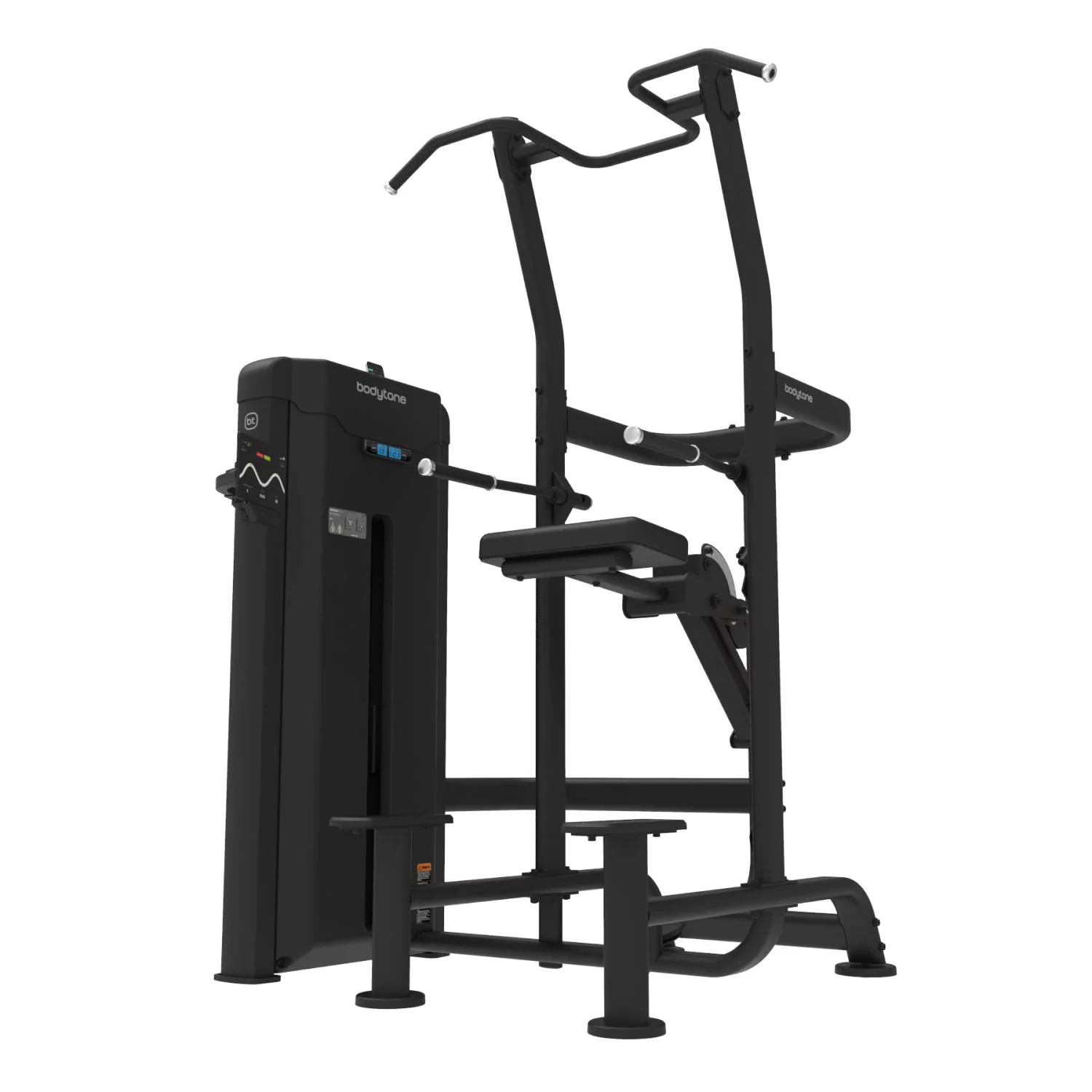
Three formats cover almost every commercial brief. An assisted dip and chin unit uses a counterweighted knee or foot platform so that a beginner can perform the full range with part of their bodyweight offset; this is the format that opens the movement to a general membership. A plate-loaded or rig-mounted dip station suits a strength-focused floor where users add load with a belt. A dip attachment on a power rack or a calisthenics structure is the space-efficient answer where the movement needs to exist but does not need its own footprint. Comparable ranges sit under strength training machines and plate-loaded machines, while outdoor and calisthenics versions are grouped under calisthenics and street workout cages.
What the movement actually delivers
Dips build upper-body pressing strength through the triceps, chest and shoulders in a single pattern, which is why they remain in almost every programme despite the rise of machine-isolated alternatives. Because the user supports their own bodyweight, the trunk musculature works to resist rotation and swing, so the movement contributes to trunk stability without a dedicated exercise. The lowering phase takes the shoulder into extension and lengthens the chest under load, which supports shoulder mobility when the depth is appropriate to the individual.
The point that matters commercially is accessibility. On an assisted unit the movement is guided and the load is adjustable, so a member with no pressing base can start productively and progress by reducing assistance. That progression is visible and easy to record, which makes the station a good retention tool as well as a good training tool.
Coaching points your floor staff should enforce
Most dip injuries on a gym floor come from depth and from swing, not from load. A short set of instructions, posted at the station and reinforced by staff, prevents the majority of them.
- Warm up the shoulders and elbows before loaded sets. Cold tissue tolerates the bottom position poorly.
- Set the machine to the user before the first repetition: seat, platform or handle position should let the user reach the start position without stretching or crouching into it.
- Hold a tall trunk with the shoulders set back and down and the chest open. A collapsed posture transfers load to the shoulder joint and the lower back.
- Lower under control to around ninety degrees at the elbow, then press back to the start. Depth beyond a comfortable range is where shoulder complaints originate.
- No momentum. Swinging the legs to generate lift removes the training effect and is the most common fault on a busy floor.
- Breathe. Users holding their breath through a full set is common and avoidable.
A progression that works for members
A simple structure suits most general-population members: warm up the shoulders with rotations, arm swings and a short period of raised heart rate, then work the dip itself. Beginners start on the assisted unit with enough counterweight to complete controlled repetitions through full range, and progress by reducing assistance rather than by adding repetitions indefinitely.
Stronger users move to bodyweight and then to added load, either with a belt or with a plate held between the knees, and can increase the trunk demand by extending one leg. Around three sessions a week is a workable frequency for most members, and progress should be recorded, since the visible move from assisted to loaded is what keeps people at the station. Dips pair well with lower-body and trunk work rather than being programmed alone, so a gym that places the station near weight benches and free-weight space tends to see it used as part of a session rather than in isolation.
Build quality and standards for commercial use
Indoor equipment for professional and supervised use is covered by EN ISO 20957-1 class S. That classification is what separates equipment built for continuous multi-user duty from equipment intended for lighter settings, and it is the specification a commercial buyer should be asking for. On a dip station specifically, the points that decide service life are the frame section and welds, the handle diameter and grip covering, the bearing or bush quality on any assisted counterweight mechanism, and the finish on contact surfaces. Upholstery on knee platforms and back pads is a consumable, so confirm that replacement pads are available for the range before committing.
Footprint and access also belong in the specification. The station needs clear space behind and to the sides for entry and exit, and if it is rig-mounted it must not conflict with the working area of the adjacent station.
Is a dip machine suitable for a hotel or apartment gym?
Yes, and an assisted dip and chin unit is often the better choice in that setting. Guests arrive with a very wide range of training experience and no supervision is available, so a guided, adjustable station is safer and gets more use than a fixed bar.
How much space does a dip station need?
It depends on the format. A standalone assisted unit needs its own footprint plus circulation space, while a rack or rig attachment adds the movement without adding a station. Send us your floor plan and we will show what fits.
Can dips replace a chest press?
They overlap but they are not interchangeable. A dip loads the chest, triceps and front shoulder together with a trunk demand, while a chest press isolates the pressing pattern with the trunk supported. Most commercial floors carry both.
Specifying your station
The right dip station depends on who uses your floor: a mixed-membership club, a strength-focused facility and a rehabilitation centre will each be better served by a different format. Tell us the setting, the expected user profile and the space available, and we will propose suitable units and a costed configuration. Request a quote and we will come back with options and pricing.
Réalisations documentées
- Cage street workout ultime, Carcassonne – armée française
- Cage street workout ultime, Tahiti – armée française, Polynésie
- Cage SP Max, centre EPIDE de Combrée – établissement public d’insertion
- Cage SP Max, lycée Saint-Bénigne de Dijon – établissement scolaire