Children's Obstacle Course Equipment for Outdoor Sites
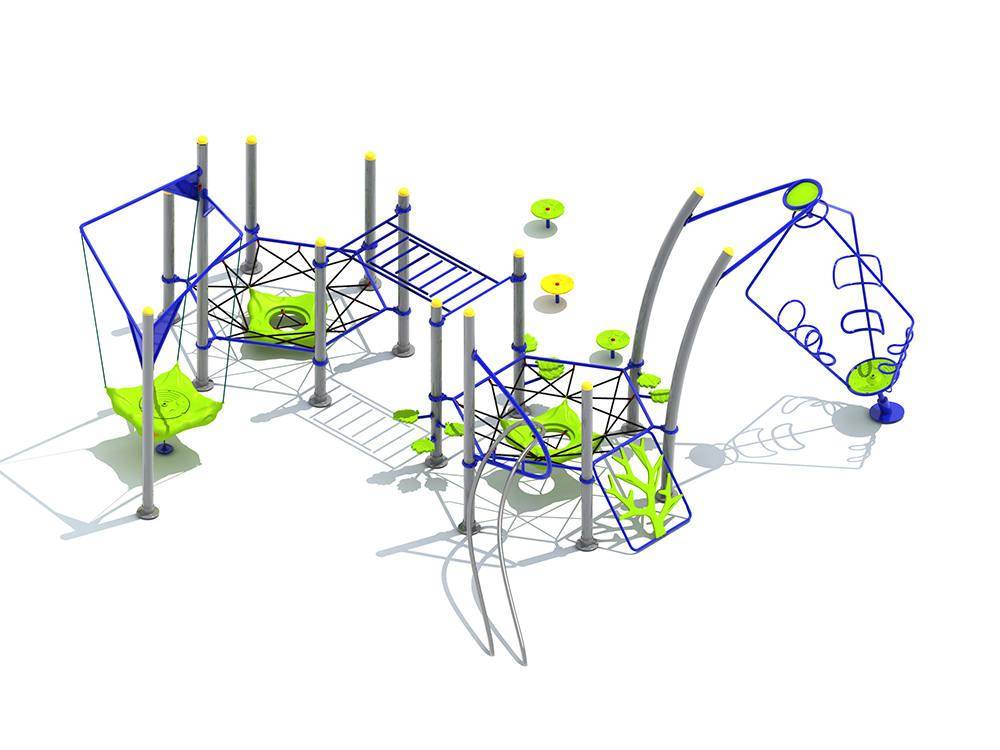
An outdoor obstacle trail for children is one of the most effective ways to turn a stretch of unused ground into a place where children move, compete and learn. It combines the logic of a fitness trail with the play value of an adventure playground: a sequence of stations that ask for balance, grip strength, spatial awareness and a little nerve. For a school, a municipality, a holiday park or a residential developer, it is also a compact answer to a difficult brief, namely how to keep a wide age range active in a limited footprint.
What a children’s obstacle trail actually is
Parents often ask whether an obstacle trail is safe for younger users. The answer lies in how the course is specified. These are professional, certified play structures, not scaled-down adult equipment. The design intent is to join usefulness to enjoyment: children think they are racing each other, while in practice they are working on motor coordination, balance, spatial orientation and unconventional problem solving. Some stations are deliberately simple and can be used in many different ways; others are complex and reward repeated attempts.
The equipment that makes up the course
A typical trail is built from advanced climbing sets, gymnastic bars and ramps, balance beams, hurdle-style jumps and linked obstacle modules. The stations that generate the most use are the ones that allow direct competition between peers on strength or speed, the swaying bridges that deliver a controlled dose of adrenaline, and the slalom sections that children happily take on roller skates or by bike. Ropes, nets and climbing pyramids add vertical play without adding much ground area.
Ranges to look at when specifying a course: playground equipment for the structures themselves, children’s outdoor fitness for cardio and mobility stations, and children’s outdoor sports parks when the trail forms part of a larger scheme.
Standards, surfacing and specification
Children’s play and obstacle equipment is covered by EN 1176-1. The impact-attenuating surface underneath is a separate matter and is covered by EN 1177. The two are not interchangeable, and a specification that names only one of them is incomplete. Free height of fall drives the choice of surfacing, so the surface should be decided at the same time as the structures rather than afterwards. Suitable systems are set out under playground surfacing.
Designing for a mixed age range
Equipment for a children’s obstacle trail comes in varying levels of difficulty and is built for the needs and expectations of children of all ages. That range is what makes a single installation work for a whole site: stations can be sequenced so that a five-year-old and a twelve-year-old use the same course at their own level. Materials matter as much as layout. Structures are made from high-grade, child-appropriate and safe materials, and every element is designed to support healthy development rather than simply to occupy time.
How much space does a children’s obstacle trail need?
It depends on the stations chosen and on the free space required around each one under EN 1176-1. A course can be laid out in a line, a loop or a cluster, so an awkward or narrow plot is rarely a blocker. Send us the plot dimensions and we will lay out a workable configuration.
Can the course be extended later?
Yes. Modular ranges are designed to be phased, which is why many sites start with a core group of stations and add to it in a later budget year. Keeping to one range makes the later additions visually and technically consistent.
Is an obstacle trail suitable for a campsite or holiday park?
It is one of the strongest use cases. Guests of very different ages arrive together, the equipment needs no supervision beyond normal site rules, and a well-built course is a genuine argument in the site’s own marketing.
Specifying your course
The quality of the equipment is what decides whether a course still looks and works well after several seasons of heavy use. Tell us the site, the age range you need to cover and the space available, and we will put together a configuration and a costed proposal. Request a quote and we will come back with a layout and pricing.
Réalisations documentées
- Parcours ninja sur mesure, Rennes – îlot des Hautes-Ourmes
- Double mur ninja extérieur, Sallanches – Haute-Savoie
Sources et références
- Décret n° 96-1136 du 18 décembre 1996 – prescriptions de sécurité relatives aux aires collectives de jeux (Légifrance)
- NF EN 1176-1 – Équipements et sols d’aires de jeux, partie 1 : exigences de sécurité et méthodes d’essai générales (AFNOR)
- NF EN 1177 – revêtements de surface amortissants : détermination de la hauteur de chute critique (AFNOR)