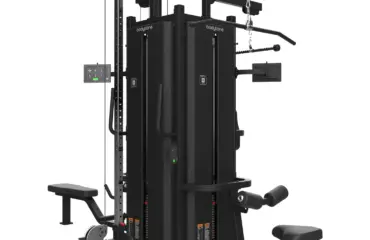
Bodytone SRX Solid Rock: Plate-Loaded Engineering
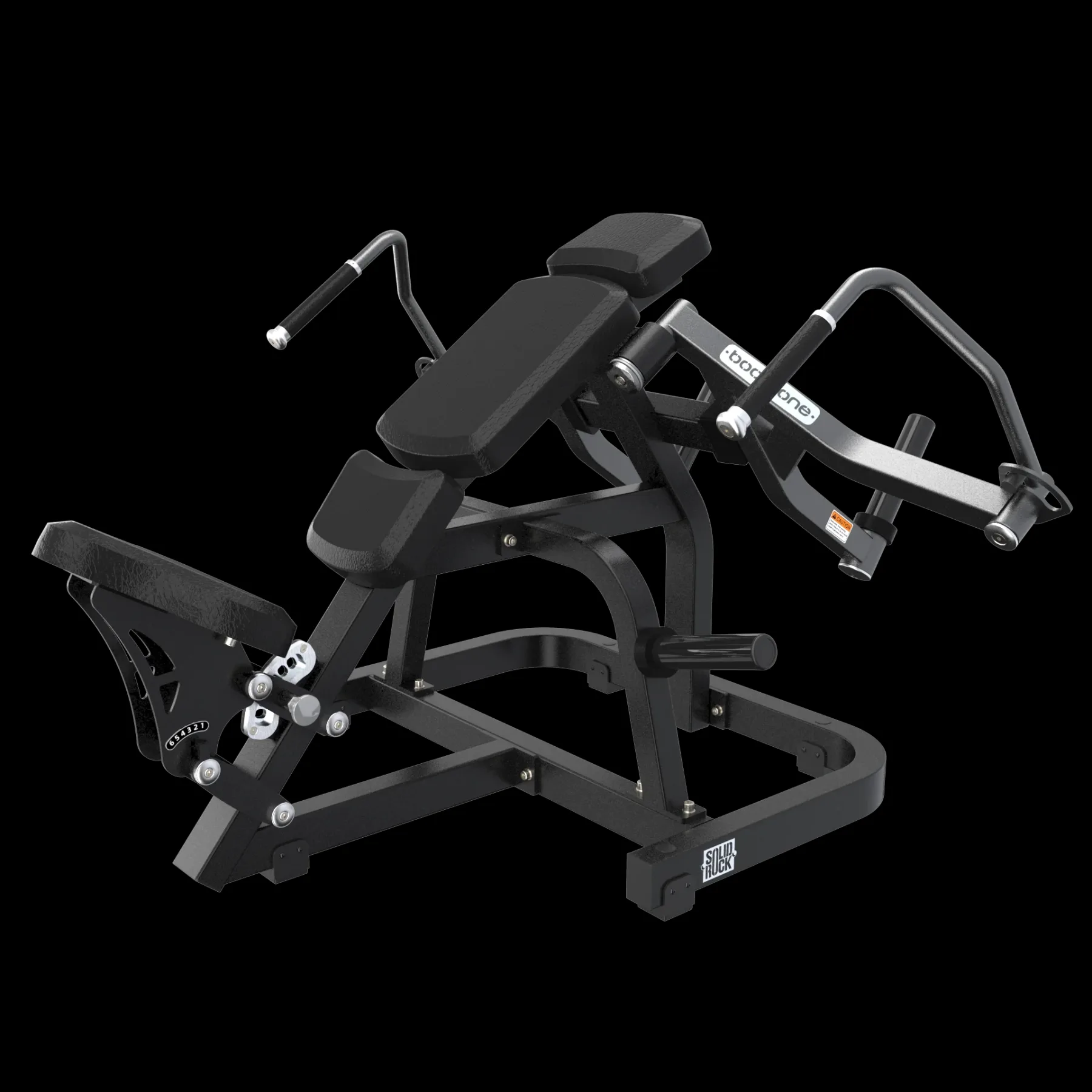
In short: the SRX generation of Bodytone Solid Rock is a structural redesign, not a cosmetic refresh. Heavier steel section, tapered double roller bearings at the pivots, thicker linkage plates and an automotive-grade paint process. For an operator, the reason to care is simple: these are the components that decide whether a plate-loaded station still moves correctly in year eight.
What SRX changes structurally
SRX stands for Solid Rock Excellence, and the changes are concentrated in the parts of a machine that fail first under commercial load.
3 mm S-275-J0H steel. Bodytone specifies an enriched steel optimised for cold bending without weakening the structure at the bend. The practical result on the floor is a frame that does not vibrate when the station is loaded to its maximum, which is what members notice long before they can describe why.
Triple-layer automotive-grade paint. The process runs immersion degreasing, an antioxidant primer and two epoxy topcoats. That build-up is what protects against corrosion and against sweat over more than ten years, in a room where humidity and salt attack every finish continuously.
The mechanics: independent, converging and diverging
The core of the range is an independent movement system, converging on the pushing stations and diverging on the pulling ones, engineered to reproduce the behaviour of free weights under a guided path.
Tapered double roller bearings. Where much of the market uses bushings or single ball bearings, SRX uses tapered double roller bearings at the pivots. The effect is a smooth movement with a constant direction and no dead point anywhere in the range, which is the property that separates a machine an experienced lifter respects from one they walk past.
10 mm linkage plates. The pivot points are reinforced with thick steel plates so that asymmetric loading, which is the normal condition on an independent-arm station, does not twist the structure. That is what keeps the movement path unchanged year after year rather than progressively drifting.
Contact points and ergonomics
Bodytone developed the SRX contact points with professional athletes, and the specification reflects it.
- High-density EVA foam at 80 kg/m3. Injection-moulded foam under an antibacterial, hypoallergenic synthetic leather cover. The density is the point: it is what stops the seat deforming under repeated heavy use and losing the lumbar support it was shaped to give.
- Anodised aluminium handles. Precision knurling gives grip without being abrasive on the hands over a long session. Turned aluminium end caps finish the assembly.
- High-safety adjustment system. Seat adjustment uses technopolymer bolts with a 750 kg breaking rating.
The specification in one table
| Element | Bodytone SRX Solid Rock |
|---|---|
| Steel thickness | 3 mm, S-275-J0H |
| Pivot bearings | Tapered double roller bearings |
| Linkage plates | 10 mm steel |
| Paint | Three layers, automotive process |
| Padding | Injection-moulded EVA, 80 kg/m3 |
| Adjustment bolts | Technopolymer, 750 kg breaking rating |
| Load capacity | Up to 280 kg depending on model |
The load figure varies by station, so take it from the model you are actually specifying rather than from the range. See the Bodytone SRX range for the individual stations.
Where SRX fits on your floor
SRX is a heavy strength range, and it belongs in a facility whose members use it. In a club with a strong free-weight culture, a cross-training box with a dedicated strength corner, a performance centre or a premium chain, it will be the equipment members talk about. In a facility whose traffic is cardio and light circuits, the same budget buys more member-hours elsewhere.
The visual argument is real and should not be dismissed. The finish is available in several colours, including the range’s signature green as well as silver and gold, and a coherent colour scheme across a strength area is what makes it photograph well, which is how prospective members see it before they ever walk in.
Alongside SRX, the wider Solid Rock plate-loaded range and the general plate-loaded machine range cover the stations you need to complete a zone without over-specifying every position.
Buying and maintaining
Indoor equipment in a commercial facility must be built and marked to EN ISO 20957-1 class S, the professional class for equipment in commercial premises. Ask for the class marking on the frame plate and the declaration of conformity for the exact models you order.
Sealed bearings and wear-resistant materials keep the maintenance requirement low, but low is not none. Plan a periodic inspection of the pivots, the adjustment mechanisms and the upholstery, and keep the record. It protects the equipment and it protects your liability file.
Frequently asked questions
What does SRX stand for?
Solid Rock Excellence. It designates the newer generation of the Bodytone Solid Rock plate-loaded range, distinguished by heavier steel, tapered double roller bearings and thicker linkage plates.
How much load does an SRX station take?
Up to 280 kg depending on the model. Because the figure varies by station, use the value published for the specific machine rather than a range-wide number.
Is plate-loaded right for a mixed membership?
It works well as the heavy corner of a strength area rather than as the whole of it. Plate-loaded stations suit members who already train with weights; a selectorised zone alongside them serves the beginners and the unsupervised hours.
Is the padding suitable for high-traffic use?
The injection-moulded EVA at 80 kg/m3 is specified specifically to resist deformation under repeated heavy use, and the synthetic leather cover is antibacterial and hypoallergenic, which matters for a cleaning protocol at commercial traffic levels.
Can the range be planned into an existing room?
Yes, and it should be. Plate-loaded stations need loading and unloading clearance around them, which is the constraint most often missed on a first plan. Send us the room and we will lay out the stations to their real footprints.
Specifying an SRX zone
The components that distinguish SRX are precisely the ones that determine cost of ownership: bearing type at the pivots, plate thickness at the linkages, steel section, and the paint build-up in a humid, salty room. Those are also the ones that never appear in a headline price comparison.
Send us your floor plan and the profile of your membership and we will come back with a specified SRX layout: request a quote.