Bodytone Evom4 Multi-Station: A Buyer Review for Professional Sites
La multistation Evom4 de Bodytone regroupe plusieurs postes à charge guidée sur un châssis unique. Elle couvre les principaux groupes musculaires sur une emprise réduite, pour un ou deux utilisateurs simultanés. Ce format convient aux résidences, entreprises et espaces contraints plutôt qu'aux plateaux à forte fréquentation.
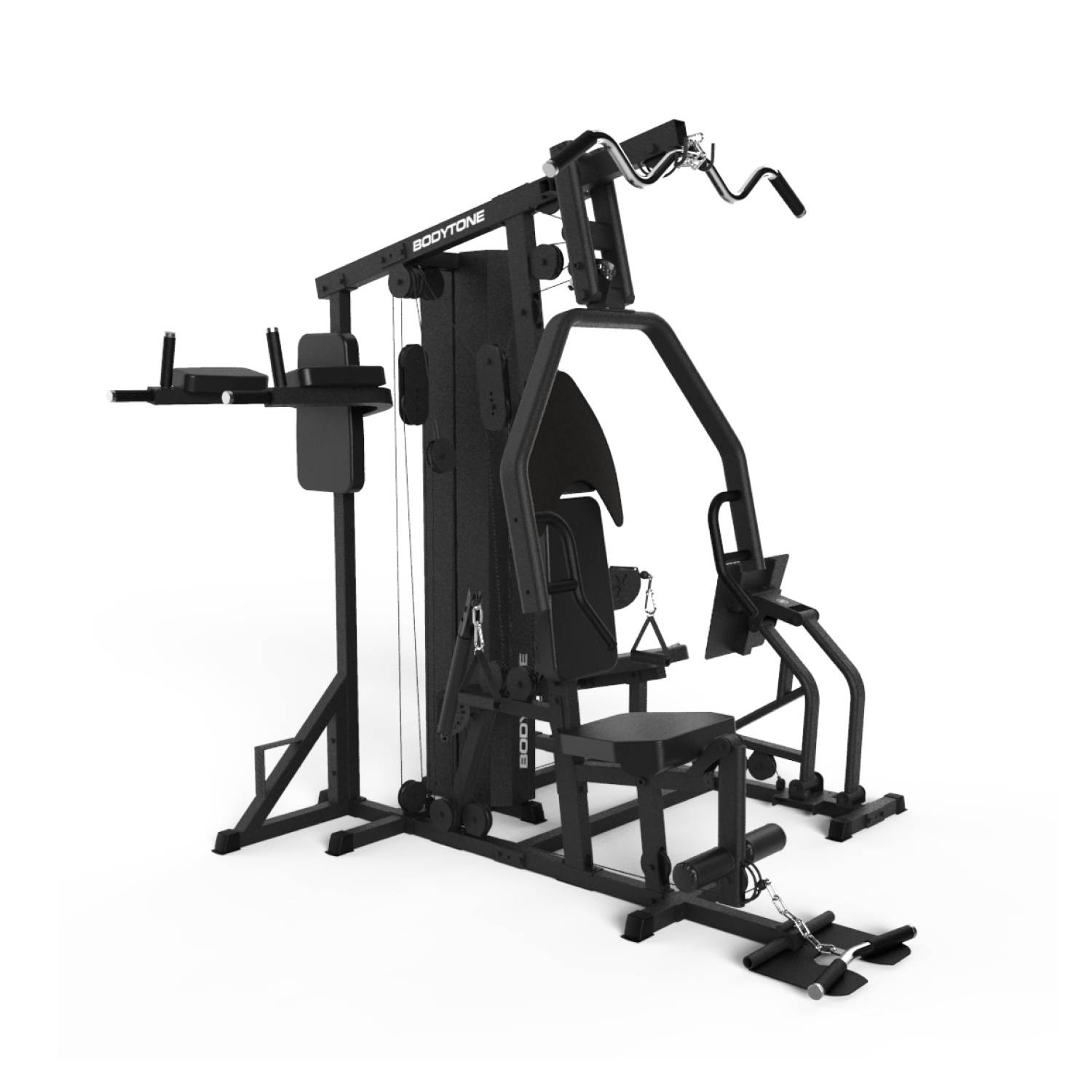
The Bodytone Evom4 gathers several guided-load stations on a single frame. It covers the main muscle groups within a reduced footprint, for one or two users at a time. That description already contains the whole purchasing decision: the Evom4 is a format, not a compromise, and the question is whether your site is one of the sites that format was designed for.
What a multi-station actually is
A multi-station gym is a single structure carrying several exercise positions around one or two weight stacks. Instead of a lat pulldown, a chest press, a low row, a leg station and a cable position occupying five separate machines and five separate footprints, they share one frame and one set of guarded weights.
The consequence people notice first is the floor area. The consequence that matters more is the supervision profile. Guided-load stations keep the load on rails and inside guards, so the movement path is constrained, the weight cannot be dropped, and a new user cannot get trapped under a bar. On an unsupervised or lightly supervised floor, that is not a convenience feature, it is the reason the equipment can be there at all.
Which sites the Evom4 format suits
The Evom4 belongs in rooms where the constraint is space and supervision rather than throughput:
- Residential fitness rooms. Apartment blocks, student residences and co-living operators need a full-body offer in a room that was never designed as a gym, with no staff on the floor.
- Corporate fitness rooms. A single unit gives an employer a complete strength offer without a machine line, and without the circulation space a machine line requires.
- Hotels and serviced apartments. Guests use a fitness room for twenty minutes; one structure covering the main movements serves them better than three specialised machines.
- Small clubs, studios and constrained rooms. Where the strength area has to fit alongside cardio and a functional zone in one space.
- Care and rehabilitation settings where guided movement paths are a requirement rather than a preference.
Where it does not belong is the busy commercial strength floor. A multi-station serves one or two users at a time; at peak hours a high-traffic club needs parallel stations, and the correct answer there is a set of dedicated selectorised machines rather than one shared frame. Choosing an Evom4 for a 1,500-member club is not a saving, it is a queue.
The specification questions worth asking
Before ordering any multi-station, settle five points with the supplier in writing.
Use class. Indoor professional equipment should be declared to EN ISO 20957-1 class S, the class intended for commercial and supervised use. This is the single most important line on the datasheet, because it governs both the construction and the validity of the warranty once the machine is placed in a facility open to third parties.
Stack weight and increments. Ask for the actual stack mass per station and the increment between plates. Increments decide whether a deconditioned user or a returning patient can progress in usable steps, which matters more in these settings than the top of the range does.
Footprint and working envelope. The advertised footprint is the frame. The working envelope is the frame plus the space a user needs at each station plus the circulation route. Ask for the manufacturer drawing with the user positions marked, and lay it out against your room before you commit.
Simultaneous users. How many people can genuinely train at once without interfering with each other? This is the number that determines whether the unit serves your peak hour.
Cables, pulleys and service. Cables and pulleys are the wear parts of any stack machine. Ask about replacement intervals, part availability and lead time for spares. On a machine that stands in a residence with no technician on site, spare part logistics are the real total cost.
Installation and the room around it
Multi-stations are heavy before they are loaded, and the mass is concentrated under the stacks. Check the floor build-up if the room is above ground level, and specify appropriate rubber flooring under the unit rather than laying it directly on a screed or a finished floor. Allow clear space at every working position, and keep the structure away from a wall on the sides where a user has to stand or pass.
Signage matters here too. In an unsupervised room, a clear instruction panel showing each station, the movement and the safety points is what keeps the equipment used correctly, and it costs almost nothing compared with the machine.
Frequently asked questions
Can a multi-station replace a full strength line?
In a residence, a hotel or a corporate room, yes, it is exactly the intended replacement. On a commercial club floor with a real strength membership, no. There the multi-station is a complement at best, and the strength offer has to be built from dedicated stations.
How many users can train at the same time?
The Evom4 format is designed for one or two simultaneous users. Size the rest of your room around that figure rather than around the number of stations printed on the frame.
Is it suitable for beginners with no supervision?
Guided-load stations were designed for that situation, which is why they dominate unsupervised fitness rooms. It still requires clear instruction panels, a sensible layout and a maintenance routine; the format reduces risk, it does not remove the operator obligation.
What maintenance does it need?
Periodic inspection of cables, pulleys, fixings and upholstery, plus cleaning of the guide rods. Frequency follows the manufacturer instructions and the use intensity of the site. Agree the spare parts channel before delivery, not after the first cable shows wear.
Getting a straight answer for your site
The Bodytone Evom4 multi-station sits in our wider multi-station gyms range, and it is one option among several formats. Tell us the room dimensions, the number of users, whether the room is supervised and what the peak hour looks like, and we will tell you whether a multi-station is the right answer or the wrong one. Request a quote and we will work from your room rather than from a product page.