Wholesale Rubber Sheets, Flooring, Mats and Tatami
Buying rubber flooring at trade volume is a different exercise from buying a few tiles. The specification has to hold across a whole delivery, the certifications have to be documented rather than asserted, and the price has to reflect the quantity. This page sets out our wholesale range of rubber sheets, flooring rolls, tiles, gym mats and tatami, and what a trade buyer should check before placing an order.
The material: what actually matters
What rubber flooring is made of
Rubber is an elastic polymer with exceptional flexibility and resilience, and for sports and safety flooring the composition comes down to two things: the granulate and the binder.
SBR granulate is the workhorse. Produced from recycled rubber, it gives excellent abrasion resistance, good grip and high impact absorption at a sensible cost. It is the core of almost every shock-absorbing tile and roll.
EPDM granulate is the coloured surface layer. It holds its colour under UV exposure far better than SBR, resists weather and ozone, and is what allows an outdoor surface to stay the colour it was specified in. It is more expensive, which is why most outdoor products use an SBR core with an EPDM wear layer.
Polyurethane binder agglomerates the granulate. The quality and quantity of the binder determine the density, the tensile strength and, ultimately, how long the product holds together under load.
Why grade matters at volume
At trade quantities, a small difference in granulate size or binder ratio changes the density of the whole delivery. Density is what determines load resistance, acoustic performance and service life, so it is the figure to specify and the figure to check on arrival, rather than thickness alone.
The wholesale range
Rubber sheets and plates
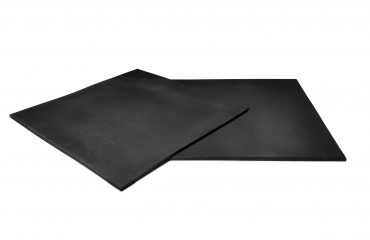
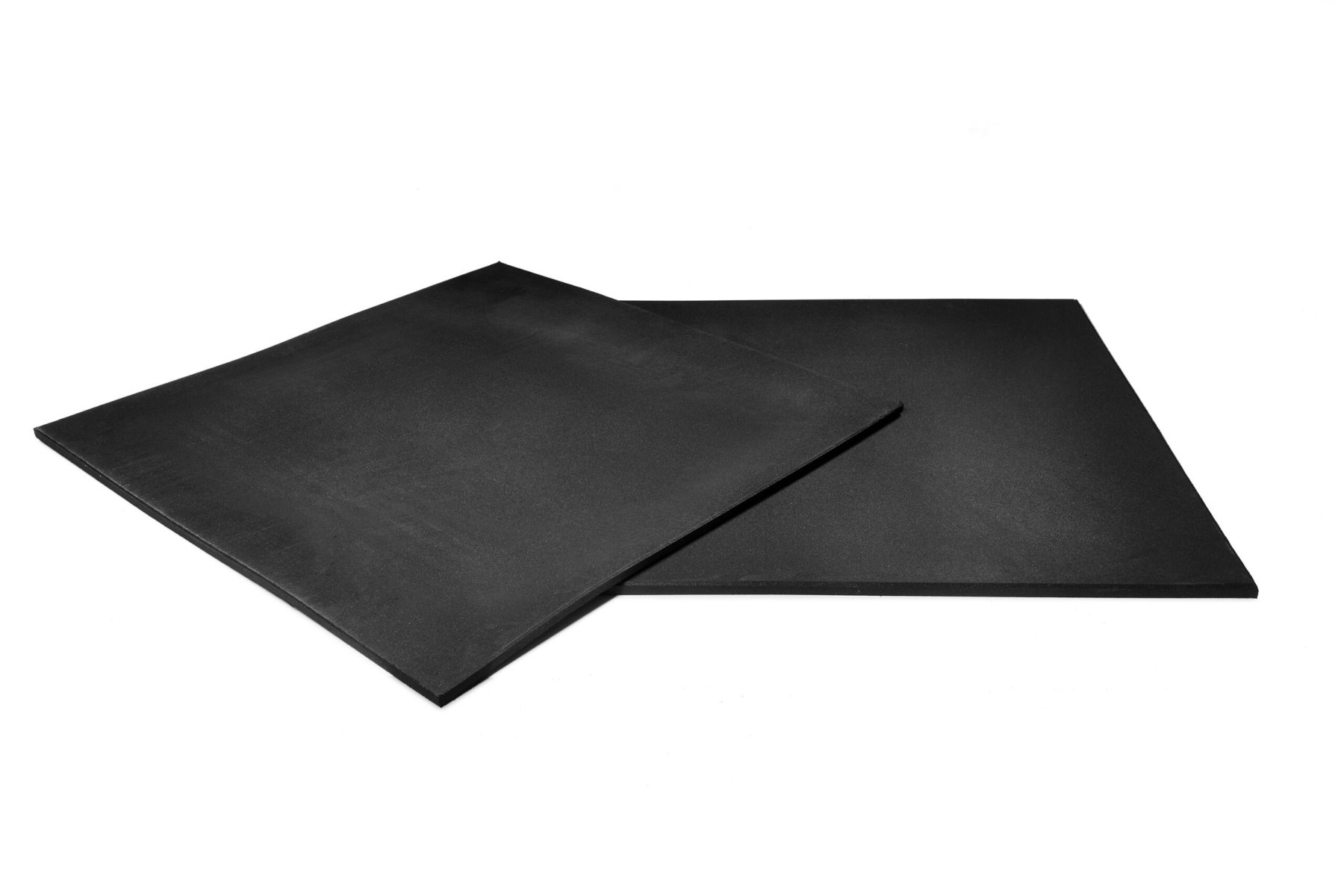
Our rubber sheets are supplied in a range of thicknesses and dimensions, suited to insulation, surface protection and vibration damping. They are the general-purpose product for protecting a substrate, cutting to shape on site and taking the impact that would otherwise reach the floor beneath. Custom formats are available on request.
Flooring rolls
Rolled rubber flooring is specified where a continuous surface with minimal joints is wanted. Rolls in SBR are designed for applications needing high abrasion resistance and good grip, which makes them the standard choice for gym floors, industrial surfaces and protective matting. They cover large areas quickly and, with fewer joints than tiles, they are easier to clean and less prone to lifting at the edges.
Flooring tiles
Tiles are the modular alternative: easier to transport, easier to replace one at a time, and available in interlocking puzzle formats for areas that may be reconfigured. Thickness is specified against the risk, from thinner tiles for load protection through to thick tiles certified for critical fall height under EN 1177 where children will use the surface.
Gym and combat mats
Roll-out mats and floor mats cover gymnastics, combat sports and fitness areas where the surface has to be laid and lifted rather than fixed. They suit multi-purpose halls, where the same floor serves several disciplines through the week.
Tatami
Tatami tiles and roll-out tatami cover dojo and combat sports surfaces, with the density and surface texture that judo, karate, aikido and grappling require. Thickness is chosen against the discipline: thinner tiles for striking arts where footwork matters, thicker tiles where throws and falls are part of the practice.
Choosing a wholesale supplier
What to check
- Product quality, range breadth and price competitiveness. A supplier with only one grade cannot serve a mixed order, and a supplier with no documented grades cannot be held to a specification.
- The ability to supply custom formats against specific requirements, including dimensions, colour and surface finish.
- Documented certification. Ask for the actual declaration rather than a claim on a website.
- Delivery terms, production lead times and after-sales service, which on a volume order matter as much as the unit price.
Certification
Certified quality is what makes a wholesale order defensible to the end client. For safety surfacing under children’s equipment, the reference is EN 1177, which sets the critical fall height determined by HIC testing. Where the floor goes into a building open to the public, a reaction-to-fire classification with its smoke index is normally required, and the class demanded is set by national building regulations in each country, so confirm what applies where the material is going. REACH compliance covers restricted substances. Note that a manufacturer’s ISO 9001 certifies a quality management system rather than the product itself.
Comparing quotations
Comparing prices between wholesalers means comparing like with like. The unit price of sheets, rolls and tiles is only part of it: delivery terms, production lead times and associated services change the landed cost materially. A supplier offering competitive pricing while maintaining documented quality is worth more than the cheapest line on a quotation, particularly on a repeat trade account.
Recycled rubber
Why recycled SBR performs
Flexible sheets and tiles in recycled rubber are durable and offer excellent resistance to impact and abrasion. They are the standard specification for play areas, sports halls and any application needing vibration damping, and they perform at least as well as virgin material in these roles.
Environmental impact
Turning end-of-life tyres and other rubber waste into new flooring keeps material out of landfill and reduces demand on raw resources. Recycled rubber flooring is one of the clearer examples of a circular material stream, which is increasingly something public-sector buyers have to evidence in a tender.
Ordering
What to send us
A useful enquiry contains the surface area, the intended use, the equipment or activity going on top, and any fire class or fall-height requirement imposed by the building rules that apply to your site. From that we can specify the grade, thickness and format, and quote against the actual quantity.
Ask for samples
On a volume order, request samples before committing. Density, surface texture and colour are all easier to judge in the hand than from a photograph, and a sample is the fastest way to confirm that the grade quoted is the grade you expected.
Our ranges
Our rubber gym flooring tiles cover the modular formats and thicknesses, the rubber flooring rolls cover continuous surfaces with minimal joints, and the tatami mats cover dojo and combat sports surfacing.
Frequently asked questions
What is the difference between SBR and EPDM?
SBR is recycled rubber granulate: strong, abrasion-resistant and cost-effective, and the core of most shock-absorbing products. EPDM is a coloured granulate with far better UV and weather stability, used as a surface layer where colour has to survive outdoors. Most outdoor products combine an SBR core with an EPDM wear layer.
Rolls or tiles?
Rolls give a near-continuous surface with fewer joints, which is easier to clean and better for large open areas. Tiles are easier to transport, easier to replace individually, and better where the layout may change or where thickness varies across zones.
What thickness of tatami do I need?
It depends on the discipline. Striking arts favour thinner, firmer surfaces where footwork and stability matter. Throwing and grappling disciplines need thicker tiles because falls are part of the practice. Specify against the activity, not against a general rule.
Do you supply custom formats?
Yes. Dimensions, colour and surface finish can be specified on request. Send the requirement with your enquiry so it is quoted correctly from the start rather than added later.
Request trade pricing
Wholesale rubber is a specification business before it is a price business: get the grade, the density and the certification right, and the price conversation is straightforward. Get them wrong and the saving disappears the first time a surface has to be relaid.
Send us your surface area, your intended use and any certification requirement, and we will quote against the quantity. Request a quote and our team will work through the specification with you.
Réalisations documentées
- Dalles et sols sportifs : livraisons documentées – plusieurs chantiers
- Sol sportif extérieur, square Georges-Vallerey – Taverny (95)