How to Lose Weight Without Cardio

It is entirely possible to lose weight without cardio, provided the right strategies are in place. The core principle is a calorie deficit: burning more calories than you take in. That means following a balanced, healthy diet and taking regular physical activity. For a gym operator, a hotel or a residential facility, this matters commercially: a large share of members will not use a treadmill, and a strength-led weight management offer keeps them enrolled rather than lost after a month.
Start with calorie intake
To lose weight, controlling calorie intake is essential. The recommendation is to consume fewer calories than are burned each day. That requires being aware of the calorie content of foods and favouring those that are low in calories. Foods rich in carbohydrates, fats and sugars are generally calorie dense, so it is better to limit them. High fibre foods such as vegetables and fruit are useful because they promote satiety while remaining low in calories.
Lean protein also matters, because it helps to preserve muscle mass and supports fat loss. This is the point where diet and training meet, and where a facility can add real value through structured guidance rather than equipment alone.
Raise your metabolism instead of running
To lose weight without cardio, the metabolism has to be stimulated. That can be achieved by increasing general physical activity. Any physical activity burns calories, even when it is not intense cardio. The priority should go to activities that load the muscles, such as resistance training and core work.
By building muscle mass, you increase your basal metabolic rate, meaning the calories burned at rest. This is the mechanism that makes a strength floor a legitimate weight management tool, not just a bodybuilding area, and it is worth explaining to members who assume that only the cardio zone counts.
Exercises for thighs, hips and midsection
There are many specific exercises that help to tone these areas. Core exercises such as crunches and planks strengthen the abdominal girdle and contribute to a flatter midsection. Squats and lunges are excellent for toning the thighs and glutes. To get results, these exercises should be done regularly and with good technique.
Good technique is also where supervision and equipment choice come in. Guided and selectorised machines let beginners load the right muscles safely, while free weight areas suit members who already train. A mixed strength zone covers both, which is why most facilities specify both rather than choosing one.
Eating habits and pace of progress
Beyond physical activity, eating habits have to be taken into account. A healthy, balanced diet is essential to lose weight and to keep the weight off. Avoid snacking between meals and limit foods that are high in fat and sugar. Favour nutritious, natural foods, and drink plenty of water to stay properly hydrated.
It should also be said that weight loss should not be rapid, because that can lead to a yo-yo effect and to harmful health consequences. Gradual, sustainable weight loss is preferable. A realistic target would be to lose a few kilos per month. Setting that expectation early is one of the most effective retention tools a facility has, because members who expect fast results are the ones who cancel first.
Equipping a strength-led weight management offer
In practical terms, a facility running this approach needs a strength area that suits untrained members, not only experienced ones. Selectorised and plate loaded machines, benches and functional accessories together cover the movements described above.
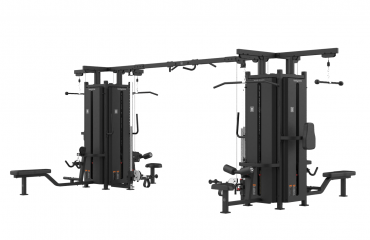
The full catalogue is available under professional strength training machines, with a dedicated section for weight benches. Where floor space is limited, a unit such as the Bodytone EVOM4 multi station gym covers several exercises in a single footprint, which suits hotels, residential facilities and smaller clubs.
Frequently asked questions
Can you really lose weight without doing cardio?
Yes. The determining factor is the calorie deficit, not the type of exercise. A balanced diet combined with regular resistance training creates that deficit and, by building muscle, raises the calories burned at rest.
Why does strength training help with weight loss?
Building muscle mass increases the basal metabolic rate, so more calories are burned at rest. Resistance work also burns calories during the session itself.
How fast should weight loss be?
Gradually. Rapid loss can trigger a yo-yo effect and harmful health consequences. A realistic target is a few kilos per month.
Which exercises tone the thighs, hips and midsection?
Crunches and planks strengthen the abdominal girdle; squats and lunges tone the thighs and glutes. Regularity and correct technique determine the result.
Specify your strength zone
Weight loss without cardio is entirely achievable through good eating habits and regular muscle strengthening work. Members should be advised to consult a health professional before starting any weight loss programme, so that the advice fits their situation. On the equipment side, tell us the available floor area and the profile of your members, and we will build a costed proposal – request a quote.