Opening a Box: Floor Area, Height, Layout, Budget and Purchase Plan
Une box se dimensionne sur le nombre d'athlètes simultanés, la hauteur sous plafond et le linéaire de rig, avant la surface totale. Il faut pouvoir faire travailler quinze personnes en même temps sans conflit de circulation ni zone de chute partagée. Le planning d'achat suit l'ordre : sol, rig, charges, cardio, accessoires.

A box is sized on the number of athletes training at the same time, the ceiling height and the linear metres of rig – before anyone talks about total floor area. Fifteen people have to be able to work simultaneously without a circulation conflict and without sharing a fall zone. The purchase order that follows from that is: flooring, rig, loads, ergometers, accessories.
Setting up a box is not buying a few barbells and painting a wall black. It is building a room where a full class can train at once without getting in each other’s way, without getting hurt, and without turning every session into an obstacle course. A box succeeds on its floor plan at least as much as on its programming.
Floor area and height: the two real constraints
Ceiling height governs which movements are possible at all: rope climbs, wall balls, rings, pull-ups. Floor area governs density, and density is the variable that matters. The tighter you pack the room, the higher the risk and the lower the comfort – and both show up in retention long before they show up in an incident report.
There is no universal minimum figure for either, and any supplier who gives you one without seeing your unit is guessing. The honest method runs the other way: start from the number of athletes you intend to coach per slot and the movements in your programming, then check whether the unit in front of you can hold them. If the ceiling is low, the answer is to adapt the layout and the equipment selection rather than to buy items that will never be used.
Layout: a box is a flow
Think in terms of circulation: entrance, warm-up, WOD zone, recovery, storage. A well laid-out box tidies quickly and resets easily between two classes, and that reset time is the difference between running six classes a day and running four.
The zones must not interfere with each other. Warm-up is not heavy loading, and heavy loading is not conditioning. Keeping them separate is what lets the room stay usable when fifteen athletes are in it. Storage is part of the layout, not an afterthought: equipment that has no home ends up on the floor, and equipment on the floor is what makes a room feel small.
The core of the room: rig, flooring, loads
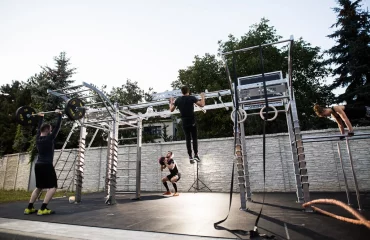
The rig or cage is usually the heart of a box – pull-ups, bars, rings, stations – and its correct size follows from the number of athletes per slot and from the programming, not from the wall it will stand against. Specify it with expansion in mind: adding bays later to a rig designed for it is straightforward, and impossible if it was not.
Flooring belongs to the foundation, not to the finishing. It carries comfort, safety, noise and durability at once, and it is the item that costs the most to get wrong, because replacing it means emptying the room. Rubber gym flooring tiles are specified by zone, with heavier protection under the lifting areas. Add olympic barbells and bumper plates, and the strength side of the box is functional.
Indoor equipment for a supervised commercial facility is designed and tested to EN ISO 20957-1 class S. Ask for the certification reference by reference and write it into the order.
Budget: buy in phases
- Phase 1 – the foundation: flooring, rig or cage, barbells and plates, a functional zone, and storage.
- Phase 2 – completing: ergometers, a power sled, accessories.
- Phase 3 – premium: finishes, options, the details that give the box its signature.
Buying in phases rather than all at once is what keeps the budget alive long enough to react to real demand. What your members actually use in month three is rarely what you predicted in month zero.
The mistake that costs the most
Buying specialised equipment too early, while the foundation is not solid: flooring, rig, barbells and plates, storage. A box with an impressive specialist machine and a thin foundation looks good in photographs and works badly on day one. Prioritising the foundation is what gets a room running from opening day.
Frequently asked questions
What is the minimum floor area for a box?
There is no honest single figure. The determining variable is density: how many athletes train at once, in what movements, with what circulation between zones. Send us the dimensions of your unit along with your intended class size and programming, and we will tell you what it holds.
What ceiling height does a box need?
Height decides which movements are possible – rope climbs, wall balls, rings, pull-ups – so the requirement follows from the programming you intend to run. Where height is limited, the layout and the equipment list are adapted rather than the ambition being abandoned.
How should the zones be arranged?
Clear circulation, and zones that do not interfere with one another: warm-up, heavy loading and conditioning kept apart. The objective is safety, flow, and a room that is still usable at full class capacity.
Do I need a rig from the start?
Yes in most cases: it is the structure the majority of the programming hangs from. Size it on athletes per slot and choose a system that accepts additional bays later.
Which accessories are genuinely useful at the start?
Versatile, class-friendly items that support progressions and circuits rather than one specific movement. Our fitness accessories range is where most of that inventory sits, and it is easy to extend once the programming settles.
How do I plan purchasing over three to six months?
Validate the layout and the foundation first – flooring, rig, barbells and plates – then add ergometers and accessories against real demand rather than against the opening-day wish list.
Getting your plan costed
A box that works is a box whose plan came before its shopping list. Send us the dimensions of the unit, the ceiling height, the class sizes you intend to run and your budget, and we will come back with a layout and a phased equipment list. Request a quote to start.
Réalisations documentées
- Dalles et sols sportifs : livraisons documentées – plusieurs chantiers
- Sol sportif extérieur, square Georges-Vallerey – Taverny (95)
À lire aussi sur le même thème
- Financing and Leasing Gym Equipment Without Draining Your Cash
- Which brands suit a HIIT and functional small group training studio?
- Quelles marques de matériel pro sont les plus robustes face aux chocs répétés des disques et barres lâchés ?
- Gym Flooring and Impact Absorption: Choosing the Right Thickness, Zone by Zone