The Most Effective Gym Machines for Commercial Facilities
L'efficacité d'une machine tient à son adaptation à l'objectif et à la morphologie de l'utilisateur, pas à sa sophistication. Une machine bien réglée sur un mouvement simple produit davantage qu'un appareil complexe mal ajusté. Le choix se fait par groupe musculaire et par trajectoire proposée.
Every square metre of a training floor has to earn its place. For a club manager, a cross-training box owner, a hotel or a local authority, the question is never simply which machine is popular, but which machine produces measurable results for the members who use it and stays reliable under commercial traffic. This guide reviews the equipment categories that deliver the most, the criteria that separate a genuinely effective machine from a well-marketed one, and how to match a machine list to the goals of your user base.
Why machine selection decides your return on floor space
Members judge a facility on results. When a machine does not target a muscle group properly, or when its adjustment range does not fit the people using it, sessions produce less, progression stalls and retention suffers. On the operator side, the same machine still occupies floor area, still needs servicing and still has to be amortised.
Choosing well means three things at once: equipment that targets the intended muscle groups through a sound movement path, equipment built for continuous commercial use, and a mix that matches the actual profile of your members. Indoor equipment intended for supervised commercial facilities is covered by EN ISO 20957-1 class S, and that rating is the baseline for any machine going into a club, a hotel gym or a municipal facility.
How to judge whether a machine is effective
Four criteria hold up across every category.
| Criterion | What to check |
|---|---|
| Range of movement | The machine allows a full, natural movement path and, ideally, several exercise variations |
| Resistance | Increments are fine enough to progress, and the top load is high enough for advanced members |
| Ergonomics and adjustment | Seat, backrest and lever positions adapt to different body sizes without tools |
| Build and serviceability | Frame, bearings, cables and upholstery rated for continuous use, with spare parts available |
Interactive consoles, heart rate sensors and preset programmes add value on cardio equipment because they help members structure a session and keep coming back. They are a motivation tool, not a substitute for a sound movement path.
The most effective cardio machines
The rowing machine
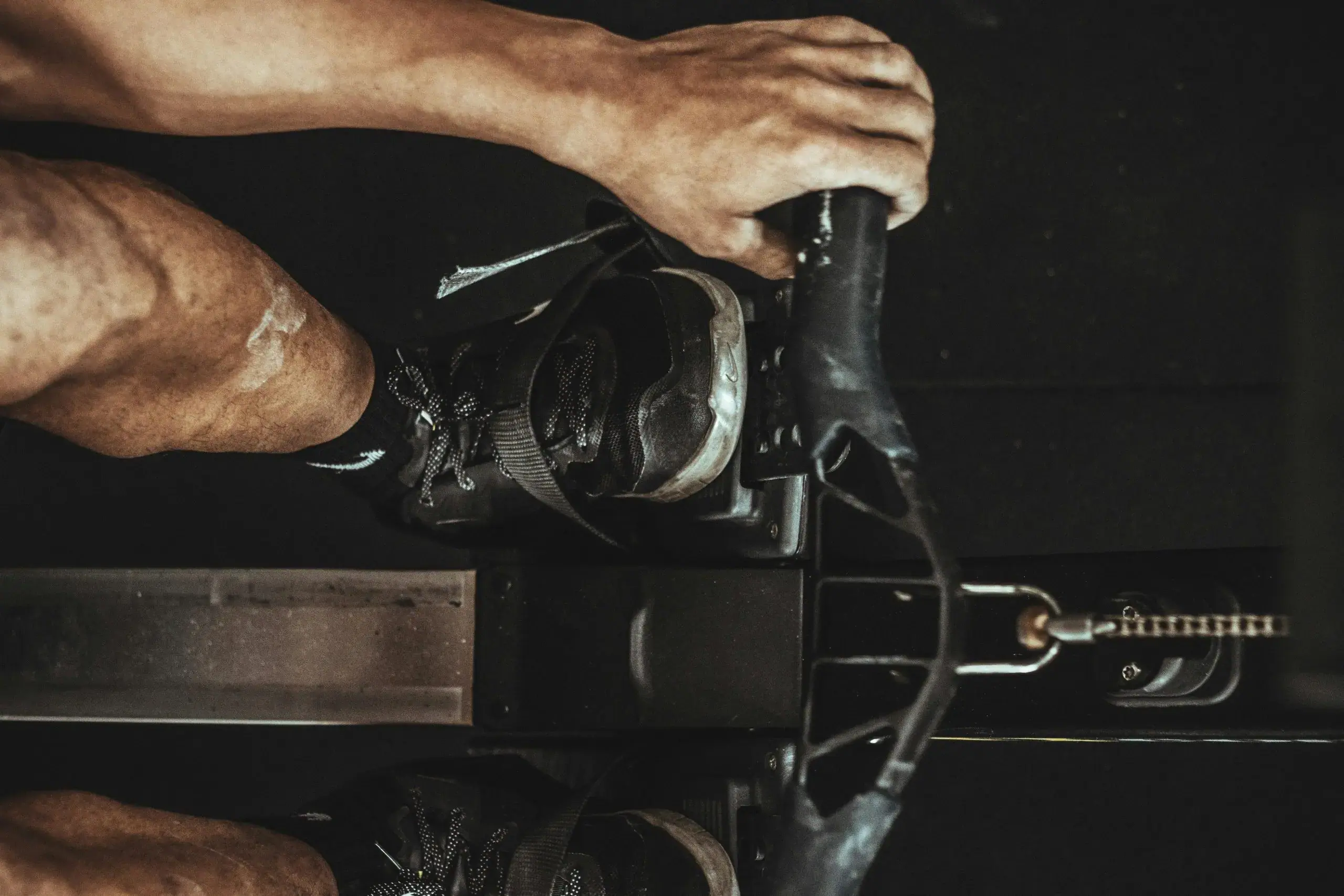
The rower is one of the most complete cardio machines available. It works upper and lower body at the same time, reproducing the rowing stroke: legs, back, shoulders, arms and trunk all contribute, while the cardiorespiratory demand stays high. Because the movement is seated and non-impact, it suits a very wide range of members, from beginners to competitive athletes. Our range of professional rowing machines covers air, magnetic and water resistance.
The incline treadmill
Raising the incline turns a treadmill into a far more demanding machine: it reproduces uphill running or walking, raises heart rate quickly and loads the quadriceps, hamstrings and calves without asking for higher speed. For clubs, incline work is also the safest way to intensify a session for members who cannot or should not run fast. See the professional treadmills range.
The cross trainer
The cross trainer delivers a low-impact workout that protects the joints while still offering enough resistance to strengthen the legs. It mainly targets quadriceps, hamstrings and calves, and the moving handles bring arms and shoulders into the movement. It is the default recommendation for hotel gyms, senior programmes and rehabilitation settings where impact has to be limited.
The most effective strength machines
The squat rack
The squat rack remains the reference station for lower body strength, in particular quadriceps and glutes. It allows barbell squats with progressive loading, and the trunk, back and shoulders work throughout to hold posture. In a commercial setting, safety bars are not optional: they are what makes the station usable without a spotter.
The bench press station
The bench press builds strength in the chest, shoulders and triceps. On a dedicated station with uprights and safety supports, the exercise can be loaded heavily and safely, which is why it stays a fixture in every serious strength area.
The leg press
The leg press targets the quadriceps with the back supported throughout, which makes it far easier to teach than a free-weight squat. It is the machine that lets a beginner load the legs seriously within a few sessions, and it absorbs a large share of traffic in the strength area. The full professional strength training machines range covers selectorised, plate-loaded and converging options.
The most effective functional training equipment
Suspension trainers
A suspension trainer uses body weight as resistance through adjustable straps fixed to a solid anchor point: a rig, a wall anchor or a dedicated ceiling fixing. In a professional facility the anchor is part of the specification and has to be rated for the load. The tool covers a wide catalogue of full-body exercises with a strong emphasis on stability and coordination, and it costs very little floor space.
Kettlebells
The kettlebell is a cast weight with a handle, used for swings, squats, lunges, carries and presses. It develops strength, endurance and coordination across the whole body and is the backbone of most small-group functional classes. Its real advantage for an operator is density: a rack of kettlebells serves a whole class in the space of one machine.
Balance trainers
A balance trainer is an inflated dome mounted on a rigid platform. Used dome up or platform up, it introduces instability to work balance, ankle and knee proprioception and trunk strength. It supports squats, push-ups and plank variations, and it is widely used in return-to-sport and rehabilitation protocols.
The most effective circuit training machines
The Smith machine
The Smith machine guides the barbell on fixed rails and offers adjustable safety catches. That guidance is what makes it valuable in a circuit: members move from one exercise to the next without re-racking, re-loading or re-learning a start position, which keeps the circuit flowing and keeps supervision simple.
The air bike
The air bike drives resistance with a fan and uses arms and legs together. Output rises with effort, which makes it self-regulating: every member works at their own level on the same machine. It burns a large amount of energy per minute and is one of the most efficient stations in a timed circuit.
The air rower
The air rower reproduces the rowing stroke with fan resistance for a realistic feel. It recruits arms, legs, back and trunk and, like the air bike, adapts automatically to the intensity the user applies, which is exactly what a mixed-ability circuit needs.
Matching the machine list to your objective
| Objective | Priority machines | Typical setting |
|---|---|---|
| Energy expenditure | Rower, incline treadmill, cross trainer | Clubs, hotels, corporate gyms |
| Strength and muscle mass | Squat rack, bench press station, leg press | Clubs, sports clubs, armed forces |
| Endurance and conditioning | Smith machine, air bike, air rower | Cross-training boxes, circuit studios |
| Stability and coordination | Suspension trainers, kettlebells, balance trainers | Small-group studios, rehabilitation centres |
Most facilities need all four columns, in proportions set by their membership. A hotel gym and a competition-oriented club buy from the same catalogue, but not in the same ratio.
Common mistakes to avoid on the training floor
- Overestimating the starting level: loads and resistance should match the member in front of the machine, not the machine capacity.
- Letting members use a machine they have never been shown. An induction session with a qualified instructor removes most incidents.
- Skipping the warm-up and the cool-down, which raises injury rates across the whole floor.
- Buying a single category in depth and leaving another empty, which sends members elsewhere for the missing work.
- Specifying equipment without checking adjustment ranges against the real morphology of your user base.
Supporting members so the equipment delivers
Effective machines only produce results when they are used correctly. Induction sessions, instructor-led classes and clear on-machine instructions do more for perceived quality than any extra feature. Manufacturer exercise guides and demonstration videos are useful support material, and posting a short movement summary on each station is a low-cost way to keep technique consistent when the floor is unsupervised.
FAQ
Which machine is the most effective overall?
There is no single answer: effectiveness depends on the objective and on the user. A machine well adjusted on a simple movement produces more than a complex machine that fits nobody properly.
Should a facility favour selectorised machines or free weights?
Both. Selectorised machines let beginners load safely and quickly; free weights and racks serve strength progression and advanced members. The ratio follows your membership profile.
How much space should be planned per station?
It depends on the machine and on circulation requirements. Space is planned from the manufacturer footprint plus the safety clearance, and it is one of the first points we go through when preparing a layout.
Do consoles and connected features matter?
They matter for engagement and for tracking, especially on cardio. They do not compensate for a poor movement path or an underbuilt frame.
Does the same machine list work for a hotel and a cross-training box?
No. A hotel gym prioritises low-impact cardio and compact multi-purpose stations; a box prioritises rigs, free weights and conditioning machines. The categories overlap, the proportions do not.
Building the right equipment mix for your facility
The most effective machine is the one that matches your members, your floor plan and your programme. Light In Fitness supplies professional cardio, strength and functional equipment to clubs, cross-training boxes, hotels, campsites, local authorities, schools, sports clubs and rehabilitation centres, and builds the equipment list around real usage rather than a catalogue page.
Request a quote with your surface area, your membership profile and your objectives, and we will come back with a configuration sized for your project.