Military shooting range flooring: why roll matting is giving way to Bfl-s1 rubber tiles
Les cahiers des clauses particulières des marchés du ministère des Armées imposent un revêtement de sol classé M1 ou Bfl-s1 sur les stands de tir. La dalle caoutchouc répond à cette exigence là où le tapis en lés se souille de résidus de métaux lourds et se remplace entièrement. Les zones de foulée concernées vont de 5 à 100 mètres.
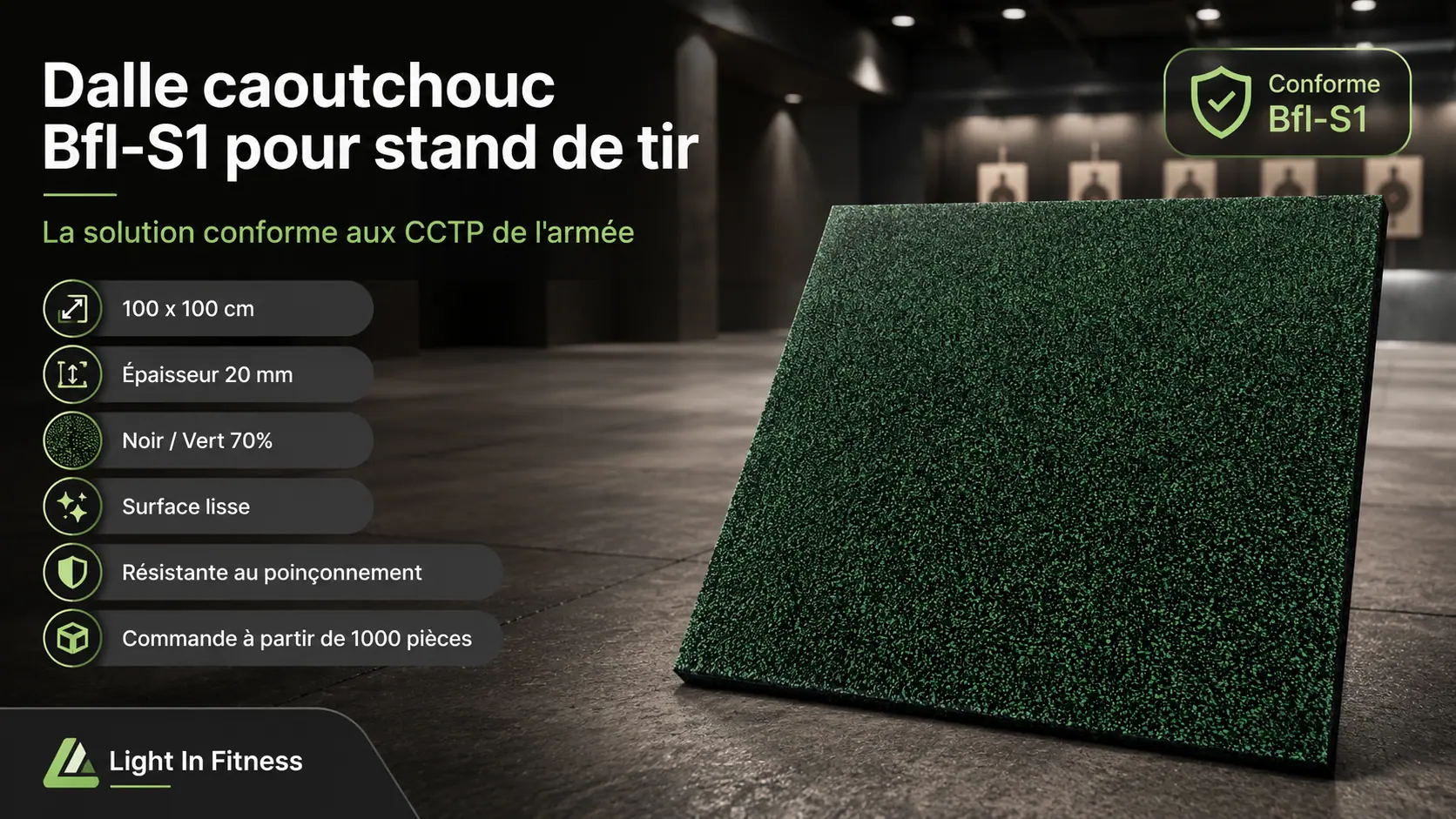
Defence and law-enforcement range refurbishment specifications increasingly call for a floor covering classified Bfl-s1 to EN 13501-1, in green, resistant to point loading, with the technical file and fire classification report approved before installation. That specification is why rolled green matting is being replaced by modular 100 x 100 cm rubber tiles across military ranges. A 20 mm Bfl-s1 tile sits at 45 EUR per square metre excluding VAT, and the modular format changes the economics of every future contamination purge on the range.
What a range refurbishment specification actually asks for
Refurbishment packages for indoor and covered military ranges follow a consistent sequence: strip out and dispose of existing matting treated as contaminated with heavy metal residues, scrape back the sand of the firing lane by 5 to 20 cm, level, import new washed silica sand of 2 to 4 mm grading, then install a new floor covering across the whole walkway.
For that finishing layer, the technical prescription is generally unambiguous.
| Typical specification clause | What a 20 mm Bfl-s1 tile delivers |
|---|---|
| Reaction to fire: Bfl-s1 to EN 13501-1, or the equivalent legacy national class | Classified Bfl-s1, the highest class available for a rubber floor covering, with the classification report supplied |
| Resistant to point loading from heavy and repeated foot traffic | High-density rubber, 20 mm, smooth surface, rated for intensive professional use |
| Colour: green | Black base loaded with 70 per cent green granulate, matching the established walkway colour convention |
| Technical data sheet submitted for approval before installation | Full data sheet and fire classification report issued at tender stage |
In other words, the question is no longer which mat to choose. It is which covering passes the engineer’s approval without a qualification. Reaction to fire is where most submissions fail, because generalist suppliers cannot produce a classification report for the exact product they are offering.
Understanding the fire classification
EN 13501-1 classifies floor coverings from Afl (best) through Bfl, Cfl, Dfl, Efl to Ffl, with a smoke sub-class of s1 or s2. For rubber flooring, Bfl-s1 is the highest achievable class: very limited contribution to fire and very low smoke emission. Several national legacy classifications map onto it, which is why specifications sometimes read as a class name plus its European equivalent.
| Class | Typical use | 20 mm tile price excluding VAT |
|---|---|---|
| Bfl-s1 | Firing lanes, escape routes, high-risk and publicly accessible premises | 45 EUR/m2 |
| Cfl-s1 | Ancillary rooms, waiting areas, general premises open to the public | 42 EUR/m2 |
| Dfl-s1 | Lower-risk areas, standard training halls | From 45 EUR/m2 at 25 mm |
| Efl | General gym and strength flooring, no specific fire requirement | From 38.50 EUR/m2 at 40 mm |
Specifying the class per room rather than across the whole building is what keeps a project affordable: the firing lane needs Bfl-s1, the equipment store usually does not. Our fire-rated rubber tile range covers all four classes.
Roll matting versus tiles: the whole-life calculation
Rolled green matting is the historic solution for firing lane walkways. It has three structural weaknesses that every refurbishment cycle exposes.
1. A monolithic hazardous waste stream
During a purge, matting is treated as contaminated with lead and antimony residues across its entire surface. There is no way to segregate it: the whole covering goes to hazardous waste disposal with the associated consignment documentation. With 1 m2 tiles, the infrastructure manager can target removal on the zones actually loaded, identified by the core sampling plan, and leave the rest in place. On a 100 m lane that is the difference between disposing of the entire floor and disposing of the 15 to 25 per cent of it that sits behind the firing points.
2. Wear that cannot be isolated
A roll that lifts or tears at a firing point requires the whole strip to be re-tensioned or replaced. A worn tile is swapped individually, in minutes, without an extended closure. That matters when the works contract requires the range to be closed to all personnel for the full duration of the works.
3. Installation that depends on the substrate
On levelled, lightly compacted sand, a 20 mm 100 x 100 cm rubber tile beds down in full contact with excellent dimensional stability, where lightweight roll matting follows every irregularity in the formation.
The procurement point: infrastructure is generally only accepted after full reinstatement and approval of the technical files. Presenting a covering whose Bfl-s1 classification is documented by a laboratory report at tender stage removes the single most common cause of a qualification at handover.
Product specification
| Characteristic | Value |
|---|---|
| Format | 100 x 100 cm |
| Thickness | 20 mm |
| Surface | Smooth |
| Colour | Black / green 70 per cent |
| Reaction to fire | Bfl-s1 to EN 13501-1 |
| Material | High-density rubber |
| Minimum order quantity | 1,000 pieces (1,000 m2) |
| Documentation | Technical data sheet and fire classification report supplied before installation |
The 1,000 piece threshold is not a constraint for this type of operation: a walkway running from 5 to 100 m across the width of a range is precisely that volume. For shorter ranges of 25 or 50 m, or for multi-site programmes, the order can be lotted across sites on request.
The rest of the range, not just the walkway
A covered range combines several zones with distinct requirements, and this is where working with a sports flooring specialist rather than a generalist changes the outcome:
- The firing lane walkway (5 to 100 m) takes the green Bfl-s1 tile described above, laid on new levelled and compacted sand.
- The firing point and rear zone, including the local armoury and waiting area, can take a more economical smooth black 20 mm tile where Cfl-s1 is sufficient. The class required varies with the designated use of each room in the specification.
- Ancillary rooms and circulation fall under the general rules for publicly accessible premises, typically Cfl-s1 or Dfl-s1.
- Weapon handling and dry training rooms often need impact attenuation as well as a fire class, which moves the specification to a thicker tile. Our tile density guide covers the trade-off between density, thickness and fire performance.
Covering all four fire classes from a single supplier, with laboratory classification reports for each, is what allows a complete tender package to be answered from the firing point to the changing rooms with one point of contact.
How to respond to the tender
For main contractors and framework holders bidding on these packages, the supplier process that works is straightforward:
- Immediate release of the data sheet and Bfl-s1 classification report for inclusion in the technical submission and early approval by the engineer.
- Detailed quotation with a firm production lead time, compatible with a call-off contract programme including the mobilisation period.
- Delivery to a military site coordinated with access constraints, with vehicles and drivers declared in advance.
- Setting-out assistance for the walkway to optimise tile count and edge cuts, which on a 100 m lane materially changes the quantity ordered.
Our military and police training equipment section covers the wider range of products supplied into defence programmes, and our notes on flooring compliance in public venues set out how the classes are applied by room type.
Frequently asked questions
What fire classification is required for a military shooting range floor?
Defence specifications generally require Bfl-s1 to EN 13501-1, or the equivalent legacy national class, meaning a covering with very limited contribution to fire and very low smoke emission. A 20 mm Bfl-s1 rubber tile meets that requirement directly, and the classification report should be supplied at tender stage for approval before installation.
Why replace green roll matting with rubber tiles?
Roll matting deforms, lifts and, during refurbishment, is treated as contaminated with heavy metal residues across its whole surface, so all of it goes to hazardous waste disposal. Modular 100 x 100 cm tiles allow targeted replacement: only the contaminated or worn tiles are removed, which reduces the cost of future purges and simplifies waste traceability.
Why a green floor colour on a range?
Green is the established colour convention for firing lane walkways and appears explicitly in refurbishment specifications. A black base loaded with 70 per cent green granulate meets the colour requirement while hiding soiling considerably better than a uniform green mat.
What is the minimum order quantity and lead time?
The 20 mm black and green 70 per cent Bfl-s1 tile is produced from 1,000 pieces, equal to 1,000 m2, which corresponds to a 100 m firing lane walkway. The technical data sheet, fire classification report and a detailed quotation are issued at consultation stage, and production and delivery lead times are confirmed with the quotation.
Does the tile resist point loading and light vehicle traffic?
Yes. Range refurbishment specifications require resistance to the point loading created by heavy and repeated foot traffic. High-density rubber at 20 mm absorbs intensive foot traffic, the movement of mobile target frames and occasional light rolling plant without permanent marking.
Bidding on a range refurbishment? Light In Fitness supplies technical sports and safety flooring in all four EN 13501-1 fire classes, with laboratory classification reports, to defence, police, public authority and commercial clients across Europe and export markets. Send us the lane dimensions and the specification clauses and we will return the data sheets, the classification report and a costed offer. Request a quote.
Réalisations documentées
- Dalles et sols sportifs : livraisons documentées – plusieurs chantiers
- Sol sportif extérieur, square Georges-Vallerey – Taverny (95)
- Cage street workout ultime, Hub Armées – DICOM-GSB EFG / Division Métiers
- Cage street workout ultime, CFIM 6 de Fréjus – armée française
Sources et références
- Arrêté du 19 avril 2011 – étiquetage des produits de construction ou de revêtement de mur ou de sol sur leurs émissions de polluants volatils (Légifrance)
- Ministère de la Transition écologique – étiquetage des produits de construction : classes d’émission A+ à C
- Code de la commande publique – texte intégral en vigueur (Légifrance)
- Direction des affaires juridiques, ministère de l’Économie – réglementation de la commande publique et fiches techniques