Smart and LED sports flooring: custom turf, pacing and sensors
Un sol sportif connecté intègre éclairage LED, capteurs de pression ou logo dans l'épaisseur du revêtement. Ces fonctions s'ajoutent aux exigences de base, amortissement et réaction au feu, sans les remplacer. Elles introduisent en revanche un poste de maintenance électronique absent d'un sol classique.
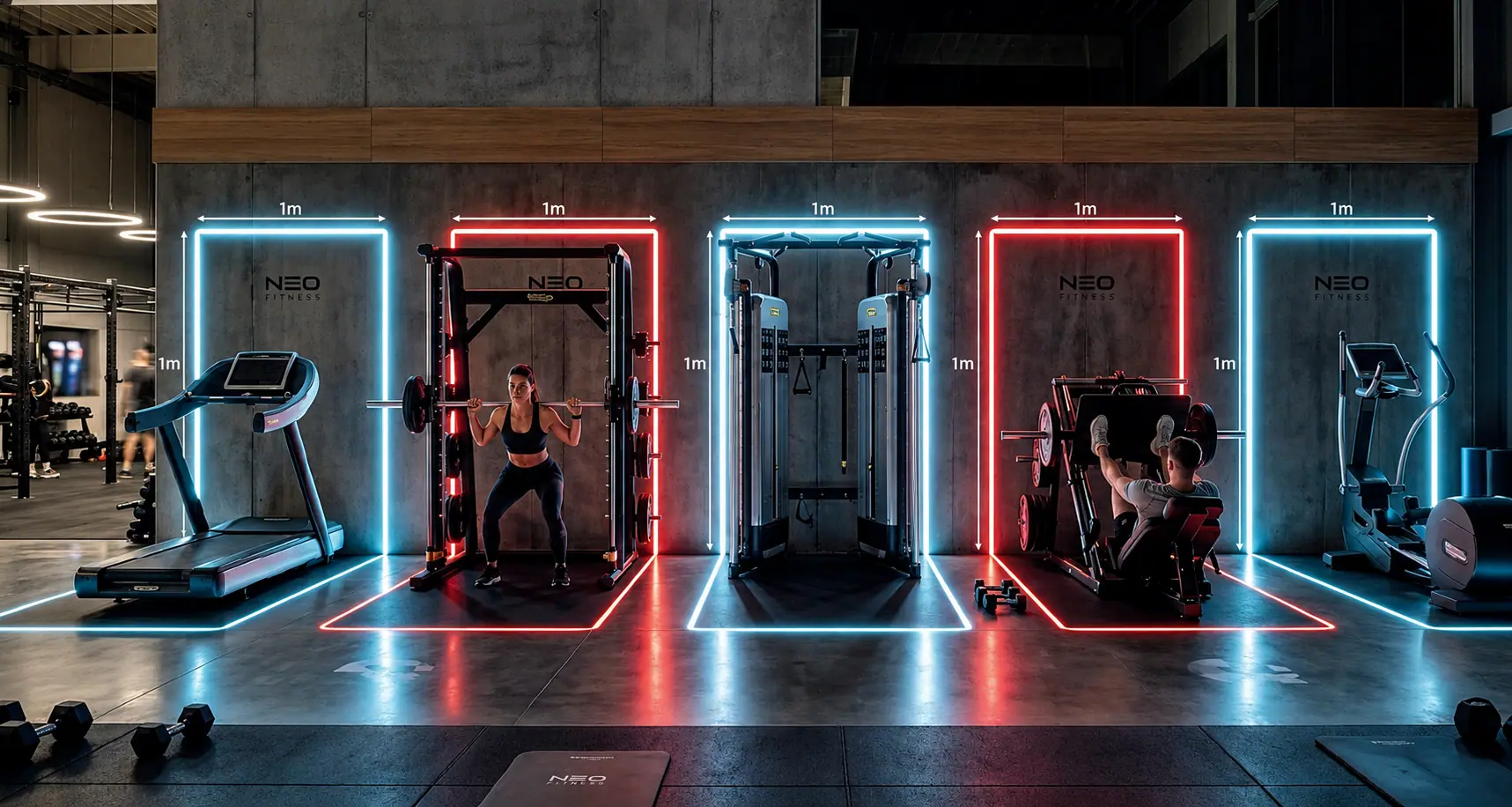
Sports flooring is becoming a piece of training equipment rather than a passive surface, but the connected options only pay off on a technically sound base. Custom turf in club colours, integrated training markings, LED pacing lights, pressure sensors that time a sled push and heated mats for yoga zones are all real products on the European professional market. Fibre quality, density, underlay and installation remain the number one durability criteria. The new-generation options add to a sound technical base; they never substitute for it.
Why the floor changed status
Three forces drive this. The rise of functional conditioning and hybrid race formats made the artificial turf lane a standard in CrossFit boxes and performance-oriented gyms. The differentiation battle between clubs means that when two gyms offer the same machines, the visual experience and brand identity decide the trial visit. And the digitalisation of training means members want data, times and measurable reference points, while the floor is the only piece of equipment in permanent contact with the athlete.
Custom artificial turf: three levels
Level 1, bespoke dimensions. Standard sled lane width is 2 metres, calibrated on sled runner spacing, with common lengths of 10 to 50 metres. Real projects run into building constraints: a structural column, an unusual corridor, a mezzanine. Turf cut and assembled to measure exploits every usable square metre instead of adapting the room to the product. Our sprint lane turf is 33 EUR excluding VAT per square metre, and a ready-made 15 x 1 m sled track is 1,030 EUR excluding VAT.
Level 2, colour and zoning. Beyond standard green, professional turf comes in anthracite, black, blue, red and two-tone. Colour zoning is not only decorative: it structures circulation, visually defines the conditioning zone, and reinforces the club’s visual identity in the photos and videos members publish, which is a free and permanent marketing channel.
Level 3, inlaid logos and markings. The premium tier inlays the club logo into the turf itself, by tufting or by cutting and inserting coloured fibres. Unlike a painted or bonded marking, an inlaid logo does not wear away under repeated sled and shoe traffic. It is the option premium clubs, franchises and athletic preparation centres choose, because the floor becomes a brand asset filmed at every session.
Integrated functional markings
Agility ladders, footwork dots, distance references every metre or every 5 metres, start boxes and lane lines can be built into the covering at manufacture. That gives two decisive advantages over accessories laid on the floor: nothing to set up and put away at each session, and no risk of slipping or catching during explosive work.
For a coach, a marked floor changes the programming. Agility drills, sprint starts and farmer’s walk distances become standardised, measurable and immediately legible to every member. For cross training and athletic preparation gyms, that is a daily time saving and a visible professionalism argument.
LED flooring: three distinct uses
Ambient lighting. Perimeter LED strips or lighting integrated under the turf edges create a strong visual signature, particularly effective in low-lit rooms, cycling studios and scripted cross training zones. Some systems are app-controlled and synchronise with the class soundtrack.
Pacing lights for sled and sprint work. The most interesting use athletically. Sequential lights travel the lane at a programmed speed, giving the athlete a visible pace target for sled pushes, sled pulls or sprints. The principle comes from the chasing lights used in athletics and swimming, and it makes pace work concrete without a timekeeper or a screen: the athlete sees in real time whether the target pace is being held.
Exercise feedback. Coupled with sensors, LEDs can indicate a target zone, validate a foot contact or mark a split time.
Sensor flooring
The most advanced tier: pressure sensors integrated under the turf or track, able to detect foot contacts and measure real times. The applications are direct: timing a 20 metre sled push without photocells to set up, measuring a sprint time, analysing foot contacts or jumps in an athletic preparation or return-to-play context.
Three types of facility have a genuine case: performance-oriented gyms wanting to objectify member progress, athletic preparation centres, and rehabilitation or return-to-play services where measuring contacts and times is part of the protocol. The investment is materially higher than standard turf and should be arbitrated on real use. For a box that simply wants to time its workouts, a wall clock remains more rational. For a centre selling individualised coaching, an instrumented floor becomes a retention tool and a justification for its pricing.
Heated zones and design surfaces
A more confidential but growing option: coverings and mats with integrated low-consumption heating elements beneath the practice surface, tempering the contact zone during a session. The relevant uses are targeted: yoga studios, especially gentle practice in winter, stretching and mobility zones, and recovery spaces. The economic argument is real for some operators, since heating the contact surface rather than the whole air volume of a studio allows a lower ambient set point at equal perceived comfort. Consumption and surface temperature figures vary by system and must be checked on each product data sheet.
The last family is technical sports carpet and design turf for zones where image matters as much as performance: reception, free weight areas, circulation, lifestyle corners. Unlike domestic carpet, a professional sports carpet combines resistance to intensive traffic, stability under load, and a surface treatment limiting bacterial growth and odour, which is critical in a daily perspiration environment.
Which innovation for which facility
| Innovation | Main use | Priority facilities | Investment level |
|---|---|---|---|
| Custom turf: logo, colours, bespoke sizes | Brand image, zoning, adaptation to the building | Premium clubs, franchises, CrossFit boxes | Moderate |
| Integrated functional markings | Session structure, standardised drills | Boxes, athletic preparation, cross training | Moderate |
| LED flooring: ambience and pacing | Member experience, pace work | Coached studios, performance gyms, differentiating clubs | High |
| Sensor flooring and timing | Performance measurement, individual tracking | Athletic preparation, rehabilitation, return to play | High |
| Heated zones | Contact thermal comfort | Yoga studios, hotels, wellness spaces | Moderate to high |
| Design sports carpet | Aesthetics of premium zones, hygiene | High-end clubs, hotels, corporate | Moderate |
Exact budgets depend on areas, options and installation constraints, so each project is priced individually.
How to integrate a new-generation floor
| Step | What it decides |
|---|---|
| 1. Audit of real use | Which training formats, what attendance, what circulation flows. Use determines the relevant option, not the novelty of the product. |
| 2. Zoning and 3D plan | The new floor sits inside an overall zoning: rubber tile on heavy zones, technical turf on the functional lane, design surfaces on premium zones. The 3D plan shows logo inlays and LED positions before any order. |
| 3. Technical specification | Fibre density, pile height, underlay, fixing system, personalisation and connected options, each arbitrated against budget and intended service life. |
| 4. Installation and follow-up | Installation governs durability, particularly where electrical elements or sensors are embedded. |
Frequently asked questions
Can LED or sensors be retrofitted to an existing lane?
Rarely without lifting the surface, because the electrical elements and sensors sit under it and need cable routes and a supply point. Plan them at the specification stage. Perimeter LED strips are the exception: they are the one option that retrofits cleanly to an installed floor.
Does an inlaid logo affect durability?
No, when it is tufted or fibre-inserted rather than printed or bonded. That is precisely the argument for inlay: painted and adhesive markings wear off under sled and shoe traffic within a season or two, while inlaid fibre wears at the same rate as the surrounding turf.
Is sensor flooring worth it for a CrossFit box?
Usually not. A box that wants workout times is better served by a wall timer at a fraction of the cost. The investment makes sense where individualised measurement is sold as part of the service: athletic preparation, return-to-play and performance testing.
What should we specify before any of these options?
The base. Fibre quality, pile height, density, underlay and the fixing system decide how long the floor lasts and how it feels. Our sled track turf guide and the sports flooring decision matrix cover those fundamentals.
Get a 3D view before you order
Light In Fitness has been a manufacturer and B2B distributor of professional sports equipment since 2013, based in Tours, France, with more than 2,500 customers equipped: gyms, CrossFit boxes, hotels, local authorities, care homes and military sites. Technical turf, logo personalisation, LED options and bespoke solutions are all quoted with a 3D layout so you can see the result, logo inlays included, before committing. We deliver across France, Belgium, Switzerland and Luxembourg, with export priced per project. Browse the artificial turf range and outdoor sports flooring, then request a quote. We reply within 24 working hours.
Réalisations documentées
- Dalles et sols sportifs : livraisons documentées – plusieurs chantiers
- Sol sportif extérieur, square Georges-Vallerey – Taverny (95)
Sources et références
- Arrêté du 19 avril 2011 – étiquetage des produits de construction ou de revêtement de mur ou de sol sur leurs émissions de polluants volatils (Légifrance)
- Ministère de la Transition écologique – étiquetage des produits de construction : classes d’émission A+ à C
- Code du sport, articles R322-4 à R322-43 – garanties d’hygiène et de sécurité applicables aux établissements d’activités physiques et sportives (Légifrance)