How to Choose Professional Strength Training Equipment
Le choix d'un appareil professionnel se fait sur quatre critères : la classe d'usage EN ISO 20957, la structure, l'amplitude des réglages et la disponibilité des pièces. Ces paramètres prédisent le coût d'exploitation mieux que le prix d'achat. Le nombre de postes se déduit ensuite de la fréquentation attendue.

Equipping a strength floor is a capital decision that you live with for the next decade. Whether you run a commercial club, a hotel fitness room, a municipal sports centre, a school, an armed forces facility or a rehabilitation unit, the machines you choose determine your maintenance budget, your programming options and, indirectly, your retention. The purchase price is the least useful number in the decision. This guide sets out the method professional buyers use, from objectives to commissioning.
1. Define what the floor has to deliver
Before looking at a single machine, write down what the space is for. Are you building strength capacity for serious lifters, general conditioning for a mixed membership, circuit training with fast station changes, or supervised rehabilitation? These are four different equipment lists. A floor that tries to be all four without a plan ends up with duplicated functions, gaps in the muscle map and machines nobody programmes. Start from the sessions you intend to sell, then work backwards to the stations that deliver them.
2. Measure the space before you shortlist
Measure the room, not the plan you were given. Note ceiling height, column positions, door widths and lift dimensions, floor loading, the position of power sockets and where the emergency exits are. Professional machines are heavy and bulky, and the classic failure is a machine that fits the drawing but cannot be carried into the room. Each station also needs a working envelope beyond its frame, and circulation between stations has to allow supervision and, where required, wheelchair access. Send us the plan and the access photographs and we will flag the problems before you order.
3. The four criteria that actually matter
Professional buyers judge a machine on four things: the use class, the structure, the adjustment range and the availability of spare parts. Together these predict the running cost far better than the purchase price does.
Use class
Indoor equipment for a supervised facility with unrestricted access must be professional equipment to EN ISO 20957-1 class S. This is the class designed for continuous, unsupervised-user, high-turnover conditions, and it governs frame strength, stability and entrapment risk. If a datasheet does not state the class, ask; if the answer is evasive, the machine is not for your floor. Note that class I is a professional class for inclusive access, not a level above class S.
Structure
Look at frame section and wall thickness, weld quality, the coating system, guide rods, bearings and cable specification. These are the components that fail after several thousand hours and they are almost never mentioned in a brochure. A well-built frame outlives three sets of upholstery.
Adjustment range
Adjustment decides how many of your users can train safely on the machine. Check the range, the number of positions and how fast an adjustment is in practice. On a mixed floor, generous adjustment is worth more than an extra function.
Spare parts and service
Ask what the common wear parts cost, how long they remain available, and whether service is available locally. A machine out of service for six weeks waiting for a cable is a machine your members complain about every day.
4. Set a realistic budget, then spend it correctly
Strength equipment varies enormously in price, and the temptation is to spread a fixed budget thinly across as many stations as possible. That is almost always the wrong move. It is better to install fewer, properly specified stations and add later than to fill a room with equipment you replace in three years. Build the budget around total cost of ownership: purchase, installation, maintenance contract, consumable parts and the replacement date.
5. Match the equipment to the objective
Building strength
For strength-focused programmes, the core of the floor is benches, squat and power racks, cable stations and free weights. These allow heavy compound work and progressive loading. See our squat racks and power racks and our cable stations.
Building endurance
Where the objective is muscular and cardiovascular endurance, the mix shifts towards exercise bikes, treadmills and rowing machines, with resistance levels fine enough to programme progression. Our cardio equipment range covers the full spread.
General conditioning
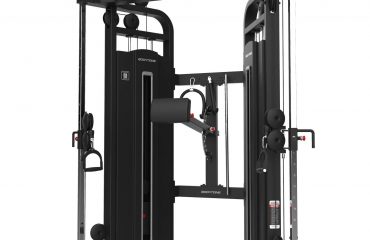
For general fitness across a broad membership, guided selectorised stations and multi-station gyms deliver the widest coverage per square metre and are the easiest to induct new members onto safely. Our strength training machines section groups these by loading system.
6. Verify quality, safety and documentation
Buy from established manufacturers and ask for the documentation rather than the marketing. You want the declaration of conformity, the use class, the assembly and maintenance manual, the parts list and the warranty terms for commercial use. Warranties written for domestic use are void on a club floor, and discovering that after a failure is an expensive way to learn it. Keep the documentation with the asset register: inspectors and insurers will ask for it.
7. Try before you commit
Where possible, use the machines before you buy them. A showroom visit, a manufacturer demonstration or a site visit to a facility running the same range will tell you more in twenty minutes than any specification sheet. Take a member of your coaching team: they will notice the adjustment that takes two hands and the pad that is uncomfortable at the third repetition.
8. Get the layout designed, not improvised
The single largest source of regret is layout, not machine choice. Supervision sightlines, circulation width, the separation of free-weight and cardio zones, flooring specification and noise transfer to neighbouring spaces all have to be resolved on paper. Our technical team produces layouts as part of the specification process, and it costs nothing to have the room checked before you commit.
Frequently asked questions
What do professional machines offer over lighter equipment?
They are built for continuous use: stronger frames, better ergonomics, wider adjustment, higher safety margins and a spare parts chain. They also allow a much wider exercise range and more precise targeting of muscle groups, which is what makes programming possible.
New or second-hand?
New equipment comes with a full warranty and a known service life. Second-hand can be a reasonable option on a constrained budget, provided you inspect the frame, cables, bearings and upholstery, verify the use class, and confirm that spare parts are still available for the model. A second-hand machine with no parts chain is a short-term purchase.
How many stations does a facility need?
Size the floor from expected peak occupancy rather than membership. The number of stations follows from the number of people training at your busiest hour and from the session format you programme. We can model this from your figures.
How long does professional equipment last?
High-quality professional equipment typically lasts five to ten years or more with proper maintenance, and the frames often outlast that considerably. The variables are traffic, maintenance discipline and the availability of consumable parts.
How should machines be cleaned and maintained?
Follow the manufacturer instructions. In general, wipe down regularly with a clean damp cloth to remove sweat and residue, and use only cleaning products compatible with the upholstery and coatings. Check the manufacturer recommendations before introducing any chemical product, and record scheduled inspections of cables, fixings and bearings.
Specifying your equipment list
The right equipment list is the one built from your objectives, your room and your traffic, specified to class S and backed by a real parts and service chain. Send us your floor plan, your opening hours and your programme, and our technical team will return a station list, a layout and a costed proposal. Request a quote to start the specification.