How to Choose Professional Gym Equipment: 7 Criteria

Specifying strength equipment for a commercial facility is a different discipline from buying a machine you like the look of. The catalogue is wide, the technology moves, and every supplier claims the same things. What separates a good purchase from an expensive mistake is having a fixed set of criteria and applying them in the same order every time.
Below are the seven criteria that actually decide the outcome, in the order we recommend applying them. Work through them for each station on your list and the shortlist tends to write itself.
Criterion 1: the machine type
Three families cover almost every professional floor, and each solves a different problem.
Selectorised machines are the backbone of the modern commercial floor. A pulley and weight stack system guides the movement, which lets the user concentrate on technique rather than on balancing the load. A guided chest press isolates the pectorals without the balance demand of a free-weight equivalent, which is why these stations are so effective for beginners and for high-turnover floors. Our selectorised machine range is built for exactly this use.
Free weights — dumbbells, barbells and their racks — require full control from the user. That is the point: squats, deadlifts and pressing with free weights recruit the stabilising musculature that guided machines deliberately take out of the equation. A free-weight area develops coordination and balance alongside raw strength, and it is indispensable for any facility selling coached strength work.
Multi-station units combine several functions in one frame. Where floor area is severely limited, one unit can cover pressing, pulling and leg work. They adapt across ability levels and they reduce monotony by offering variety in a small footprint. The trade-off is concurrency: only one or two people can use the unit at a time, which makes them a poor fit for a busy floor. See our multi-station gyms and cable stations for the options.
Criterion 2: materials and build quality
Durability comes down to material choices. Stainless steel is generally preferred over painted mild steel where humidity is a factor, because it resists corrosion and wear far better; a wet area, a poolside gym or an outdoor-adjacent installation makes that difference decisive.
Build quality is also a safety matter. A bench with weak welds can fail under load, and the consequences on a commercial floor are serious. Professional equipment is tested for the forces it will see in service, and the frame section, the weld quality and the fixings are what deliver that. Ask for the specification, not the adjective.
The reference framework for indoor equipment in a supervised, multi-user facility is EN ISO 20957-1 class S. Make that the first filter, before any discussion of finish or colour.
Criterion 3: fit to your training goals
Define what the facility sells before choosing what it buys. A programme built on hypertrophy needs adjustable dumbbells, benches and loaded stations. A programme built on tone and definition benefits from cable stations, which give the widest exercise catalogue per square metre. A programme built on weight management combines strength work with cardio equipment, since sessions that combine both are more effective for body composition than either alone.
Match the equipment to the sessions you actually programme and you avoid the most common and most expensive error: buying stations that go unused because they do not belong to any session on the timetable.
Criterion 4: adjustment range and user fit
A station only works for the members who fit it. Seat height, back pad position, footplate position and handle options determine whether a shorter and a taller member can both achieve a full range without compensating.
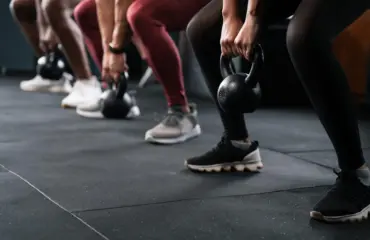
Beginners are also better served by equipment appropriate to their level. Simple tools — kettlebells, resistance bands, a straightforward selectorised station — build confidence faster than a complex multi-function unit. Advanced users want progressive load and finer increments. A floor that serves both needs equipment at both ends, which is a specification question, not a budget question.
Criterion 5: safety and comfort features
Safety stops, adjustable spotter arms on benches, protective padding, non-slip handles and upholstered seats are not extras on a commercial floor. Adjustable safety supports let a member work close to their limit without a spotter present, which matters enormously in a facility where supervision is intermittent.
Comfort belongs here too. Memory-foam or high-density seat padding makes long sessions tolerable, and a well-finished machine contributes to an environment members want to return to. Adherence is an operational metric, and the equipment influences it.
Criterion 6: connectivity and data
Many current machines integrate Bluetooth or Wi-Fi and connect to fitness applications. Console dashboards can track repetitions, load and heart rate in real time, and members can export or share their sessions.
For an operator, the question is whether you will use the data. Connected equipment supports coaching, retention programmes and personalised progressions, but it also adds a maintenance surface and a software dependency. Specify connectivity where a programme depends on it, not because the console has a screen.
Criterion 7: total cost of ownership and warranty
Price alone is a poor guide. A high-grade steel bench costs more and absorbs years of intensive use; a lightweight alternative may need replacing within a fraction of that time. The number that matters is cost over the service life, including spare parts and downtime.
Warranty is the manufacturer telling you what they expect. A long frame warranty signals confidence in the build; a one-year warranty signals the opposite. Read what is actually covered — frame, moving parts, upholstery and cables are usually covered differently. Our steel structures carry a warranty of up to 20 years, and our stainless steel structures a lifetime warranty.
Finally, weigh the supplier as well as the machine. Established manufacturers invest in development and hold spare-part stock; that is worth more over ten years than a lower line on the first invoice.
Frequently asked questions
In what order should these criteria be applied?
Machine type and standard compliance first, because they eliminate most of the catalogue. Goal fit and adjustment next. Features, warranty and cost last, as tie-breakers between shortlisted options.
Is stainless steel always the right choice?
Not always, but it is the right choice wherever humidity is present: pool halls, spa areas, coastal sites and any partly open installation.
How much should be spent on free weights versus machines?
It depends on supervision. A largely self-directed floor leans toward guided stations. A coached facility can put more of the budget into free weights, since technique is supervised. Our fitness accessories range covers the free-weight side.
Applying the criteria to your project
The seven criteria narrow the field, but the final list depends on your floor plan, your peak occupancy and the sessions you programme. Send us those and we will return a costed configuration built against these criteria. Request a quote.