Choosing a commercial strength equipment brand: what service really covers
La musculation développe la force, la masse musculaire et la densité osseuse, avec des effets documentés sur la santé métabolique et la prévention des chutes. La progression repose sur la surcharge progressive, la récupération et la régularité. Le matériel, charges guidées ou charges libres, se choisit selon le niveau et l'encadrement disponible.
Fitting out a commercial gym is a procurement decision, not a shopping trip. The machines you install will be used by hundreds of members every week, in a room you cannot close for a fortnight when a cable frays. So the questions that decide the project are rarely about upholstery colour. They are: who actually builds this frame, and what happens on the morning something stops working?
Light In Fitness has equipped professional operators since 2013: clubs, cross-training boxes, hotels, campsites, local authorities, schools, rehabilitation centres and armed forces. This guide sets out how to read a strength equipment offer the way a buyer should read it, rather than the way a brochure invites you to.
What professional strength equipment means on a commercial floor
The dividing line is not the badge on the shroud, it is the standard the machine was built and tested against. For indoor stationary training equipment the reference is EN ISO 20957-1 class S: equipment intended for use in a supervised commercial facility, where the load is continuous, the users are unknown to the operator and the weight stack is cycled thousands of times a month.
One point is regularly misread in tender documents. Class I is a professional class covering inclusive access, designed so that a user with reduced mobility can transfer onto or approach the station. It is not an intensity tier sitting above class S. The two classes answer different questions, and a specification that treats one as an upgrade of the other will produce a floor that satisfies neither the inclusion brief nor the durability brief.
Everything else follows from that choice: steel section, weld quality, bearing type, guide rods, cable diameter, pulley material, and the upholstery foam density that decides whether a bench still looks presentable after two seasons of chalk and sweat.
Where the cost really sits: frame, moving parts, contact surfaces
A strength machine is three products in one. The frame is a structural item that should outlive the business plan. The moving assembly, cables, bushings, bearings and pivots, is a wear system with a predictable service life. The contact surfaces, pads, grips and handles, are consumables that will be replaced several times during the life of the frame.
Two quotations that look identical on line price can differ enormously once you separate those three layers. The useful comparison is not the invoice, it is the cost of keeping the station in service. Ask for cable references, bushing references and pad references before you sign, not after. A supplier who can hand you that list in a working week is a supplier who stocks the parts.
Selectorised, plate-loaded or free weights: matching the mix to your members
The right mix is a function of who walks through the door and how much supervision you can provide.
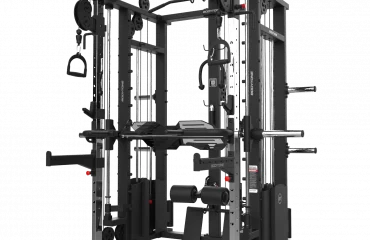
Selectorised stations are the backbone of a mixed-membership club. Guided paths, a clear starting position and a pin that anyone can move mean a beginner can train safely with minimal coaching, and throughput at peak hour stays high. Browse the selectorised machines range to see how a circuit is normally assembled.
Plate-loaded machines suit strength-oriented rooms, performance clubs and facilities where members already handle loaded barbells. The resistance curve is more demanding, the loading ritual is part of the appeal, and the absence of a weight stack reduces the number of wear parts. The plate-loaded machines category covers converging presses, rows and leg stations.
Racks, benches and free weights remain the highest-value square metres in most facilities, provided the flooring and the supervision are right. In practice, most successful floors run all three families, weighted towards whichever audience actually pays the subscriptions. The full strength training machines catalogue is organised so that a mixed floor can be built from one coherent product family rather than assembled from unrelated sources.
Brand is a promise. Service is the proof.
Every manufacturer photographs well. What separates them is what happens between month twelve and month sixty.
Ask a supplier the awkward questions before the order, because the answers are cheap then and expensive later. Are spare parts held in stock, or ordered per incident? Are technical drawings and exploded views available to your own maintenance staff? Can upholstery be re-covered on site, or does the machine leave the floor? Is there a documented diagnosis route before an engineer is dispatched? Who is responsible for installation, and is the equipment commissioned and checked against the manufacturer instructions before members use it?
A brand that answers all five clearly is worth more than a brand that shaves a percentage off the line price. Downtime on a leg press at seven in the evening costs more than the discount you negotiated.
Planning the room before you plan the order
Layout is where equipment budgets are quietly wasted. Circulation lanes that are too narrow force members to walk through a working station. Machines pushed against a wall for tidiness make maintenance access impossible. Loading zones placed away from the plate storage create a permanent clutter problem no cleaning schedule will fix.
Work from the footprint drawings and the required user space around each station, group by movement pattern rather than by supplier catalogue order, keep free-weight and platform work away from the beginner circuit, and reserve the flooring specification for the zones that actually need shock absorption. A floor plan agreed before the order avoids the far more expensive exercise of rearranging a delivered room.
Total cost of ownership across the life of the floor
Model the decision over the life of the installation, not over the opening month. The elements that move the total are the cost and availability of wear parts, the ease of on-site repair, the resale or redeployment value of the frames, and the impact of downtime on member retention. A machine that is out of service during peak hours is a machine your members are learning to live without.
Warranty terms deserve the same scrutiny. Read what is covered, for how long, and above all what the process is: a warranty that requires the machine to be shipped back is a very different commitment from one that sends a part to your door.
Frequently asked questions
Do I really need class S equipment for a small facility?
Yes. The class relates to the context of use, not to the size of the room. As soon as the equipment is placed in a supervised commercial facility open to members, EN ISO 20957-1 class S is the applicable reference, whether you have eight stations or eighty.
How do I compare two quotations that look identical?
Separate frame, wear parts and consumables, then ask both suppliers for spare part references, delivery terms for those parts, and the installation and commissioning scope. Differences that were invisible on the price line usually become obvious within three questions.
Can I mix several brands on the same floor?
You can, and many operators do. Be aware that you multiply the number of parts channels, the number of technical contacts and the number of maintenance procedures your staff must know. Mixing is a deliberate trade-off, not a default.
What should a supplier provide before I sign?
Footprint drawings and required user space for each station, the declared standard and class, the spare parts list with references, the installation scope, and the warranty process in writing. If any of those is missing, the offer is not yet comparable.
How often should strength equipment be inspected?
Follow the manufacturer instructions supplied with each machine, and record every check. Cables, fixings, pivots and safety stops are the items that justify a routine visual inspection, with a fuller technical inspection at the interval the manufacturer specifies.
Build the floor around the service, not the catalogue
Brand tells you what a manufacturer intends to be. Service tells you what it is. For a professional operator, the correct order of questions is: which standard and class, which wear parts and how they are supplied, which layout, and only then which finish.
Send us your room dimensions, your membership profile and your opening constraints, and we will come back with a configuration and a costed proposal. Request a quote and we will work from your plan.