Children's Fitness Trails: What They Are and Which Types Exist
Un parcours santé pour enfants associe modules de franchissement, d'équilibre et de suspension, dimensionnés par tranche d'âge. Il relève de la série EN 1176 lorsqu'il s'agit d'équipements de jeu, et non de l'EN 16630 réservée aux utilisateurs de plus de 1 400 millimètres. Le sol de réception se calibre sur la hauteur de chute libre de chaque module.
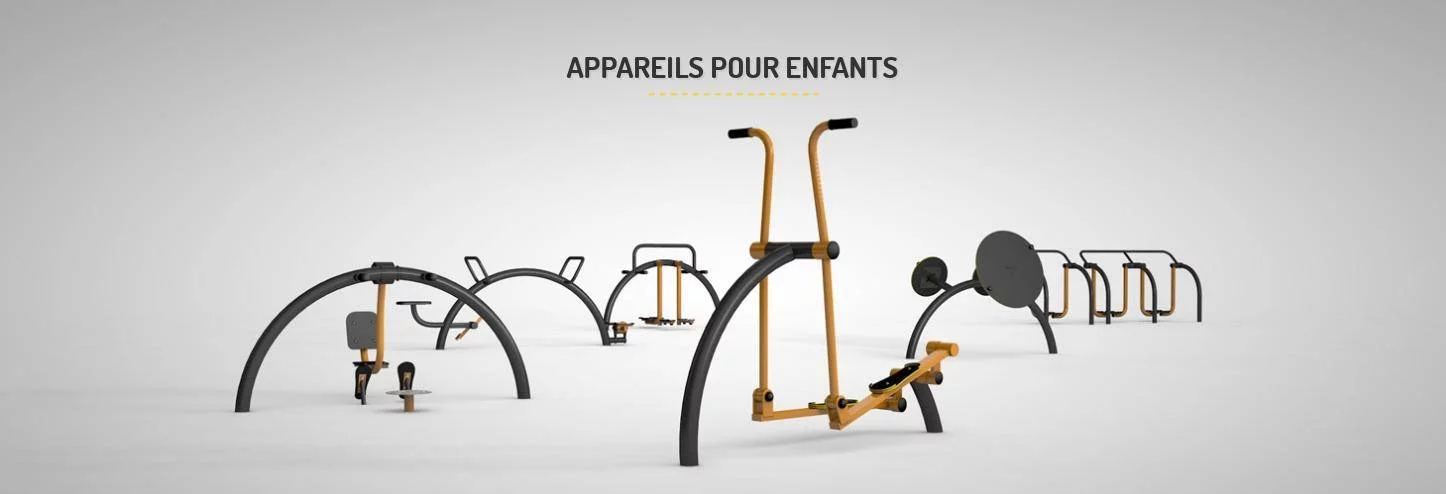
Ask a facilities manager, a head teacher or a campsite owner what should go into a new play area, suggest a children’s fitness trail, and the first reply is almost always a question: what exactly is that? The reaction is fair enough. A generation ago, a play area meant a creaking swing, a rusting slide and a sandpit nobody cleaned.
Modern recreational installations are a different discipline altogether. They are a proving ground for playground designers, who combine an open brief on form with a working knowledge of how young children develop. If the term is still unfamiliar to you, this guide sets out what a children’s fitness trail is, which types exist, what equipment goes on one, and which European standards govern the whole thing.
What is a children’s fitness trail?
Start from this: no two children’s fitness trails are alike. These installations are built around a high degree of customisation, driven by the needs and expectations of the people who will use them. The number of modules that can be mounted on a single layout is very large. The secret, as in cooking, is not quantity but the right combination of ingredients.
The elements of a fitness trail are designed to support the healthy development of children and teenagers while giving them a genuinely memorable experience. They can be play modules or fitness modules, or a mix of both. The only real limits when creating such a zone are the budget and the designer’s imagination.
In procurement terms, a children’s fitness trail is a defined activity zone, usually inside a wider play area, where a child plays and develops physically at the same time. That definition matters because it determines which standard applies to which module, and therefore what your safety file has to contain.
Types of children’s fitness trails
Most projects aim for universality. Designers select playground equipment so that the result works for several age groups at once. Whatever a child’s fitness level, skill or interests, there should be something on the trail for them.
Increasingly, though, specialised versions are commissioned: layouts aimed at a specific user group, or built from modules selected around a shared theme. The three most common families are the sensory trail, the motor-skills trail and the running trail.
Sensory trails
Among the various types of children’s fitness trail, the ones built around sensory stimulation stand out clearly. A sensory trail is generally made up of elements that stimulate the sensory receptors in the child’s hands and feet. That effect is achieved through materials with varied textures and properties, some of them deliberately unusual.
The stimulus can come from play items such as sensory stones, or from the ground surface itself. Sand, gravel, rubber tiles, synthetic chippings or natural bark are all commonly used to build this kind of trail. That variety lets a young child learn the properties of different substances and build up their sensitivity and their ability to respond to different types of sensory input.
Shape matters just as much on a sensory trail. Components are deliberately made unusual, so that they arouse curiosity and make a child want to take a closer look. Touch, after all, is the basic tool a small child uses to learn about and explore the world.
Sensory modules also turn out to be very useful for developing balance and motor coordination in younger users. Some of them can help correct posture defects or provide a simple foot massage.
Beyond touch, there are trails that develop the other senses, particularly sight, which is addressed mainly through highly coloured objects reproduced in fine detail. Hearing is addressed through musical trail elements: various types of instruments and sound devices designed for the play area.
Motor-skills and obstacle trails
This is another extremely broad category of children’s fitness trail, a kind of obstacle course that asks for real physical condition. It is worth making sure that the modules aimed at motor development are as varied as possible and matched to the abilities of different age groups. Every child should find a challenge suited to them in such a zone, and be able to compete on it with their peers, building new social relationships in the process.
This is the family that overlaps most closely with children’s outdoor fitness equipment, where climbing, hanging and traversing modules are sized specifically for younger users rather than scaled down from adult stations.
Running trails
A running trail is relatively rare. As the name suggests, it is a designated area laid out for running. To stop it becoming monotonous, the routes for these small marathon runners are varied with different surfaces and with obstacles to be cleared or slalomed around.
The point of a running trail is, of course, competition. Who will finish the course fastest? Who will even reach the finish line before exhaustion sets in? Building this kind of installation can help spot genuine sporting talent early.
What goes on a children’s fitness trail
When a playground manufacturer proposes equipment for a fitness trail, the modules most often offered are slaloms, obstacle sequences, platforms, skill games, advanced rope elements, large-format climbing walls and classic gymnastic devices in the form of ladders, bars and handrails.
In practice, a workable specification mixes three registers: modules that ask for strength and grip, modules that ask for balance and coordination, and modules that simply invite exploration. A structure such as the Cube Maxi timber play structure can anchor the layout, with lighter balance and traverse elements arranged around it.
Standards: EN 1176, EN 1177 and EN 16630
A children’s fitness trail is play equipment, and it is covered by the EN 1176 series, EN 1176-1 setting the general safety requirements for the equipment itself. It is not covered by EN 16630, which applies to permanently installed outdoor fitness equipment intended for users taller than 1,400 millimetres. Applying an adult outdoor fitness standard to a children’s module is a specification error, and one that surfaces quickly during an inspection.
The surfacing is governed separately, by EN 1177, which sets out how impact-attenuating surfaces are tested and how the critical fall height is determined. The impact area under each module is calibrated on that module’s free height of fall, not on a single figure applied across the whole zone. Where the trail mixes low balance elements with taller climbing structures, the playground surfacing specification will vary from one part of the layout to another.
Keeping the two standards apart is the single most useful thing a specifier can do at tender stage: EN 1176-1 for the equipment, EN 1177 for the ground beneath it, and never EN 16630 on a children’s module.
Why the benefits are hard to argue with
The advantages of a well-designed children’s fitness trail are difficult to dispute. A responsible manufacturer makes sure that the modules placed in these zones are well regarded by child psychologists, teachers, parents and, not least, by the children themselves.
The greatest benefit of these educational and recreational installations is that they look after the healthy development of children. Exactly how that happens, and which aspects of a child’s functioning can be expected to improve, depends on the specific trail: a sensory layout and a running layout are answering different questions.
Frequently asked questions
Which standard applies to a children’s fitness trail?
EN 1176-1 for the play equipment and EN 1177 for the impact-attenuating surfacing. EN 16630 covers outdoor fitness equipment for users over 1,400 millimetres and does not apply to children’s modules.
How much space does a trail need?
There is no single figure. The footprint is the sum of each module’s own dimensions plus its impact area, which is derived from its free height of fall. That calculation is done module by module at design stage, on the actual layout.
Can a fitness trail be mixed with a conventional play area?
Yes, and most projects do exactly that. The trail is treated as a defined zone within the wider play area, with its own circulation and its own surfacing specification where the fall heights differ.
Sensory, motor-skills or running: which type should we choose?
Most public projects go for a universal layout that serves several age groups. A specialised trail makes sense when the operator has a clear user profile, for example a school working on sensory development or a club scouting for athletic potential.
In summary
It is hard to give one detailed, exhaustive answer to the question of what a children’s fitness trail is. The general definition can only be this: a separate space, usually within a play area, where a child can play and develop healthily at the same time. The details depend on the creativity the designer brings to that particular trail.
The emphasis usually falls on universality and on adapting the zone to the widest possible range of potential users, but a trend towards specialisation is also emerging. It shows up in installations that develop one selected area of a user’s ability: the sensory trail concentrates on the child’s senses, while the running trail is an investment in future distance runners.
In future, as knowledge of how children learn about the world and build individual skills continues to feed into design, trails will be created that today’s designers have not even imagined. The field of play area design is developing quickly, driven by people asking how best to look after the development of the next generation.
If you are scoping a children’s fitness trail for a municipality, a school, a campsite or a residential development, our team can size the modules and the surfacing against your actual plot and your age brackets. Request a quote and we will come back with a layout and a specification.
Sources et références
- Décret n° 96-1136 du 18 décembre 1996 – prescriptions de sécurité relatives aux aires collectives de jeux (Légifrance)
- NF EN 1176-1 – Équipements et sols d’aires de jeux, partie 1 : exigences de sécurité et méthodes d’essai générales (AFNOR)
- NF EN 1177 – revêtements de surface amortissants : détermination de la hauteur de chute critique (AFNOR)