Arm training in a commercial gym: exercises, equipment and programming
Arm training in a commercial gym: exercises, equipment and programming
Arm training is the request operators hear most often and the one they plan for least. Members ask for biceps and triceps work, then queue at the two cable stations while an entire rack of dumbbells sits unused because nobody explained what to do with it. For a club manager, an armed forces training room, a school, a rehabilitation centre or a hotel fitness suite, the practical question is not which exercise builds the biggest arms but which pieces of equipment a coherent arm programme actually requires, how many of each, and where they go on the floor. This guide answers that from the operator side.
The anatomy that drives the equipment list
The upper arm has two functional groups. The biceps brachii sits at the front and flexes the elbow while also supinating the forearm, which is why grip orientation changes what a curl trains. The triceps brachii sits at the back, extends the elbow and accounts for the larger share of upper arm mass, which is why a facility that offers only curling stations delivers less than half of what members came for. The brachialis and the forearm flexors work alongside both groups, and the tendons that connect them to the elbow and shoulder are the tissues that fail first when load is added faster than technique improves.
Two consequences follow for the equipment list. First, the range of loads matters more than the top load: elbow flexors and extensors progress in small increments, so a set with genuine light and mid range pairs is used far more than one that jumps in large steps. Second, the same movements have to be available seated, standing and lying, which means benches are part of the arm specification and not an accessory to it.
Biceps work and what it needs on the floor
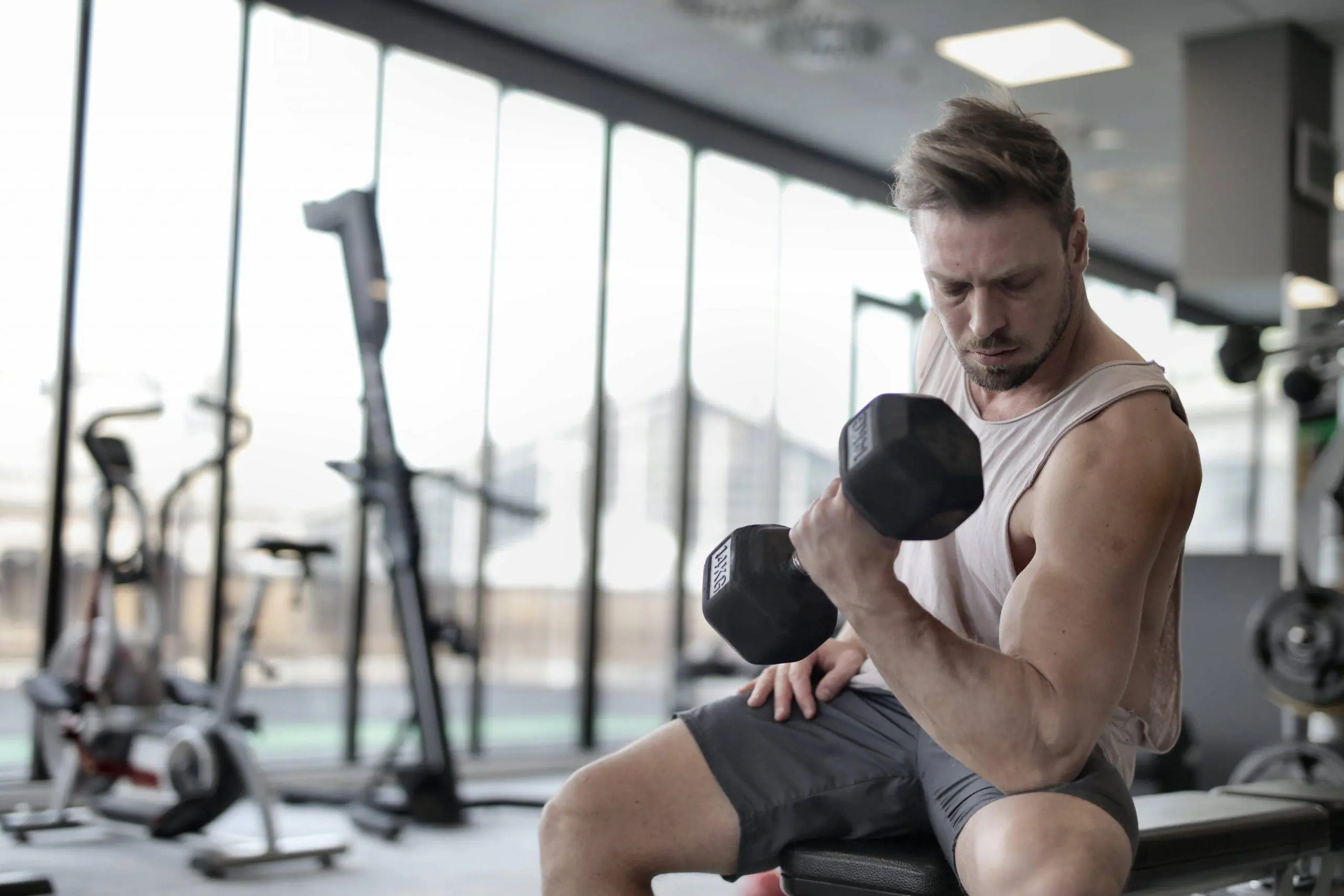
The dumbbell curl is the backbone of any arm offering. The user stands with the arms extended alongside the body and flexes the elbow to bring the load up, keeping the trunk still. Changing the grip changes the emphasis: a supinated grip loads the biceps most directly, a neutral hammer grip shifts work onto the brachialis and the forearm, and a pronated reverse curl brings in the wrist extensors. All three variants run from the same pair of dumbbells, which is the strongest argument for a complete range rather than a handful of pairs.
Preacher and incline variants remove the swing that untrained members use to move a load they cannot control. Both need a bench, and the incline version needs an adjustable one. Cable work adds constant tension through the whole range and is the variant most requested by experienced members, so a cable station in or near the free weight zone earns its footprint. Barbell curls remain useful for heavier sets and for progression tracking, since the increments are known.
Pull ups and chin ups belong in the arm section of a programme but they are a back exercise first. A supinated chin up recruits the biceps heavily alongside the latissimus dorsi; a pronated pull up shifts the work towards the back and shoulders rather than the triceps. Presenting either one as a triceps exercise, as some training articles still do, sends members to the wrong movement for the result they want.
Triceps work and what it needs on the floor
Overhead extensions are the classic mass builder for the long head. The user raises the arms overhead and lowers the load behind the head by bending the elbows under control, then extends. It can be done with a dumbbell, with an EZ bar or on a cable, and the seated version with back support is the one to steer beginners towards because it removes the lumbar arch that appears as soon as fatigue sets in.
Close grip push ups, with the hands under the shoulders, are the zero equipment option and belong in any circuit or induction programme. Bench dips load the triceps heavily but compress the shoulder in a position many members cannot hold safely, so a parallel bar dip station or an assisted dip machine is the better provision when the space allows. Cable pushdowns complete the picture and are, in most facilities, the single busiest arm station at peak hour, which is worth remembering when specifying how many cable positions a room needs.
Programming: frequency, volume and progression
Direct arm work two to three times a week is enough for most members, and the recovery between sessions is where the adaptation happens. Beyond that frequency the limiting factor is tendon tolerance rather than muscular fatigue, and the injuries that follow are the slow, nagging kind that end memberships. Volume should be enough to be a real stimulus and no more; the practical marker on the floor is technique, since the first repetition performed with trunk swing is the point at which the set stopped training the arm.
Progression comes from varying the exercises, the grips and the tempo, and from adding load in small steps over weeks rather than sessions. For an operator this translates into one requirement: the equipment has to allow small increments and several grip options, otherwise members plateau and the induction programme runs out of road after a month. A complete dumbbell range, an adjustable bench and a cable station cover almost every arm progression a general facility will ever need.
Balance: why an arm zone is never only an arm zone
Building a room around arm training alone produces the imbalance every coach recognises and every member eventually complains about. Arm work is an accessory to a full body programme, not a substitute for one, and the facilities where members stay are the ones where the arm stations sit inside a coherent floor: lower body, pushing, pulling, then the isolation work that finishes the session. Nutrition and recovery matter as much as the training itself, but they belong to the coaching offer rather than to the equipment specification, and an operator should be careful about how supplement advice is presented on the premises.
Specifying the zone
A workable arm and accessory zone in a commercial facility comes down to four items. A complete dumbbell range with its rack, since almost every arm movement starts there; choosing it well is a subject in itself, covered in our guide to choosing dumbbells for a commercial gym. Adjustable and flat benches in sufficient number, because incline and preacher variants are the ones that keep technique honest, and the weight bench range is built for exactly this use. At least one cable position with a straight bar, a rope and a stirrup handle. And a bar or dip station for bodyweight work. All of it must be built to EN ISO 20957-1 class S, the professional standard for indoor training equipment in facilities open to the public.
Frequently asked questions
How many dumbbell pairs does an arm zone really need? Enough to cover the light and mid range without gaps, and duplicated pairs where the traffic is. Extending the heavy end helps a handful of members; completing the middle helps everyone.
Cable station or free weights for triceps? Both, if the space allows. Cables are the busiest station at peak hour and the easiest to supervise; free weights give the overhead work that cables do poorly in a low ceiling room.
Can arm training be programmed for a hotel or campsite gym with no staff? Yes, with a fixed dumbbell range, one adjustable bench and a clear wall panel showing three curl and three extension variants. Avoid anything that requires collars to be tightened.
What about rehabilitation settings? The light end of the range becomes the working range, and the increments have to be small. Specify the set from the bottom up rather than from the top down.
Getting the zone quoted
Tell us the type of facility, the peak attendance and the surface available, and we will size the dumbbell range, the benches, the cable positions and the flooring as one package rather than four separate purchases. Our professional dumbbell ranges are quoted with their racks, and benches and cable stations are proposed to match the traffic you describe. Send the room dimensions and the intended use through the quotation request form and you will receive a costed proposal for the whole zone.