Rowing Ergometer for Professional Endurance Training
Le rameur professionnel sollicite environ 90 % de la masse musculaire sur un mouvement sans impact articulaire. La résistance à air monte proportionnellement à l'effort, ce qui convient à l'entraînement en intervalles comme en endurance. C'est l'un des postes cardio les plus polyvalents d'un plateau.
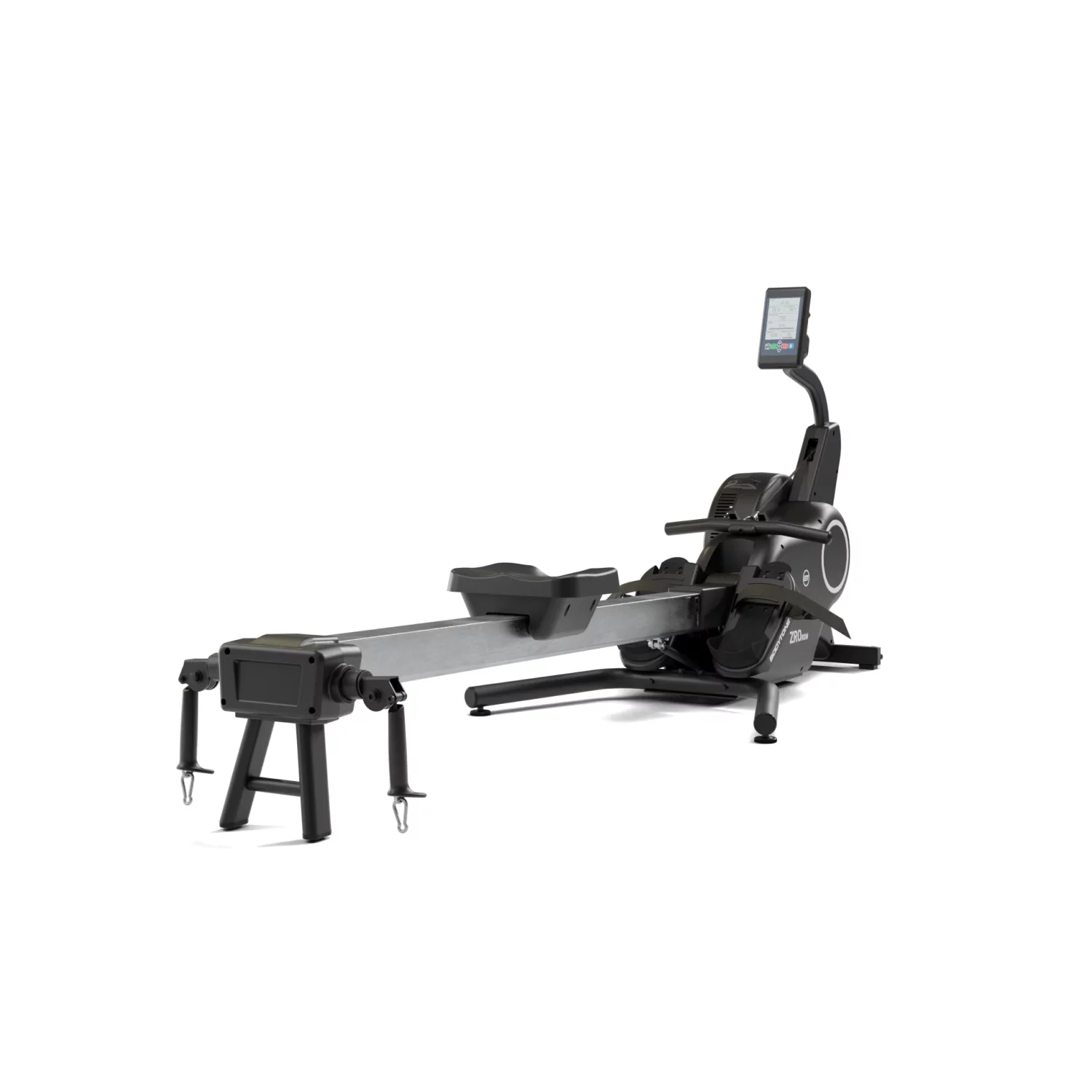
The rowing ergometer recruits close to 90% of the body muscle mass on a movement that carries no joint impact. That combination is what makes it one of the most versatile stations on a commercial cardio floor: it delivers a full-body endurance stimulus, it scales from a beginner intake session to interval work at competition intensity, and it puts no load through the knees and ankles that a treadmill inevitably does. Light In Fitness supplies rowing ergometers for gyms, clubs, hotels, armed forces and rehabilitation centres.
How the rowing stroke works on an ergometer
The athlete sits on a sliding seat, places the feet on the footplates and pulls a handle attached to a strap or chain. The stroke is a chain of movements rather than an arm exercise: the legs drive first and provide most of the power, the trunk swings open, and only then do the arms finish the pull. The recovery reverses that order. Coached properly, the sequence is what separates an effective rowing session from a shoulder and lower-back problem, which is why an intake briefing on technique is worth building into your onboarding process.
Which muscles the ergometer trains
Rowing is often filed under upper-body work, and that is the most common misconception about the machine. The legs supply the majority of the power on each stroke, through the quadriceps, glutes and hamstrings. The posterior chain, the mid-back, the lats and the trunk stabilisers handle the transfer, and the arms and grip finish the movement. The result is a whole-body endurance stimulus in a single station, which is why the ergometer earns its place even on floors where space is scarce.
Programming endurance work on the ergometer
Air resistance loads in proportion to the effort applied, so the same machine covers the whole range of endurance work without any change of setting. Three formats cover most commercial needs:
- Steady-state: 20 to 40 minutes at a conversational rate, the base of any aerobic build and the format that suits deconditioned members and return-to-activity programmes.
- Intervals: short repeats with fixed rest, where the proportional resistance lets the athlete express maximum power without a machine adjustment between efforts.
- Timed test pieces: fixed distances that give members a repeatable benchmark and give your coaching team an objective progress marker.
Because the ergometer records distance, pace and stroke rate, it also gives a facility something a free-weight station cannot: a measurable output that members can track from one session to the next.
Choosing an ergometer for a commercial floor
For a gym or a box, air resistance on a reinforced chassis is the working standard. Look at the wear parts before anything else – strap or chain, monorail and seat carriage bearings decide the real cost of a fleet in continuous use. Check the footprint including the rearward travel of the seat, and check whether the model stores upright if your floor is tight. For hotel and residential cardio suites, magnetic resistance is the quieter option; for premium studios, water resistance is chosen for the feel and the sound of the stroke.
Frequently asked questions
Is the rowing ergometer an upper-body machine?
No. The legs supply most of the power on each stroke; the back and trunk transfer it and the arms finish it. It is a whole-body endurance station, not an arm exercise.
Is rowing suitable for deconditioned members?
Yes, provided the technique is coached. The seated position and the absence of joint impact make it one of the more accessible cardio stations, which is why it is widely used in rehabilitation settings.
How many rowing ergometers should a facility plan for?
A standard cardio zone works with one ergometer for every three to four cardio stations. A box that programmes sessions in waves lines up as many ergometers as there are athletes per wave.
Browse the professional rowing machine range and the Xebex air cardio equipment, or request a quote for your cardio floor.