What Are the Obstacles on a Military Obstacle Course?
The classic military obstacle course is built around twenty obstacles. Ten of them come up again and again: the climbing wall, the balance beam, the ditch, the horizontal ladder, the cargo net, the smooth climbing rope, the tunnels, the inclined boards, the drop jump and the hurdle crossing. Together they test strength, endurance, agility and nerve. The same vocabulary now drives a whole civilian market, from OCR races to indoor Ninja rigs, and it is what most clubs, schools and armed forces units are actually asking for when they specify an obstacle installation.
The obstacles and what each one measures
An obstacle course is not a random pile of structures. Each element isolates a physical quality, and a well-specified course spreads those qualities across the run rather than repeating the same demand five times.
| Obstacle | What it tests |
|---|---|
| Climbing wall | Upper-body power and explosive push |
| Balance beam | Balance and proprioception under fatigue |
| Ditch | Horizontal jump and landing control |
| Horizontal ladder | Grip endurance and shoulder transfer |
| Cargo net | Coordination and confidence at height |
| Smooth climbing rope | Pulling strength and rope technique |
| Tunnels | Crawling, orientation and composure in a confined space |
| Inclined boards | Traction and leg drive on an unstable angle |
| Drop jump | Impact absorption and landing mechanics |
| Hurdle crossing | Rhythm, speed and repeated jumping |
Natural obstacles versus built obstacles
Courses mix two families. Built obstacles – hurdles, barriers, rigs – measure speed and jumping ability under controlled, repeatable conditions. Natural obstacles – broken ground, slopes, water, mud – measure endurance and the ability to keep moving when footing is unpredictable. A third group, the obstacles that genuinely cannot be cleared alone, exists to test teamwork and the willingness to help another runner through.
For a permanent installation the built family is the one you specify and buy. The natural family is a site characteristic: it is either there or it is not, and it cannot be ordered.
From military course to civilian OCR
Obstacle course racing has turned that military grammar into a mass participation sport. Spartan Race and Tough Mudder are the best known formats internationally, and every country now has its own series. The obstacles are recognisably the same; what changes is the density, the length of the run and the level of risk the organiser is prepared to accept from an untrained field.
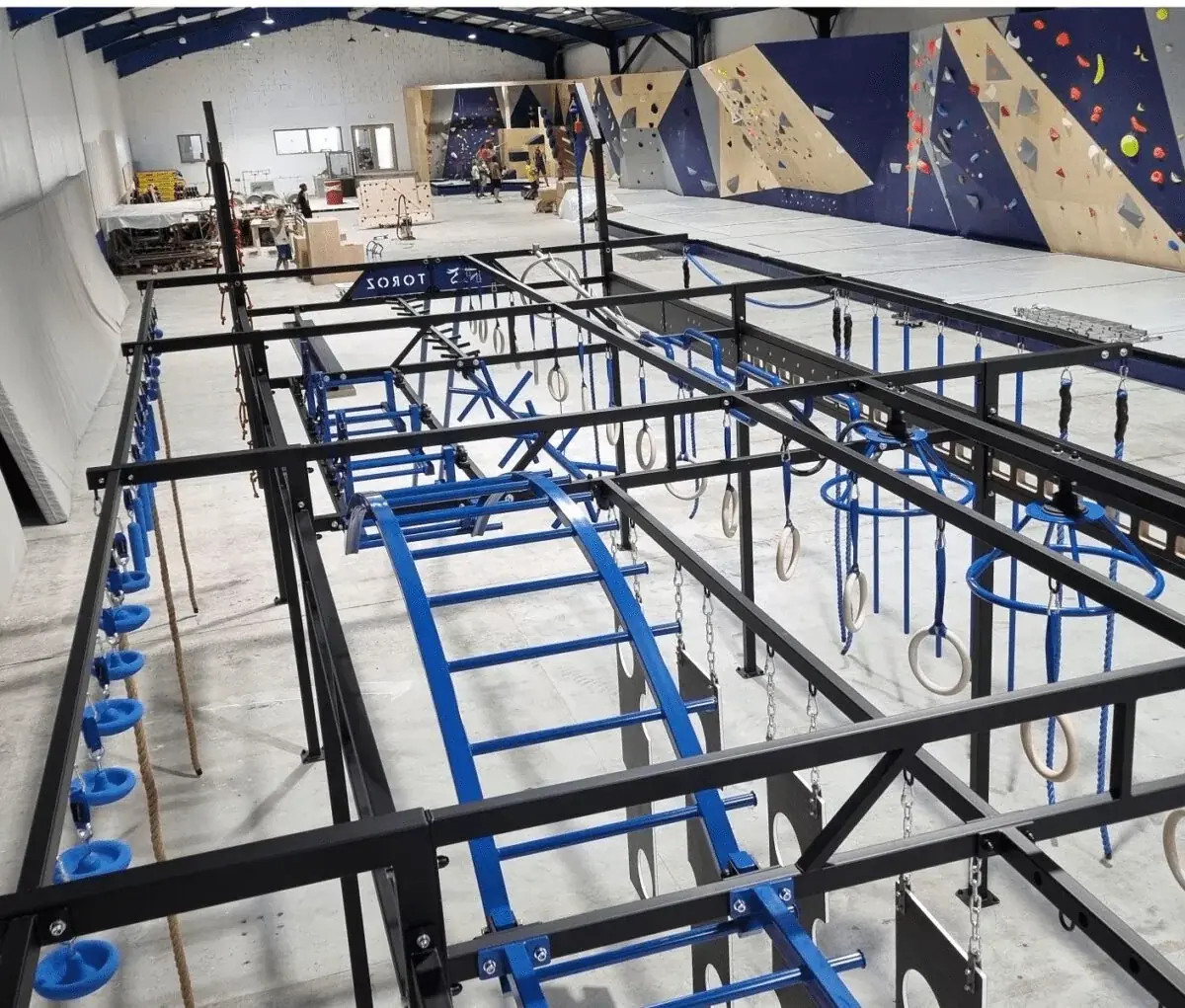
Civilian versions divide into two equipment categories that are often confused. OCR obstacle courses reproduce the running-and-clearing logic over distance. Ninja Warrior rigs compress the challenge into a short, dense sequence of suspended modules, where grip and fluidity matter more than raw power. A club that buys one expecting the other is usually disappointed within a month.
Training for the obstacles
Preparation is what separates a finish from an injury. Regular cardio work, pull-ups, burpees and swimming cover most of what the obstacles demand, and a coach shortens the process considerably by working on grip endurance and landing technique rather than general fitness. This is also why many boxes install a street workout rig alongside their obstacle equipment: bar work is the most efficient preparation for anything that has to be hung from.
Specifying a permanent installation
A permanent obstacle installation for adults, built outdoors and used without supervision, falls under EN 16630. A course built for children on a school or municipal site is a different framework: the equipment falls under EN 1176-1 and the impact-absorbing surfacing under EN 1177. The two are not interchangeable, and applying the adult standard to a children’s installation is the single most common specification error on this type of project.
Frequently asked questions
How many obstacles does an obstacle course have?
The classic military course is built around twenty obstacles. Civilian OCR courses run from ten to thirty obstacles depending on the length of the route.
What is the difference between an obstacle course and Ninja Warrior?
The military obstacle course rewards raw power and sustained endurance. Ninja Warrior rewards agility, grip and fluidity between suspended modules. Different equipment, different training, different injury profile.
Can an obstacle course be installed on a school or municipal site?
Yes. Modular structures allow a course to be built outdoors in a schoolyard, a park or a residential development, or under a covered area, provided the standard matching the intended user group is applied.
Building the course
The useful starting point is not a catalogue but a brief: who runs the course, how many at a time, on what surface, and with or without supervision. Those four answers determine the obstacle mix, the spacing and the surfacing far more than any preference for a particular module. Request a quote with your site dimensions and user profile and the layout can be costed as a whole.
Réalisations documentées
- Cage street workout ultime, Carcassonne – armée française
- Cage street workout ultime, Tahiti – armée française, Polynésie
- Cage SP Max, centre EPIDE de Combrée – établissement public d’insertion
- Cage SP Max, lycée Saint-Bénigne de Dijon – établissement scolaire
Sources et références
- Décret n° 96-1136 du 18 décembre 1996 – prescriptions de sécurité relatives aux aires collectives de jeux (Légifrance)
- NF EN 1176-1 – Équipements et sols d’aires de jeux, partie 1 : exigences de sécurité et méthodes d’essai générales (AFNOR)
- NF EN 1177 – revêtements de surface amortissants : détermination de la hauteur de chute critique (AFNOR)
- NF EN 16630 – modules fixes d’entraînement physique de plein air : exigences de sécurité et méthodes d’essai (AFNOR)