EVA Foam Puzzle Mats for Nurseries and Schools: Safety, Comfort and Maintenance
When you specify a floor covering for a nursery or a primary school, safety and comfort come before every other criterion, and both have to survive daily cleaning. EVA foam puzzle mats are the standard answer for soft play areas, motor skills rooms and activity corners: they cushion the floor, they interlock without tools and they can be lifted and reconfigured when the room changes use. This guide covers what they do well, where their limits are, and which questions to settle before you order. Browse the full tatami and puzzle mat range to see the available formats.
Why nurseries and schools choose EVA puzzle mats
EVA foam puzzle mats are designed for the specific constraints of an education setting:
- Cushioning. They soften the floor and reduce the severity of everyday knocks and stumbles.
- Fast cleaning. The closed surface wipes down in minutes, which is what makes a shared play area workable.
- Versatility. The same mats serve a soft play room, a motor skills area and a floor-based activity corner.
Key benefits at a glance
| Benefit | What it means in practice |
|---|---|
| Impact cushioning | Absorbs shock and softens falls from standing height during play. |
| Non-slip surface | The textured top face limits slipping during active play. |
| Tool-free installation | The pieces interlock directly; no adhesive and no fixings. |
| Low-emission material | Tested for the absence of harmful substances, suitable for young children. |
1. Safety: what the mats do, and what they do not certify
EVA foam is a flexible closed-cell material. It deforms under impact and returns to shape, which is why it softens the everyday knocks that happen in a room full of moving children. The textured top face adds grip, which matters more than most specifiers expect on a smooth screed or a tiled floor.
On the regulatory side, be precise about which requirement you are meeting. Puzzle mats supplied for children’s environments are tested against the EN 71 series on toy safety, which addresses the migration of harmful substances, and carry CE marking. That is a material and chemical safety statement. It is not a fall protection performance statement.
Where a specification calls for certified impact attenuation for a defined critical fall height, typically under climbing frames or elevated play equipment, the applicable standards are EN 1176-1 for the equipment and EN 1177 for the impact-attenuating surface. That is a different product family with a different test regime, covered by our playground surfacing range. Settle which of the two requirements applies to your room before you order: a flat floor for motor skills work and a fall zone under play equipment are not the same specification.
| Safety characteristic | EVA puzzle mats |
|---|---|
| CE marking | Yes |
| Non-slip surface | Yes, high-grip texture |
| Mat thickness | 2 cm on the range described here |
| Certified critical fall height | Not applicable; use EN 1177 surfacing where required |
2. Comfort: a floor children want to sit on
Comfort is what gets children onto the floor in the first place, and floor-level work is most of what happens in a nursery. A 2 cm mat gives enough give underfoot without becoming unstable, which matters when a toddler is learning to stand and push up.
- Appropriate thickness. At 2 cm the mats cushion without the spongy feel that makes balance harder.
- Soft to the touch. The foam is pleasant on hands and bare feet, suitable for floor games, stretching and children’s yoga.
- Thermal break. The mats insulate against a cold slab, which keeps floor-level activity comfortable in winter.
Practical tip: the same mats work well in rest and nap areas, where the thermal break matters as much as the cushioning.
| Comfort criterion | EVA puzzle mats |
|---|---|
| Thickness | 2 cm, balancing cushioning and stability |
| Thermal insulation | Yes, isolates from a cold floor slab |
| Surface feel | Soft, suited to floor-based activity |
3. Cleaning and hygiene
Maintenance in a nursery has to be fast, repeatable and done by the people already on site. EVA puzzle mats are built for that:
- Non-absorbent surface. Closed-cell foam does not soak up spills, so liquids stay on the surface and wipe off.
- Simple routine. A damp cloth with a neutral detergent removes dust, marks and most spills.
- Liftable. Individual tiles can be taken up, washed separately and dried before being clipped back in, which is the real hygiene advantage over a bonded floor.
One point to be clear about: EVA foam is not an antibacterial material. What it offers is a non-porous surface that does not trap moisture or dirt, so an ordinary cleaning routine stays effective. Hygiene comes from the routine, not from the material.
| Maintenance aspect | EVA puzzle mats |
|---|---|
| Routine cleaning | Damp cloth, neutral detergent |
| Liquid resistance | Non-absorbent closed-cell surface |
| Deep cleaning | Tiles lift out individually for washing and drying |
4. Installation and reconfiguration
Puzzle mats are designed to be laid by the site team rather than a flooring contractor.
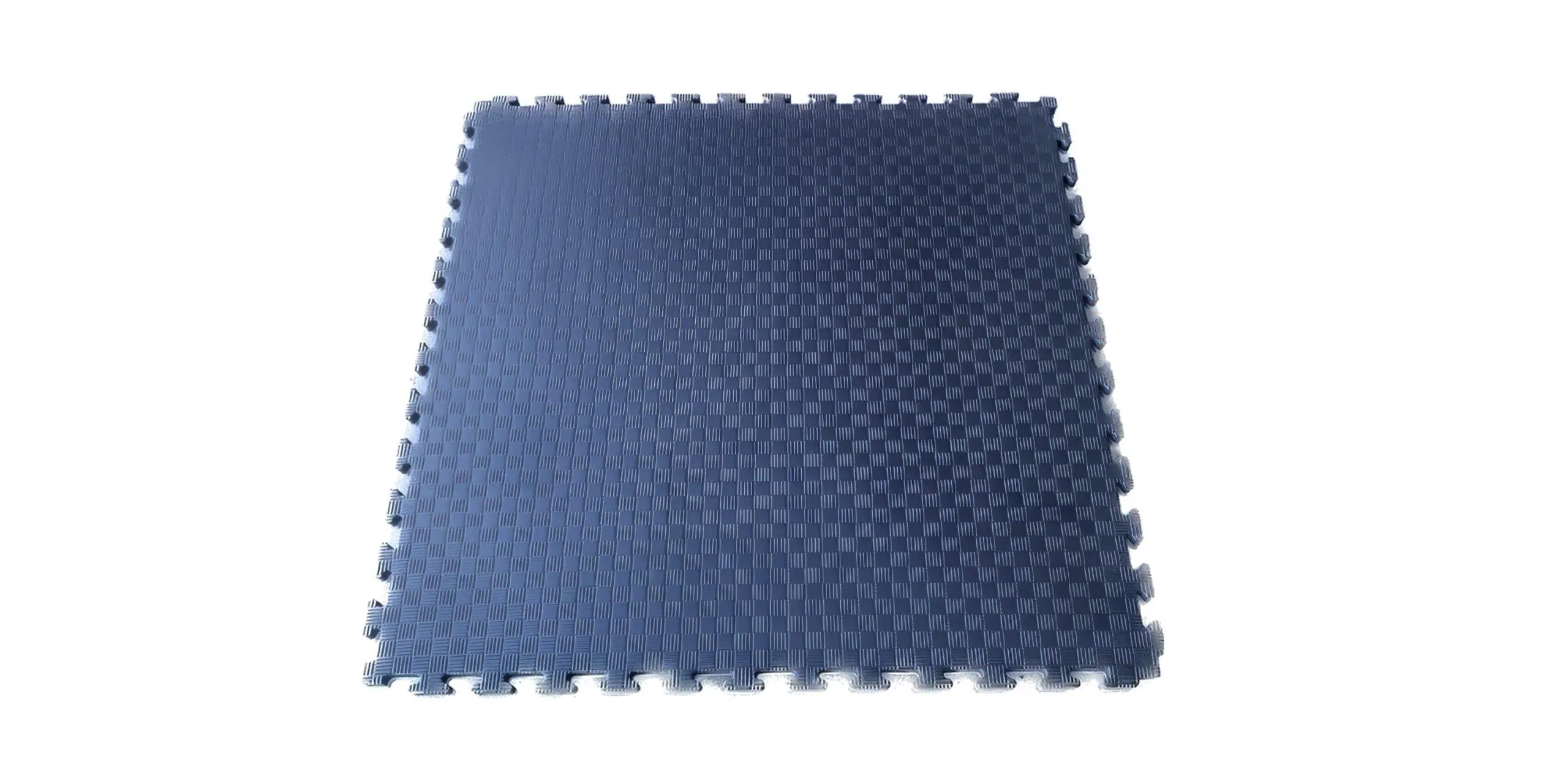
- Interlocking edges. The tiles clip together into a flat, gap-free surface.
- Modular. Add or remove tiles as the area changes; border pieces finish the perimeter cleanly.
- Easy to move and store. The mats are light and stack flat, which suits both permanent floors and areas that have to be cleared for other uses.
Practical tip: concentrate the mats where the traffic and the floor-level activity actually are, typically the motor skills room and the soft play corner, rather than spreading a thin coverage across every room. For martial arts or gymnastics rooms in a school, a thicker format such as the dojo puzzle tatami tile is the correct specification.
| Installation aspect | EVA puzzle mats |
|---|---|
| Assembly | Interlocking, no tools or adhesive |
| Modularity | Reconfigurable to different room layouts |
| Storage | Light and stackable |
Frequently asked questions
Are EVA puzzle mats enough under climbing equipment?
No. Fall zones under play equipment require surfacing tested to EN 1177 for the relevant critical fall height, with the equipment itself covered by EN 1176-1. Puzzle mats are a comfort and cushioning floor, not certified fall protection.
What thickness should we choose?
2 cm suits general nursery and classroom floor work. Rooms used for martial arts, gymnastics or throwing work need a thicker tatami format instead.
How long do they last in a school?
Service life depends on traffic, cleaning products and whether furniture is dragged across them. Because the floor is modular, worn tiles are replaced individually rather than the whole area being relaid.
Can they be laid over an existing floor?
Yes, provided the substrate is flat, dry and clean. They are laid loose over screed, tiles or existing vinyl.
Specifying your floor
Tell us the room, the activity and the age group and we will tell you whether puzzle mats are the right answer or whether your specification calls for certified impact-attenuating surfacing. Request a quote with your room dimensions to receive a tile count and a price.