
Gavin Marguerite★★★★★mars 2026
Au top, utiliser chez SPINNERS CYCLING À TOULOUSE
Les parcours santé enfants de Light In Fitness s'adressent aux municipalités, aux parcs, aux jardins publics et aux espaces scolaires. Les modules sont dimensionnés pour un usage collectif en extérieur et se posent sur un sol amortissant conforme à la norme EN 1177. Implantation, fourniture et installation sont chiffrées sur devis.
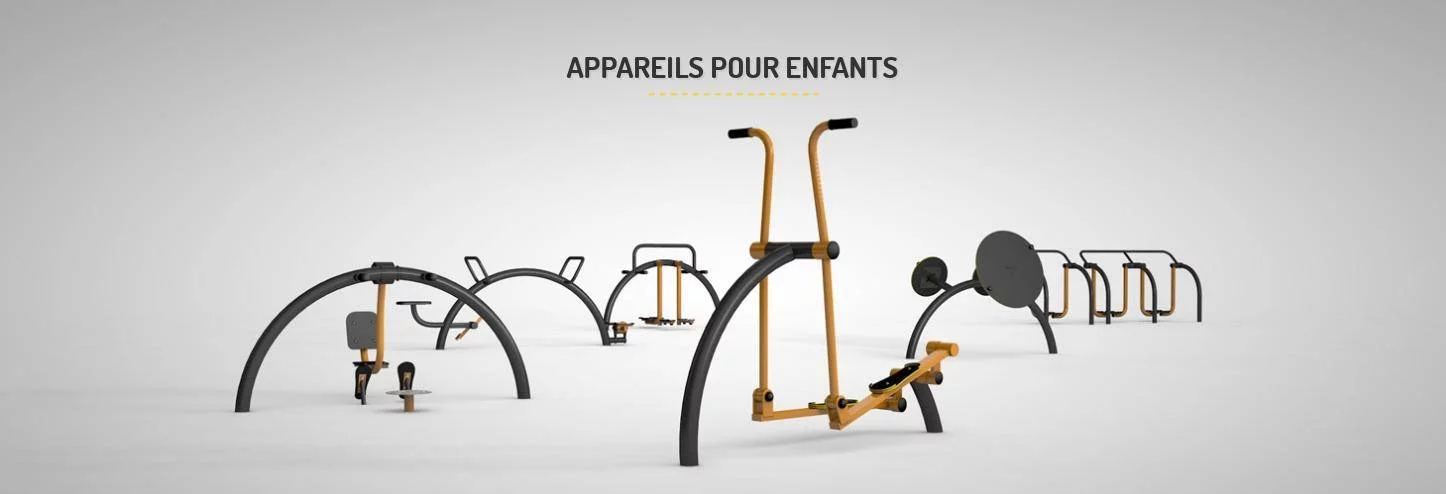
A children’s fitness trail works when it sits beside the adult equipment, not away from it. Younger users copy the adults they came with, families stay longer, and the installation becomes a meeting point rather than a set of objects nobody uses. Light In Fitness supplies children’s outdoor fitness stations to local authorities, schools, campsites, residential developments and leisure operators, with design, manufacture, installation and maintenance handled in house.
The World Health Organization recommends at least 60 minutes of moderate to vigorous physical activity a day for children and adolescents. Public equipment only contributes to that if children actually use it, and use is driven by proximity to the adults supervising them. A children’s series placed alongside an adult outdoor gym gives parents and grandparents somewhere to train while their children are within sight, which is what turns a single visit into a weekly habit.
At this age, physical activity supports psychomotor development as much as physical condition. Balance, coordination, suppleness and confidence are built on equipment that is deliberately easier than it looks, and that lets a child succeed on the first attempt.
| Age band | Station types | Design priorities |
|---|---|---|
| Approximately 3 to 6 | Low balance beams, small climbing frames, spring elements, tunnels | Very low fall heights, wide grips, no pinch points |
| Approximately 6 to 10 | Monkey bars at reduced height, low bars, agility elements, steps | Progression, clear success on first attempt, visible from the path |
| Approximately 10 to 14 | Pull up bars at reduced height, parallel bars, climbing walls, traverses | Bridge to the adult circuit, group use, durability |
| Mixed family use | Paired child and adult stations on the same movement | Side by side use, shared instruction signage |
Paired stations are the detail most often missed. A child sized pull up bar next to an adult one, or a low balance beam beside an adult balance element, produces far more use than a fenced off children’s corner, because the activity becomes something families do together.
This is the point that decides the whole compliance file. Equipment intended for children falls under EN 1176 for the equipment itself and EN 1177 for the impact attenuating surface beneath it. Permanent outdoor fitness equipment intended for adults falls under EN 16630. A site that mixes both, which is exactly what we recommend, keeps two clearly defined zones with their own surfacing, their own signage and their own inspection records.
Age labelling is not decoration. Signage stating the intended age band, together with a note that supervision remains the responsibility of the accompanying adult, is part of the operator’s file and is one of the first things an inspector looks for.
The surface is specified against the free height of fall of the equipment above it, and it is tested to EN 1177. Four options cover most sites.
| Surface | Advantages | Points to watch |
|---|---|---|
| Rubber safety tiles | Consistent performance, easy to inspect, accessible for wheels and pushchairs | Highest purchase cost, needs a prepared base |
| Wet pour rubber | Seamless, allows colour design and graphics | Installed on site, weather dependent programme |
| Bonded mulch | Natural appearance, permeable | Periodic resurfacing needed |
| Loose fill wood chips, 5 to 30 mm grade | Lowest purchase cost, natural look, compliant with EN 1177 at the stated depth | Depth must be maintained, redistributes under use, regular topping up |
Loose fill is the cheapest to buy and the most expensive to neglect. It only performs at its stated depth, so the maintenance schedule has to include raking and topping up, particularly under the landing points where it migrates fastest.
A children’s trail is a sequence, not a cluster. Distribute the stations along a route so several children can use the circuit at once without crowding a single element or getting in each other’s way, and keep every station visible from the path so that supervision is possible without following each child. Alternate demanding stations with easier ones so the route reads as a progression. Where the site allows, close the loop back to the start, which keeps the whole family in one area.
Stations can be added or removed from the layout as budgets allow, which makes phased delivery straightforward: install the route and the core stations first, extend it in a later financial year.
Equipment is manufactured from galvanised steel with a powder coat finish for inland sites, and in 316L stainless steel where exposure to salt or a known vandalism problem justifies it. Every structure is new and manufactured in our own production unit, in series or as a single unit, so bespoke layouts, colours and authority branding are part of the standard offer.
Once the site is open, the operator carries a documented inspection duty: routine visual checks, more detailed operational inspections and an annual principal inspection, plus a maintenance record for the surfacing. We supply the technical file, conformity documents and installation records the regime requires, and can quote maintenance alongside the installation.
EN 1176 for the equipment and EN 1177 for the impact attenuating surface, because the intended users are children. Adult outdoor fitness equipment falls under EN 16630 instead. A mixed site keeps two separate zones with their own surfacing and records.
Yes, and it is the configuration we recommend. Families stay longer, adults train while children are in sight, and the site becomes a destination. The two zones remain distinct in terms of surfacing, signage and inspection.
It depends on the free height of fall and on the maintenance resource available. Rubber tiles and wet pour give consistent performance and simple inspection; loose fill wood chips cost less to buy but must be raked and topped up to keep their compliant depth.
Yes. Stations are added to or removed from the layout without altering the others, so a route can be installed with its core stations and extended in a later budget year.
It is designed for unsupervised use by the age band stated on the signage, with supervision remaining the responsibility of the accompanying adult. Clear age labelling and instruction panels are part of the installation, not an option.
Send the site plan, the age bands you want to serve and any existing adult equipment on site, and we will return a layout, a surfacing specification and a budget within 24 working hours. Browse the ranges on the kids outdoor fitness and playground equipment pages, or use the request a quote form.
Ce que disent nos clients
5.0 / 5 sur 30 avis publiés sur Google
Au top, utiliser chez SPINNERS CYCLING À TOULOUSE
Très réactif, très disponible au téléphone, livraison rapide, matériel de qualité. Je recommande Vraiment.
Prix compétitifs, gérant joignable par téléphone et par mail, délais respectés.
Livraison rapide de très bon conseil j'ai équipé totalement mes deux structures je recommande :)
Avis publiés sur Google — voir la fiche complète
À propos de l’auteur
Michaël Galy – Fondateur et directeur de Light In Fitness
Titulaire d’un BAC+3 en sciences du sport et du Brevet d’Éducateur Sportif, Michaël Galy accompagne depuis 2013 les salles de sport, box CrossFit, hôtels, EHPAD, collectivités et bases militaires dans leurs projets d’équipement. Plus de 2 500 clients professionnels équipés en France et en Europe, de l’audit initial à l’installation et au suivi SAV.
Page mise à jour le 23 April 2026.