Abdominal Machines for Gyms: What They Do and How to Choose One
Une machine à abdominaux guide la flexion du tronc contre une résistance réglable, ce qui permet une progression mesurable du grand droit. Elle ne fait pas perdre de graisse abdominale : la réduction de la masse grasse dépend du bilan énergétique global. Son intérêt tient au renforcement du tronc et à la réduction des contraintes cervicales par rapport au crunch au sol.
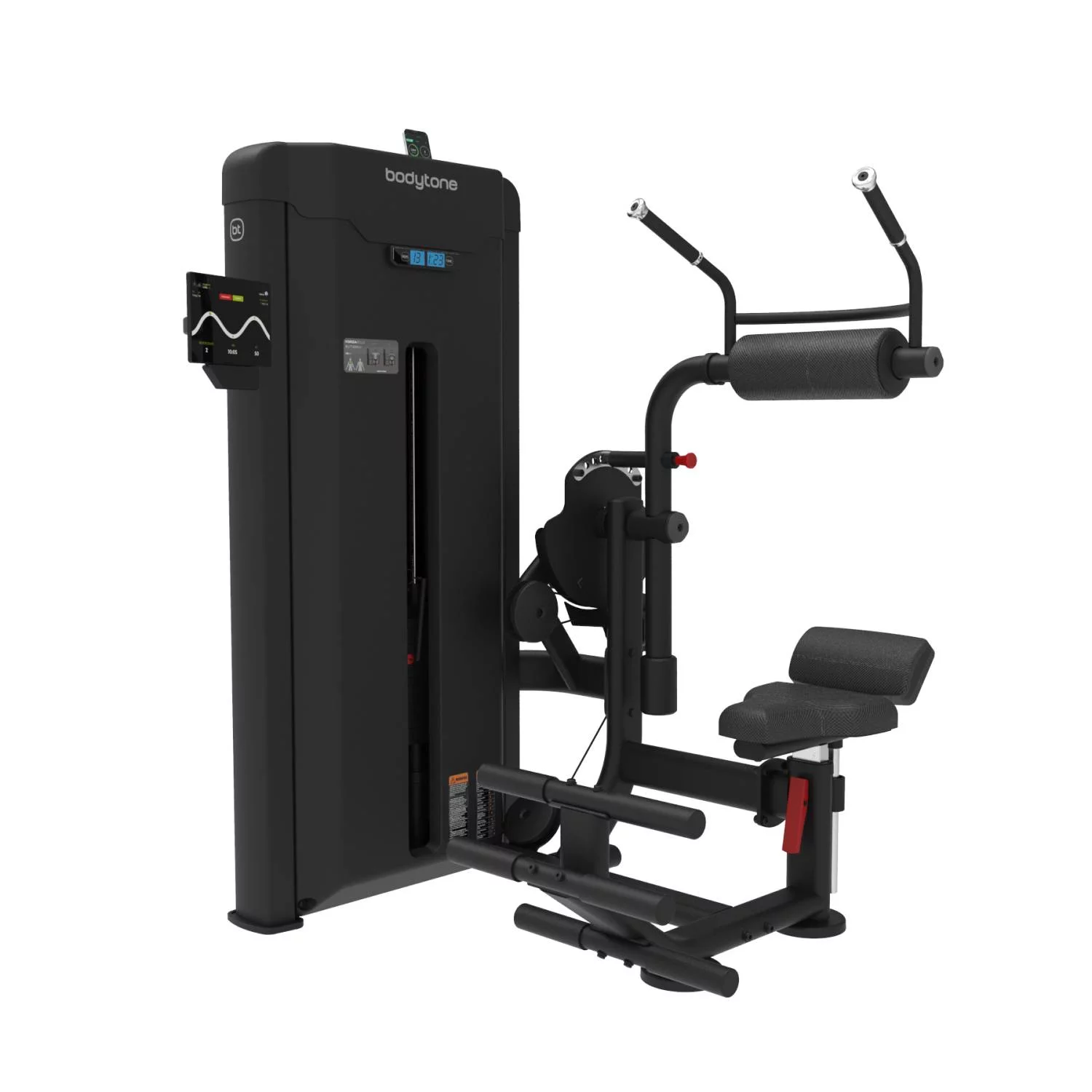
Abdominal training is one of the few things every member of a gym asks about, and one of the few areas where a facility can quietly disappoint them. Floor crunches are free, uncomfortable, hard to load progressively and rough on the neck. A dedicated abdominal machine solves all four problems at once – which is why it earns its footprint on almost every commercial floor, from a municipal sports hall to a hotel fitness room to a full-size club.
This guide sets out what an abdominal machine actually does, what it does not do, how members should be coached to use it, and how to choose and place one in a professional facility.
What an abdominal machine is
An abdominal machine guides trunk flexion against an adjustable resistance. The user sits, the torso is supported, the movement path is fixed by the frame, and the load comes from a weight stack or from plates rather than from body weight alone. That combination does three things a floor exercise cannot.
It makes the movement measurable. A member who trains against a known load can see progress from one month to the next, which is the single strongest driver of retention in strength training. It makes the movement repeatable: the machine puts every user into the same position, so form does not degrade as fatigue sets in. And it reduces cervical strain compared with a floor crunch, where the neck is often used to pull the head forward once the abdominals give out.
Because the resistance is adjustable, the same station serves a first-time user and an experienced lifter without any change of set-up beyond moving a pin. That is what makes it viable in a mixed-audience facility.
What it does – and what it does not do
This is worth stating plainly, because the market around abdominal training is full of promises that equipment cannot keep. An abdominal machine builds and strengthens the abdominal muscles. It does not remove abdominal fat. Reduction of body fat depends on overall energy balance – nutrition and total activity across the week – and cannot be targeted to one area of the body by training that area.
The genuine benefits are worth having on their own: a stronger trunk, better transfer to every other lift on the floor, better postural support, and less lower-back complaint among members who sit all day. Those are the results to promise, and they are the results a machine reliably delivers.
A facility that frames abdominal work honestly – strengthening, not slimming – also avoids the disappointment cycle that costs memberships in the third month.
Coaching members through correct use
Getting value out of the station is largely a question of instruction at the point of use. A warm-up of five to ten minutes prepares the trunk before any loaded flexion. Resistance is then set to the user’s current level rather than to an ambitious one; starting too heavy is the most common cause of soreness and of members abandoning the station entirely.
From there, controlled repetitions matter more than fast ones. The movement should be driven by the abdominals through a full range, with short rests between sets, and stopped at the point where form breaks rather than at an arbitrary count. Around ten to fifteen minutes of dedicated abdominal work, three to four times a week, is a realistic target to communicate to members; more than that adds fatigue without adding results.
A few points belong on any instruction card at the station: avoid loaded trunk flexion immediately after eating, keep the spine aligned against the back pad rather than rounding away from it, and stop immediately if there is pain rather than working through it. Those three lines prevent most of the incidents that occur on this equipment.
Machine work versus floor work and other methods
The advantage of a machine over crunches and sit-ups is targeting and progression. On the floor, the load is fixed at body weight and the hip flexors take an increasing share of the work as the user tires. On a machine, resistance is constant through the movement, the path is fixed, and the load can be raised in small steps as the user gets stronger.
That does not make floor work useless, and a well-programmed facility keeps both. Planks, carries and anti-rotation work train the trunk in ways a flexion machine does not, and they cost nothing in floor space. The machine is what makes the flexion component progressive and safe for a general membership that is not coached individually.
Against other equipment categories, an abdominal station is one of the cheapest ways to add a genuinely used station to a floor. It occupies a small footprint, needs no assembly change between users, and sees traffic from almost every membership segment.
Choosing and placing the station
Three questions decide the specification. How many members will use it in a peak hour, which determines whether one station is enough or whether the flexion work should sit inside a wider selectorised circuit. What range of users the facility serves, which determines the range of loading required at the low end as much as the high end. And what space is available, since an abdominal machine is normally placed where it can be supervised rather than in a far corner.
Our Bodytone Forza FH selectorised range covers the abdominal station within a coherent family of machines, which matters when a facility wants a single visual language and a single maintenance routine across the floor. Where the abdominal station is being added to an existing room, the wider professional strength training machines catalogue lets it be matched to what is already installed.
Frequently asked questions
Will an abdominal machine give members a flat stomach?
No. It strengthens and develops the abdominal muscles. Visible definition depends on body fat level, which is governed by overall energy balance rather than by training one muscle group. Setting that expectation early is better for retention than promising the opposite.
How much space does an abdominal station need?
Less than most selectorised stations, because the user is seated and the movement is contained within the frame. Circulation space around it is specified with the rest of the floor plan rather than in isolation – send us the layout and we will position it.
Is an abdominal machine suitable for beginners?
Yes, and that is one of its main arguments. The guided path means a new member cannot easily adopt a damaging position, and the adjustable load means the entry point can be set very low. It is often the first strength station a hesitant member will use.
How does it fit alongside functional training?
Well, as a complement. The machine covers progressive loaded flexion; functional work covers bracing, rotation and carrying. Facilities that programme both tend to see better trunk strength outcomes than those that rely on either alone.
Specifying your floor
An abdominal station is a small decision inside a larger one: how the strength area is laid out, what it has to serve, and how it will grow. That is the conversation worth having before ordering a single machine.
Tell us the surface available, the expected number of users and the equipment already installed, and we will come back with a configuration and a costed proposal. Request a quote and our team will work through it with you.
À lire aussi sur le même thème
- Les 4 secrets minceur de Harvard pour une perte de poids efficace et sans effort
- Les astuces ultimes pour perdre du gras et avoir une jolie silhouette
- Comment faire pour perdre la graisse du ventre ?
- Comment maigrir sans régime ?
Tous les articles « Perte de poids et composition corporelle »