Outdoor plate-loaded stainless machines: selection, layout and upkeep
Installer des machines inox à disques en extérieur relève d'un projet d'aménagement, pas d'un simple achat : sécurité des usagers, résistance au vandalisme et gestion des disques en accès libre. L'inox supprime la corrosion, mais le stockage et la fixation des charges restent à traiter. Le sol de réception et l'ancrage conditionnent la conformité de l'installation.

An outdoor plate-loaded machine turns a passing fitness spot into a place people train at regularly, but it only works if the circuit, the safety zones and the plate logistics are planned before the order. This guide covers how to select and lay out stainless steel outdoor strength machines loaded with discs rather than a weight stack, what EN 16630 actually requires, and the assembly details that decide whether the installation still looks and works well in ten years.
What makes an outdoor plate-loaded machine different
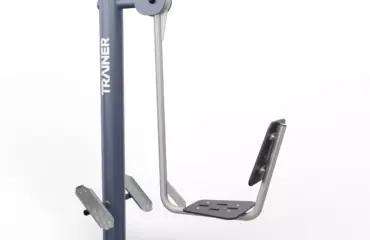
A stainless outdoor machine is a training station designed for open-air use, with the structure and most critical parts in stainless steel so it resists humidity, rain, frost, ultraviolet exposure, chlorinated and saline atmospheres, frequent washing and heavy public use. What separates a plate-loaded unit from the rest is that resistance is set with discs, usually Olympic, rather than a shrouded weight stack.
That has three consequences on site. Progression feels like indoor training, which is what keeps regular users coming back. Maintenance is simpler, because there is no cable and pulley transmission to inspect and replace. And the machine has to be dimensioned for repeated handling of real loads, which brings a logistics question with it: where the discs live, how many are provided, and how they are kept in order.
EN 16630 and who the equipment is for
The reference standard for permanently installed outdoor fitness equipment is EN 16630, covering safety requirements, test methods, inspection and maintenance. One point is regularly missed in briefs: the standard addresses equipment intended for adolescent and adult users, commonly specified as above 1400 mm in height, and not play equipment for young children. That is why a credible product sheet states a minimum user height and a recommended age alongside the load range and the safety zone.
If the intention is a family-oriented space, the answer is zoning rather than mixing. Keep the strength circuit separate from anything aimed at younger children, and say so in the signage.
Build a circuit, not a shopping list
The single most common error is buying from a catalogue instead of designing a route: equipment scattered without coherence of use and without progression. A working outdoor strength area balances four movement families.
| Movement family | Typical stations | Planning note |
|---|---|---|
| Push | Bench press, incline press, shoulder press | Highest footfall, keep clear of the entry point |
| Pull | Seated row, lat pull, standing triceps | Group with push so users alternate without crossing paths |
| Legs | Leg press, leg extension | Largest safety zones, place at the edge of the circuit |
| Core | Loaded abdominal bench | Small footprint, useful as a transition station |
| Compound | Multi-bar or multi-exercise station | Best exercises per square metre on a small site |
A core of five to seven plate-loaded machines covering those families produces a usable circuit. Beyond that, add duplication of the busiest stations rather than more exotic movements.
Safety zones govern the layout, not the footprint
Serious product sheets state the safety zone in square metres, and it is a large number. An outdoor stainless leg press, for example, can require a safety zone in the region of 19 to 23 m2 depending on the model and its overall dimensions. Draw a simple plan, place the machines in families, and check that movement paths do not cross. It is the sum of the safety zones, plus general circulation, that determines how many stations a site actually holds.
Under stations presenting a free fall height, the receiving surface has to be impact attenuating and matched to that height, assessed to EN 1177. Plan the surfacing at the same time as the layout, not after it.
Plate logistics: the part that gets forgotten
A plate-loaded outdoor area needs a sufficient stock of discs so progression is possible, a defined storage position so they do not end up on the ground, and a usage logic for how loads rotate between stations. Without those three things, the discs scatter within weeks and the whole installation loses the premium feel that justified the investment. For unsupervised public sites, decide early whether discs are permanently attached to the station, stored in a lockable position, or issued by an operator.
Matching the specification to the site
| Site objective | Recommended selection | Why it works |
|---|---|---|
| General public fitness area | Multi-bar, abdominal bench, shoulder press | Simple, attractive movements with a low barrier to entry |
| Serious outdoor strength area | Bench press, incline press, leg press, triceps, leg extension | Full push, pull and legs coverage |
| Premium campsite or hotel | 4 to 6 plate-loaded machines plus a stainless calisthenics circuit | Upmarket appearance combined with versatility |
| Corporate wellbeing site | Guided stations with clear signage | Safety and repeat use without supervision |
On grade, the usual rule applies: 304 is a very capable general-purpose stainless, while 316 is preferred in marine, saline and chlorinated atmospheres for its resistance to pitting corrosion, which comes from its molybdenum content. Write that choice into the specification if the site is near the sea, close to a pool or in an aggressive industrial atmosphere.
Assemblies matter as much as the structure
An outdoor installation lives with vibration, thermal expansion, tightening and loosening, and friction. Stainless fasteners are covered by ISO 3506, which sets property classes and stainless families and flags a very practical risk: galling, or thread seizure, when stainless fasteners are tightened. That is why assembly practice, including appropriate lubrication and a defined tightening method, belongs in the installation method statement. Paradoxically, a stainless structure can suffer if the joints are poorly conceived, through galling, incorrect torque or bimetallic couples.
Foundations deserve the same attention. Undersized foundations produce play in the structure and alignments that drift, which is the failure mode that generates most after-sales cost on outdoor strength areas.
Read corrosion claims carefully
Sales arguments are sometimes built entirely on salt spray hours. Salt spray testing to ISO 9227 gives an indication, but it does not always correlate with long-term behaviour in real service. Durability outdoors is a system: the stainless grade chosen for the environment, the surface finish, drainage and siting, the quality of the assemblies, and the maintenance routine. A single test number is not a substitute for that.
Maintenance routine
EN 16630 also addresses inspection and maintenance, and the minimum practical routine is short: regular visual inspection of edges, play and bolts; periodic checking of tightening torques; cleaning suited to the environment, particularly in saline atmospheres; and a maintenance register. The register is what turns a set of good intentions into evidence, which matters in risk management terms if an incident occurs.
Frequently asked questions
Which standard applies to outdoor stainless strength machines?
EN 16630, covering safety requirements, test methods, inspection and maintenance for permanently installed outdoor fitness equipment. It addresses adolescent and adult users, commonly specified as above 1400 mm in height.
What is the difference between a guided outdoor machine and a plate-loaded one?
The plate-loaded machine is loaded with discs, usually Olympic, which gives progression closer to indoor strength training and generally simpler maintenance than a stack and cable system. In exchange it requires the loads to be organised, stored and secured.
Are plate-loaded machines suitable for local authority sites?
Yes, provided safety zones, anchoring, signage and a maintenance routine are all handled. The EN 16630 framework is designed precisely for supervised outdoor use of this kind.
How do you avoid galling on stainless fasteners outdoors?
ISO 3506 flags the risk and points to appropriate assembly practice, meaning suitable lubrication and a controlled tightening method. Specify it in the installation method rather than leaving it to the fitter.
Does a salt spray test prove real durability?
Not on its own. ISO 9227 results give an indication but do not reliably predict long-term in-service behaviour. Judge the system: grade, finish, siting, assemblies and maintenance.
Design your outdoor strength circuit
Light In Fitness has supplied stainless outdoor equipment from Tours, France, since 2013, with a lifetime warranty on stainless and dispatch in 5 to 10 working days from stock. Send us the area, the user profile and the environment, whether coastal, frost-exposed or subject to vandalism, and we will return a circuit of five to seven stations with a layout validated against the safety zones. Quotations are issued within 24 working hours. Browse stainless steel outdoor machines and outdoor gym equipment, or request a quote.
Réalisations documentées
- Cage street workout ultime, Carcassonne – armee francaise
- Cage street workout ultime, Tahiti – armee francaise, Polynesie
- Cage SP Max, centre EPIDE de Combree – etablissement public d insertion
- Cage SP Max, lycee Saint-Benigne de Dijon – etablissement scolaire
Sources et références
- NF EN 16630 – modules fixes d’entraînement physique de plein air : exigences de sécurité et méthodes d’essai (AFNOR)
- Code du sport, article L322-2 – garanties d’hygiène et de sécurité des établissements d’activités physiques et sportives (Légifrance)
- Code de la commande publique – texte intégral en vigueur (Légifrance)
- Direction des affaires juridiques, ministère de l’Économie – réglementation de la commande publique et fiches techniques
À lire aussi sur le même thème
- Street workout rig layout and station capacity: sizing a calisthenics installation
- Street Workout Cages and Calisthenics Structures: How to Choose and Why Buyers Choose Light In Fitness
- Choosing an outdoor fitness supplier: what a manufacturer and distributor changes
- The Council Checklist for a Successful Street Workout Park