Commercial elliptical trainers: buying guide for gyms and clubs
A professional elliptical trainer for a commercial gym costs between 2,000 and 6,000 EUR excluding VAT, and the right choice comes down to four things: drive type (rear, front or centre), stride length of at least 51 cm, magnetic or self-generating resistance, and certification to EN ISO 20957-1:2024 class S for commercial use. The elliptical is one of the most versatile cardio stations on the floor — near-zero joint impact, full-body engagement and a user base that runs from rehabilitation clients to seniors to conditioned athletes. Here is how to choose a fleet that survives commercial duty.
The three drive architectures
- Rear drive. The flywheel sits behind the user, producing a flat, elongated stride that feels closest to running. Fewer moving parts at the front means simpler maintenance. Generally the preferred architecture for commercial floors.
- Front drive. Flywheel at the front, more compact footprint, slightly more inclined stride. Often cheaper; check pedal-arm rollers and rails, which are the wear points of this design.
- Centre drive. Twin flywheels either side of the user give the most compact footprint and a very natural foot path, at a premium price. Interesting where floor space is the binding constraint.
The technical criteria that separate commercial from domestic
- Certification: EN ISO 20957-1:2024, class S. A domestic machine (class H) on a commercial floor voids warranties and fails duty cycles within months.
- Stride length: minimum 51 cm for adult comfort; adjustable stride widens the audience further.
- Flywheel and resistance: magnetic (electromagnetic) resistance with 20 or more levels; it is silent, precise and wear-free. Self-generating models need no mains socket, which frees your floor plan and cuts cabling costs.
- Q-factor: the lateral distance between pedals. Below about 10 cm keeps hips and knees aligned; wide Q-factors cause the discomfort users describe as “riding a barrel”.
- Max user weight: 150 kg or more for commercial duty.
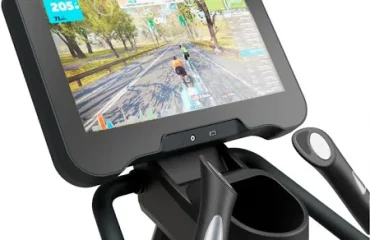
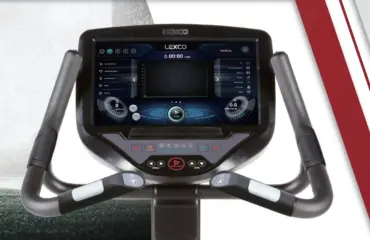
- Console: keep it simple unless your positioning demands screens. Bluetooth/app connectivity now matters more to members than built-in TV.
- Serviceability: accessible covers, standard bearings, local spare parts. Ask for the price of a pedal-arm bearing set before you sign.
Sizing the fleet: how many ellipticals per member base
| Facility | Members | Recommended ellipticals | Budget excluding VAT |
|---|---|---|---|
| Hotel / corporate gym | — | 1 – 2 | 2,500 – 8,000 EUR |
| Club up to 500 members | 300 – 500 | 2 – 4 | 5,000 – 16,000 EUR |
| Club 500 – 1,500 members | 500 – 1,500 | 4 – 8 | 10,000 – 35,000 EUR |
| Large club / chain site | 1,500+ | 8 – 12 | 20,000 – 60,000 EUR |
Rule of thumb: ellipticals typically represent 20 to 30 percent of the cardio line, alongside treadmills and bikes. Our commercial treadmill buying guide covers the highest-traffic neighbour on the cardio row.
The five most common failures — and what they cost
- Pedal-arm bearings and bushings (squeaking, play): the classic wear item from year two onward; 50 – 200 EUR per intervention.
- Drive belt wear or misalignment: slipping or a knocking cadence; 80 – 250 EUR.
- Roller and rail wear (front-drive models): grinding noise; clean weekly to delay it.
- Console or cable faults: dead displays, unresponsive buttons; check cable routing through the moving arms.
- Resistance unit faults: rare on quality magnetic systems, expensive on cheap ones — another argument for class S machines.
A simple preventive routine — weekly cleaning and inspection, monthly bolt-torque and bearing checks, annual technician service — roughly halves lifetime maintenance cost. The full facility routine is described in our cardio machine maintenance schedule.
Total cost of ownership: why the cheap machine is the expensive one
Over seven years of commercial duty, a 900 EUR domestic elliptical replaced every 18 – 24 months, plus repairs and downtime, ends up costing more than a 3,000 EUR class S machine that runs the full period with routine servicing — before counting the member experience cost of out-of-order signs. Buy the duty cycle, not the ticket price.
When the elliptical is not the right choice
- Performance and cross-training floors: air bikes, ski ergometers and rowers deliver the intensity profile that clientele expects.
- Very small studios: a bike offers more training minutes per square metre.
- Sprint-based programming: the elliptical is a steady-state and interval tool, not a maximal sprint tool.
Installation and floor requirements
Ellipticals are the tallest machines on most cardio rows: with pedal arms at top travel, user head height can reach 2.4 m on a raised platform, so check ceiling clearance of 2.5 m or more, especially under beams, ducts or mezzanines. Allow a footprint of roughly 2.0 × 0.8 m per machine plus 60 cm lateral spacing and a metre of rear access. Machines should stand on 15 – 20 mm rubber tiles or individual damping mats: the elliptical transmits less impact than a treadmill but more lateral rocking, and a level, damped base is what keeps the frame quiet over years. Self-generating models can be repositioned freely — a real advantage when you re-plan the floor — while mains-powered units need sockets planned before the electrician leaves.
What separates the price tiers
Between a 2,000 EUR and a 6,000 EUR class S elliptical, the specification differences are concrete rather than cosmetic:
- Frame and bearings: heavier gauge steel, larger sealed bearings at every pivot, and tighter tolerances that keep the stride silent at year five, not just at delivery.
- Drive system: heavier flywheels and induction-brake resistance with faster, finer level changes — noticeable in interval programmes.
- Ergonomics: lower step-up height, narrower Q-factor, multi-grip handlebars and, at the top of the market, adjustable stride and incline that widen the machine’s audience.
- Console and service: better displays and connectivity, but more importantly diagnostic menus, hour counters and error logs that cut technician time — a running-cost feature disguised as electronics.
Mid-tier machines are the value sweet spot for most clubs; the premium tier pays for itself in flagship positions and heavy-traffic sites where downtime is most visible.
Frequently asked questions
What lifespan should a commercial elliptical deliver?
Ten years or more under daily commercial use, provided it is a class S machine on a proper preventive maintenance routine. Domestic machines last 1 to 3 years in the same environment.
Self-generating or mains-powered?
Self-generating models place anywhere without sockets or cable trays, save electricity and survive power cuts. Mains models support bigger screens. For most floors, self-generating is the more flexible choice.
What stride length should we specify?
At least 51 cm fixed, or an adjustable stride if your audience spans small-framed users and tall runners. Short strides are the main reason members abandon the machine.
How much should we budget for maintenance?
Around 2 to 4 percent of the fleet value per year, including consumables and one annual professional service visit.
Are ellipticals still worth floor space against newer cardio formats?
Yes, for a reason usage data keeps confirming: the elliptical is the machine chosen by members who are intimidated by treadmills and bored by bikes — typically a third of a general club’s base. Air bikes and ergs serve the conditioned minority; the elliptical quietly serves the majority who renew memberships. Keep the ratio at 20 – 30 percent of the cardio line and it earns its area every month.
Specify your cardio line with Light In Fitness
Light In Fitness has equipped commercial gyms, hotels and public facilities since 2013. Browse our professional cardio machines or request a quotation — we will size your elliptical fleet against your member numbers, floor plan and budget.
À lire aussi sur le même thème
- Which Cross Trainer (Elliptical) for a Commercial Gym?
- Vélo elliptique / vélo elliptique pour faire de l’exercice et perdre du poids
- Quels muscles travaille le vélo elliptique ?
- Commercial rowing machines: a specification and buying guide
- Running a profitable spin studio: sizing, wear parts and operations