How to Fit Out a 40 m2 Gym on a 5,000 Euro Budget
Avec 5 000 EUR excl. VAT sur 40 m², l'équipement se concentre sur un sol sportif, un rack, une barre avec disques, un banc réglable et un poste cardio. Cette base couvre l'ensemble des mouvements polyarticulaires. Les machines guidées, plus coûteuses par poste, s'ajoutent dans un second temps.
Yes, a functional 40 m2 training space can be fitted out for around 5,000 EUR excluding VAT, provided every purchase is strategic: a versatile adjustable bench, an adjustable dumbbell set, one pulley station, one compact treadmill, rubber flooring across the full area and disciplined circulation planning. The core equipment table below lands at roughly 3,200 EUR, leaving headroom for accessories, a mirror and contingencies. This budget produces a credible starter facility for a workplace micro-gym, a residence or a coaching studio; it does not produce a commercial club floor, and we are explicit below about where the compromises sit.
Start with the layout, not the shopping list
Before buying anything, define how the room will be used:
- Decide the training types to cover: strength, cardio, stretching.
- Measure the real usable area for flooring and equipment, allowing for doors, radiators and windows.
- Plan circulation flow so two or three people can train simultaneously without crossing each other’s working zones.
On 40 m2, a workable split is roughly 15 m2 for strength (bench, dumbbells, pulley station), 8 m2 for cardio, 8 m2 for stretching and mobility, and 9 m2 for circulation. If your floor area or ambitions are larger, see our guides to a 50 square metre gym layout and to gyms under 70 square metres.
The worked 40 m2 configuration
| Equipment | Dimensions (L x W x H) | Quantity | Indicative unit cost | Total |
|---|---|---|---|---|
| Adjustable incline bench | 1.2 x 0.5 x 1.2 m | 1 | 500 EUR | 500 EUR |
| Adjustable dumbbells | – | 1 set (2-24 kg) | 300 EUR | 300 EUR |
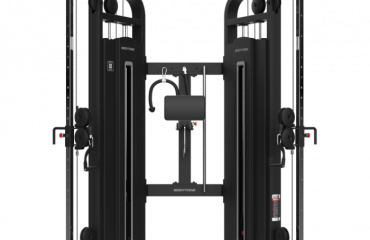
| Pulley station | 1.8 x 0.6 x 2 m | 1 | 800 EUR | 800 EUR |
| Compact treadmill | 1.8 x 0.8 x 1.4 m | 1 | 1,200 EUR | 1,200 EUR |
| Stretching equipment | – | 4 | 25 EUR | 100 EUR |
| Storage shelving | 1.5 x 0.5 x 1.8 m | 1 | 200 EUR | 200 EUR |
| Rubber flooring (40 m2) | – | 1 | 800 EUR | 800 EUR |
| Core total | 3,900 EUR |
All figures are indicative project estimates excluding VAT, to be confirmed by quotation. On top of the core list, allow around 300 EUR for accessories (resistance bands, Swiss balls, mats) and up to 500 EUR for finishing touches, above all a wall mirror, which transforms both usability and the perception of space. That brings the realistic total to roughly 4,300-4,700 EUR, keeping a small contingency inside the 5,000 EUR envelope.
Why these five purchases and not others
- Adjustable bench: the single most versatile item in the room, covering pressing, rowing, step work and core training.
- Adjustable dumbbells: the space-saving alternative to a full dumbbell rack; one set replaces a dozen pairs.
- Pulley station: the widest exercise coverage per square metre for back, arms and shoulders, safe to use unsupervised.
- Compact treadmill: the cardio anchor. On this budget, a compact model is the honest choice; heavy club-grade cardio starts at several times this price point.
- Rubber flooring everywhere: the least glamorous line and the least negotiable. A 40 m2 floor in 15-20 mm rubber tiles protects the slab, dampens noise and prevents injuries. Sizing rules are covered in our guide to rubber tile thickness by dropped load.
Where this budget compromises, and how to stage upgrades
Be clear-eyed about what 5,000 EUR does not buy: club-certified cardio (EN ISO 20957 class S equipment for commercial use sits well above this price band), heavy free-weight capacity, or redundancy when a machine is out of service. The staging logic that works:
| Phase | Trigger | Typical additions | Indicative budget |
|---|---|---|---|
| Phase 1 (now) | Opening the room | The core list above | ~4,500 EUR |
| Phase 2 (6-12 months) | Regular usage established | Half rack, Olympic bar and plates, second cardio unit | 2,500-4,000 EUR |
| Phase 3 (12-24 months) | Sustained demand | Selectorised machine, upgraded professional cardio | 3,000-6,000 EUR |
Buying the floor and layout right in phase 1 means phases 2 and 3 slot in without re-doing anything. For a broader view of what each budget tier buys, see our guide to small gym equipment budgets.
Three layout mistakes to avoid in a small space
- Ignoring circulation flow: equipment placed without walking lanes makes simultaneous use impossible and the room feels cramped immediately.
- Overestimating the space: catalogue dimensions exclude the user’s movement envelope; a treadmill needs free space behind it, a bench needs a metre around it. Choose compact models deliberately.
- Skimping on the floor: an unsuitable floor causes accidents, noise complaints and damaged screed, and retrofitting flooring under installed equipment costs far more than doing it first.
Frequently asked questions
Is 5,000 EUR enough for a commercial gym?
No. This budget suits a workplace micro-gym, a shared residence facility, a hotel back-of-house staff room or a personal training studio’s starter setup. A commercial club open to paying members requires class S equipment under EN ISO 20957-1 and budgets an order of magnitude higher.
What should be bought first if the budget shrinks further?
Floor, bench, dumbbells, in that order. A safe floor and a versatile bench with adjustable dumbbells already support a complete strength programme; cardio and the pulley station can follow.
How many people can train at once in 40 m2?
Two to three comfortably with this configuration. Beyond that, queues form at the bench and treadmill, which is the signal to move to phase 2 additions.
Does the flooring really need to cover all 40 m2?
Yes. Partial flooring creates trip edges, leaves the slab exposed where equipment inevitably migrates, and looks unfinished. Full coverage in 15-20 mm tiles is the correct baseline, thickened locally if free weights get heavier in later phases.
Get a costed plan for your small space
Send us your room dimensions, photos and intended use. You will receive a free layout recommendation, an itemised equipment list matched to your budget, and a quotation within two working days. Request a quote from Light In Fitness, professional fitness equipment supplier since 2013.