Punch bags and free-standing bags: how to choose and how to hang them
Le choix se fait entre trois formats : le punching ball sur pied, autoportant et sans travaux, le sac suspendu, qui exige un point d'ancrage, et la poire de vitesse, réservée au travail de rythme. Le sac suspendu offre le meilleur rendement en frappe lourde, à condition d'un support plafond ou mural dimensionné. Le modèle sur pied, lesté à l'eau ou au sable, reste la seule option lorsque la structure du bâtiment ne peut pas être percée.
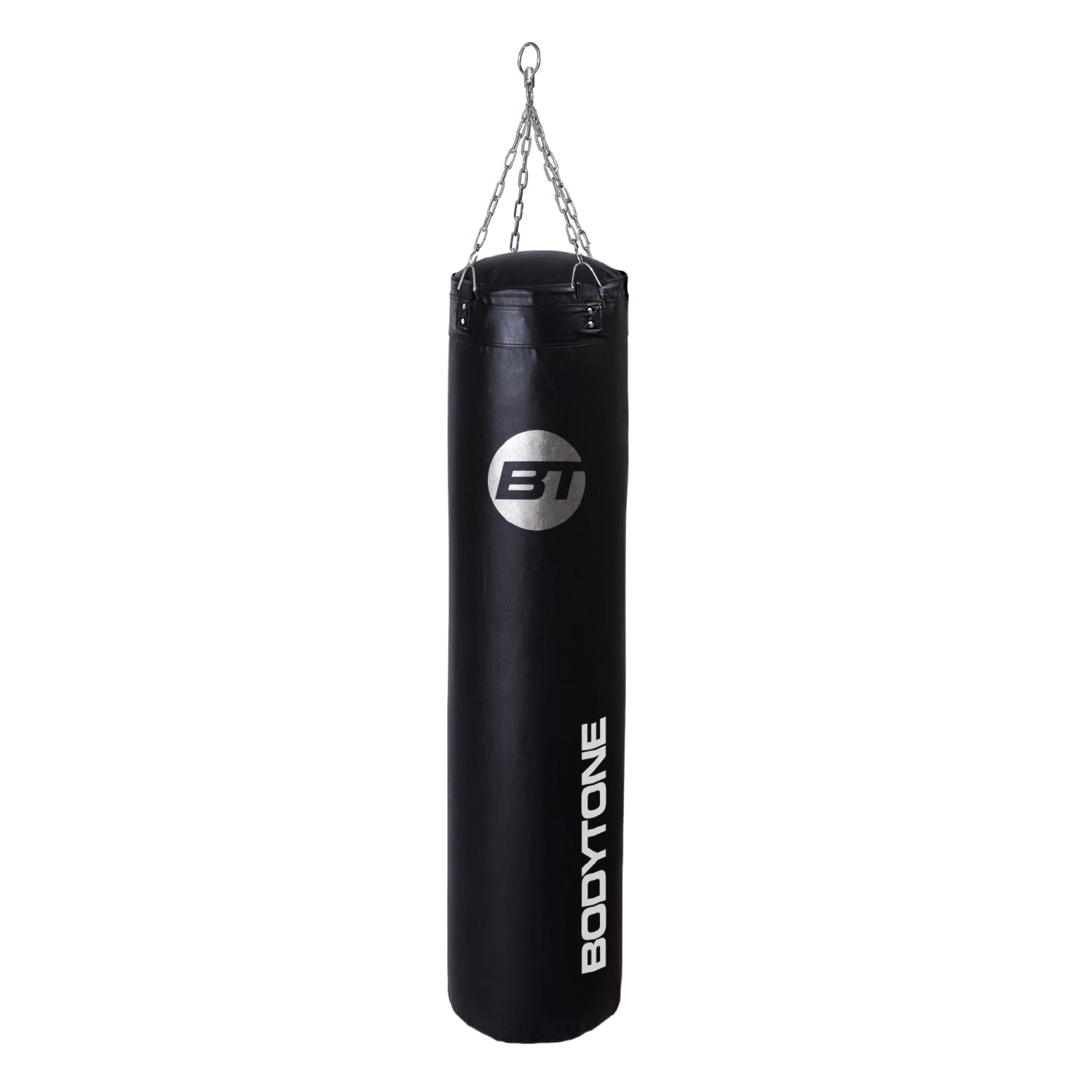
The rule of thumb for a heavy bag is half the user’s bodyweight, so 35 to 45 kg covers most adult members, and the decision that actually drives the budget is not the bag but how it is suspended. A commercial hanging bag starts at 149 EUR excluding VAT; a single stainless outdoor bag frame is 1,499 EUR excluding VAT; a four-station frame is 6,250 EUR excluding VAT; and a ten-station self-supporting conveying rail, which lets staff unhook and stow the bags after a class, is 16,500 EUR excluding VAT. Get the suspension decision right and the rest follows.
Free-standing punch bag: no structural work required
A free-standing bag sits on a base filled with water or sand and needs no fixing at all. The sprung stem returns energy, which trains reflexes and timing rather than raw power. Its real advantage is operational: it can be positioned for a class and moved out of the way afterwards, so a multi-purpose studio can run boxing conditioning without dedicating the room to it.
Where it fits: fitness boxing in group classes, corporate and hotel gyms, decompression corners in workplace facilities, and any leased space where drilling the structure is not permitted. Where it does not: serious combat sport training, because the base slides under heavy hooks and the stem does not reproduce the feel of a hanging bag.
Hanging heavy bag: the reference for power work
The suspended heavy bag remains the standard for power, combinations and movement around the bag. It swings, so the athlete has to time entries and exits, which a free-standing bag cannot teach. It also transmits load into the building, which is the whole design problem.
Bag weight and length
| User profile | Bag weight | Length | Note |
|---|---|---|---|
| Beginner, fitness boxing | 25 to 35 kg | 100 to 120 cm | Moves visibly; forgiving on the wrists |
| General adult member | 35 to 45 kg | 120 to 150 cm | The reference for a mixed membership |
| Kickboxing and Thai boxing | 45 to 60 kg | 150 to 180 cm | Extra length allows low kicks to the base |
| Power and heavyweight work | 60 kg and above | 150 cm and above | Barely moves; specify the frame accordingly |
Filling matters as much as weight. Textile-shred filling is progressive and forgiving; sand-heavy filling settles into a hard base and is the usual cause of wrist complaints on a club bag. Specify a bag with a retaining internal structure if it will be used unsupervised.
Suspension: four options and what each costs
| Method | Suits | Structural requirement | Indicative cost excluding VAT |
|---|---|---|---|
| Wall bracket | One or two bags, studios, small clubs | Solid concrete or reinforced masonry; chemical anchors, dynamic load rating | Bracket cost plus installation |
| Ceiling fixing | Where the wall is needed for mirrors or storage | Structural slab with verified pull-out capacity and a structural survey | Survey usually exceeds the hardware cost |
| Free-standing frame, single or double | Clubs, outdoor areas, leased premises | Bolted baseplates or ballast | 1,499 EUR single, 1,999 EUR double in stainless steel outdoor specification |
| Multi-station frame or conveying rail | Boxing clubs and class-based operations running 6 to 12 bags | Bolted to slab; rail also loads the structure it is fixed to | 6,250 EUR for a 4-bag frame, 16,500 EUR for a 10-station L-shaped conveying rail |
The conveying rail deserves attention from any operator running mixed programming in one room. Bags slide along the rail and are stowed at one end after a class, which frees the floor for functional training, classes or circuits in the following slot. On a room used 14 hours a day, that recovered floor time is the entire business case. See our punch bag rail systems for configurations.
Whichever method is chosen, a swinging bag applies a cyclic, off-axis load, which is the load case that loosens mechanical expansion anchors. Bonded chemical anchors into sound structural concrete are the correct specification; our anchoring guide sets out the substrate requirements and cure times.
Outdoor bag stations
Outdoor boxing has grown quickly in public parks, residential developments, military sites and school grounds. The specification differs on three points: the bag must be weather-resistant and closed-cell so it does not absorb water, the frame must be hot-dip galvanised or, near a coastline, grade 316 stainless steel, and the whole installation falls under EN 16630 for permanently installed outdoor fitness equipment. Weather-rated outdoor bags sit at 799 EUR excluding VAT for boxing and mixed martial arts formats, and a complete outdoor boxing structure with integrated frame from 1,320 EUR excluding VAT.
Floor and layout
- Spacing. Allow a 2 m diameter circle per hanging bag so a boxer can move fully around it. Bags on a rail can be tightened to 1.6 m centres in class use because the movement pattern is more constrained.
- Ceiling height. A 150 cm bag hung with a 30 cm bottom clearance needs at least 2.6 m of usable height, and 3.0 m is the comfortable working figure.
- Surface. Twenty to 25 mm rubber tile under the bag zone. Where the same room hosts ground work or grappling, tatami matting is specified as a separate zone rather than as a continuous surface, because the two disciplines need different densities.
- Noise. Bag impact is structure-borne. In an upper-floor unit, mount frames on the structural line and specify an acoustic underlay; this is the most common source of neighbour complaints in converted retail premises.
Three realistic budget scenarios
| Scenario | Equipment | Indicative budget excluding VAT |
|---|---|---|
| Hotel or corporate gym, boxing corner | 2 free-standing bags, gloves, 12 m2 of 20 mm rubber tile | 1,200 to 2,000 EUR |
| Fitness club running boxing classes | 4-bag frame, 4 heavy bags, 30 m2 of flooring | 7,500 to 9,500 EUR |
| Dedicated combat sports facility | 10-station conveying rail, 10 bags, tatami zone, cage or ring | From 25,000 EUR upwards |
For a full facility, the bag line is rarely the largest item. Cages, rings, matting and flooring dominate; our combat sports equipment section covers the complete fit-out.
Frequently asked questions
Free-standing bag or hanging bag?
A free-standing bag needs no fixing, moves out of the way between classes and suits multi-purpose rooms and leased premises. A hanging bag gives a far more realistic feel and allows movement around it, but requires a wall bracket, ceiling fixing or frame designed for a repeated swinging load. Clubs that run both boxing and functional programming in the same room usually end up with a rail system for exactly this reason.
What weight of punch bag should I choose?
Approximately half the user’s bodyweight for kickboxing and boxing, which puts most adult members in the 35 to 45 kg band. A heavier bag moves less and suits power work; a lighter bag moves more and suits timing, reflex and fitness boxing. In a club, specify a mix rather than a single weight.
What gloves are needed for bag work?
Bag gloves of 10 to 12 oz with hand wraps underneath are sufficient for hitting a bag. Sparring gloves are more heavily padded and are reserved for partner work; using them on the bag wears them out quickly and gives poor feedback.
Can a punch bag be fixed to any ceiling?
No. The fixing must go into a structural concrete slab with verified pull-out capacity, using bonded chemical anchors rated for dynamic load. Suspended ceilings, timber joists without assessment, and screed toppings are all unsuitable. Where the structure cannot be verified, a free-standing frame is the correct answer.
How much space does each bag station need?
A 2 m diameter working circle per hanging bag for free movement, reducing to about 1.6 m centres on a rail in class formats, plus 2.6 m minimum usable ceiling height for a 150 cm bag. Allow separate circulation so participants are not crossing another station between rounds.
Equipping a combat sports area? Light In Fitness supplies bags, frames, rail systems, cages, rings and matting to clubs, hotels, defence facilities and public operators across Europe and export markets, including structural fixing specification and installation. Send us your room dimensions, ceiling height and class format and we will return a costed proposal. Request a quote.