Commercial cold plunge: equipment, protocols and water treatment
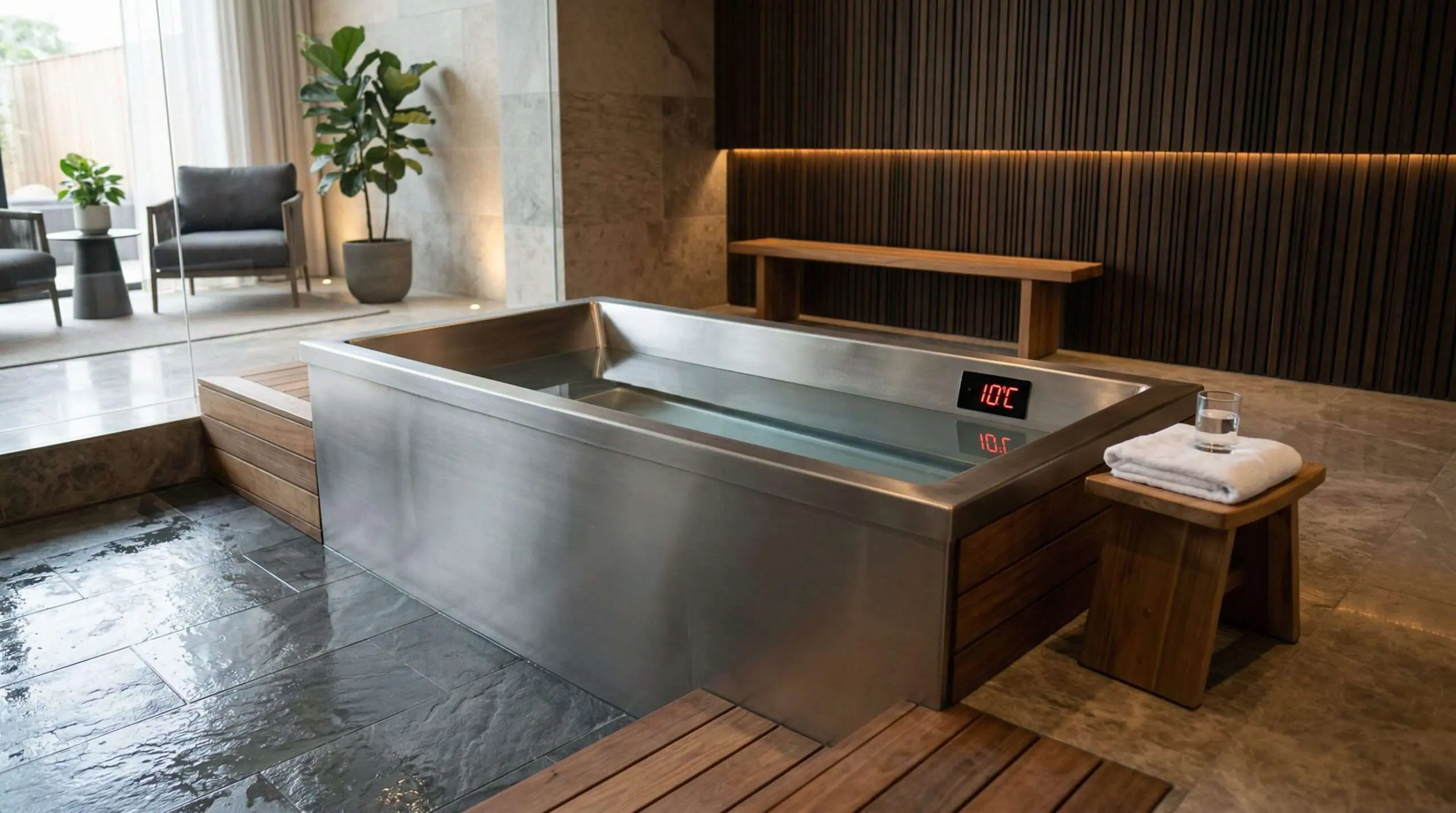
A professional cold plunge for a gym or wellness centre is built around three decisions: a tub in 316 stainless steel (the commercial standard) or acrylic, a chiller sized to hold 4 – 10 °C under continuous multi-user rotation, and a water-treatment chain that keeps a shared unheated bath hygienic all day.
Budget 5,000 to 20,000 EUR excluding VAT for a commercial-grade single-user installation, more for multi-place builds. Cold-water immersion has moved from elite-sport changing rooms into mainstream club wellness zones, and for operators it is a differentiation and secondary-revenue lever — provided it is specified as commercial plant, not as a consumer tub bought at scale.
This guide covers equipment choice, temperatures and protocols, hygiene and integration into a recovery zone.
Tub types: what survives commercial duty
| Type | Indicative price excluding VAT | Strengths | Limitations |
|---|---|---|---|
| 316 stainless steel tub | 6,000 – 15,000 EUR | The commercial standard: hygienic non-porous surface, corrosion resistance, 10+ year life, premium look | Highest purchase price; weight needs a checked floor |
| Acrylic / composite tub | 3,000 – 8,000 EUR | Lighter, design freedom, good mid-market option with a proper chiller | Scratches and clouds over years of heavy rotation |
| Portable / inflatable tubs | 300 – 1,500 EUR | Trial deployments, pop-up events | Not commercial equipment: hygiene, durability and image all fail under club traffic |
Cooling: chiller, not ice
A commercial installation needs a refrigeration chiller that holds the set temperature continuously, filtering and circulating as it cools. Sizing rule: the chiller must recover the temperature rise of back-to-back users at your busiest hour — for club duty that typically means a unit of 1 – 2 kW cooling capacity per tub, more for multi-place baths.
Ice is not an operating model: cooling a 400-litre bath with bagged ice costs more per week in logistics than a chiller costs in electricity, delivers unstable temperatures and cannot be scheduled. Reserve ice for occasional event use.
Temperatures and protocols for a mixed clientele
| Use | Temperature | Immersion time | Notes |
|---|---|---|---|
| Beginners / general wellness | 12 – 15 °C | 1 – 3 min | The onboarding zone; most members should start here |
| Regular recovery practice | 8 – 12 °C | 2 – 5 min | The standard club setting |
| Experienced users / athletes | 4 – 8 °C | 1 – 3 min | Supervised or explicitly experienced users only |
House rules for unsupervised collective use: posted contraindications (cardiovascular conditions, pregnancy, under the influence), never alone in the area, controlled breathing before entry, no breath-hold games, exit on shivering, and non-slip flooring with grab access in and out. A timer visible from the tub prevents the two failure modes — token dips and macho overstays.
Water treatment: the part that decides whether you stay open
A shared cold bath is legally and practically a small public pool: it needs continuous filtration, disinfection and monitoring, not a weekly water change. The working chain for commercial installations combines mechanical filtration, a sanitiser residual appropriate to cold water, and UV or ozone as a secondary barrier — cold slows chemical kinetics, which is why UV/ozone support matters more than in warm pools.
Check the pool-water hygiene regulations applicable to publicly accessible baths in your country: registration, water-quality logging and periodic testing typically apply. Operationally: users shower before entry (a posted, enforced rule — it is your main hygiene lever), daily water-quality checks are logged, and the tub is drained and cleaned on the manufacturer’s schedule.
Two specification details separate installations that age well from those that do not. First, insulation: a well-insulated tub with a fitted cover holds temperature overnight on a fraction of the energy, and the chiller cycles less — quieter plant room, longer compressor life. Second, water volume: larger volumes are more thermally and chemically stable under user rotation, which is why commercial tubs of 400 litres and more behave better at rush hour than compact consumer volumes ever can.
Integrating the plunge into a recovery zone
The plunge performs best as part of a circuit — typically sauna, plunge, rest — because contrast protocols are what members actually book. Allow 6 – 10 m² for a single-tub corner including circulation and drying space, waterproof flooring with a floor drain, and ventilation sized for the humidity load. Building the wider space — saunas, plunge, relaxation — is covered in our guide to recovery rooms for clubs and performance centres, and the heat side in the commercial sauna buying guide.
Wellness zones monetise directly: clubs typically run cold-plunge access as a premium membership tier or paid add-on, which is why the investment case usually closes faster than the wellness label suggests.
Operating economics: what the plunge earns
The revenue patterns are consistent across early adopters: cold immersion works commercially as an access tier rather than a pay-per-dip product. Typical structures are a wellness add-on of 10 – 25 EUR per month on top of standard membership (covering plunge, sauna and recovery area), coached contrast-therapy sessions sold in blocks, and inclusion in premium tiers to drive upgrades.
Against operating costs of a few euros a day, a plunge that converts even thirty members to a 15 EUR add-on returns its mid-range purchase cost within the first year — which is why the specification questions above (duty cycle, hygiene, chiller sizing) matter more than the ticket price: the asset only earns while it is open, cold and clean.
Position it visibly — glass-walled recovery zones near the entrance outperform hidden back rooms — because the plunge is also marketing: it photographs distinctively, and it signals a facility investing in how members feel, not just how they train.
Frequently asked questions
What does a commercial cold plunge cost to run?
Electricity for a well-insulated tub with a properly sized chiller typically runs 1 – 3 EUR per day, plus water treatment consumables and periodic draining — a small line next to the membership revenue it supports.
Can we just buy several consumer ice-bath tubs?
No. Consumer tubs lack the filtration, disinfection capacity and duty cycle for shared use; hygiene is where that decision fails first, and image second. One commercial unit outperforms three consumer tubs on every operating metric.
Does a cold plunge need a lifeguard or supervision?
Requirements vary by country and facility classification; most clubs operate unsupervised plunges with posted rules, contraindication signage, emergency call points and staff within sight or call. Confirm with your insurer and local regulations before opening.
What temperature should a club set as default?
10 – 12 °C serves the widest audience: cold enough for a genuine effect, warm enough that beginners return. Advanced settings below 8 °C are better offered in coached sessions.
Where should the plunge physically go?
Next to a drain, on a floor checked for the filled weight (a 500-litre stainless installation approaches 700 kg), away from electrical distribution, and ideally adjacent to the sauna to enable contrast circuits. Ground floors simplify everything; upper-floor installations need a structural check and a leak containment plan. Allow service access to the chiller side — the maintenance nobody planned space for is the maintenance that does not happen.
Add cold immersion to your facility
Light In Fitness supplies commercial cold plunge tubs, chillers and complete recovery-zone fit-outs, with the water-treatment specification your operation needs. Request a quotation and we will configure a plunge installation for your space and clientele.
Réalisations documentées
- Functional Rig inox – installations sur trois continents
- iGreenMill, tapis de course extérieur – installations sur trois continents