Cellulite and Exercise: What Actually Works (and What Does Not)
Cellulite affects roughly 85–90% of women at some point in their lives, whatever their weight or body shape. The dimpled “orange peel” appearance on thighs, glutes, stomach and sometimes arms is a major aesthetic concern — and miracle creams and treatments are everywhere. The honest truth: no method eliminates cellulite completely, because it is a normal physiological feature of female anatomy. But its appearance can be significantly reduced, and exercise — specifically the combination of strength training and cardio — is the most effective and durable approach. Here is what actually works, with realistic timelines.
What cellulite is — understanding it before acting
Cellulite is not a disease. It is a change in the structure of subcutaneous fat tissue, linked mainly to how fat cells are naturally arranged in women. Female connective tissue is organised in vertical columns, allowing fat cells to push towards the surface and create the dimpled look; in men the fibres cross in a mesh that holds fat more tightly. It is an anatomical difference, not a flaw.
| Type | Characteristics | Responsiveness to exercise |
|---|---|---|
| Adipose | Linked to localised excess fat; soft, painless | The most common and most responsive to training and nutrition |
| Fluid-retention | Linked to water retention and sluggish circulation; puffy look, heavy legs | Physical activity and hydration are key |
| Fibrous | Long-established; firm, sometimes tender — collagen fibres have stiffened | Exercise helps, but results are slower |
Aggravating factors: sedentary lifestyle, diets high in refined sugar and saturated fat, hormonal fluctuations (puberty, pregnancy, contraception, menopause), stress, poor circulation, smoking and genetics.
Why exercise is the best available approach
- Reducing body fat: less subcutaneous fat means less visible dimpling. Note that fat loss is always body-wide — you cannot “spot-reduce” one area, as our article on spot reduction explains — but overall fat loss reliably improves the areas that concern you.
- Muscle tone: firm, developed muscle under the skin visually smooths the surface. This is the fastest and most visible effect of training.
- Better circulation: exercise stimulates blood and lymphatic flow, reducing fluid retention — particularly effective against fluid-retention cellulite.
The most effective exercises
For thighs and glutes (the number-one cellulite zones):
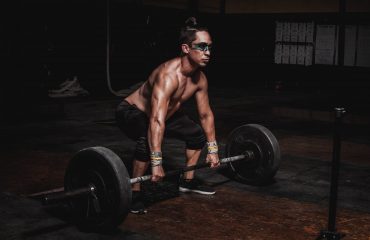
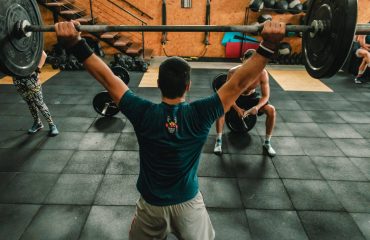
- Squats: the king of lower-body exercises — 4 sets of 12–15, adding dumbbells or the leg press to increase intensity
- Lunges: forward, reverse or lateral — 3 sets of 12 per leg
- Hip thrusts: the top exercise for firm glutes — 4 sets of 12 with back supported on a bench
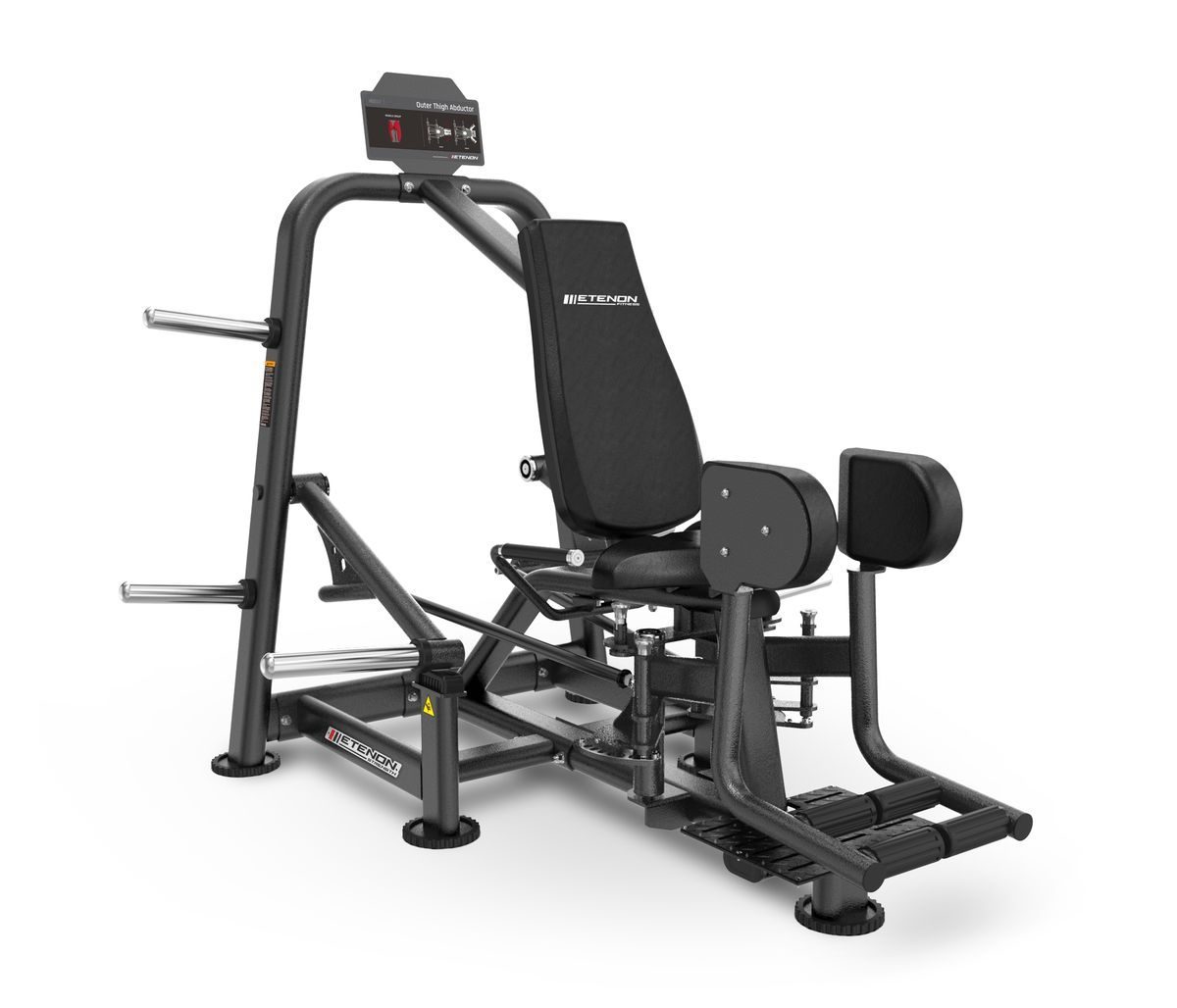
- Abductor machine: targets the outer thigh and gluteus medius — 3 sets of 15–20
- Leg curls: the back of the thigh — 3 sets of 12–15
- Leg press: high foot placement for glutes, low for quadriceps — 4 sets of 12
For the stomach and waist: planks (3 x 30–60 seconds), mountain climbers (3 x 20) and Russian twists (3 x 20). All of these movements are available on commercial guided equipment — see our strength training machines and our guide to designing a glute training zone.
Cardio that helps
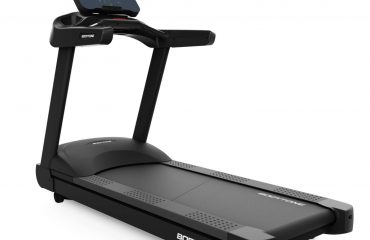
- HIIT: the most time-efficient fat-loss method — 20–25 minutes, 2–3 times per week on a rower, treadmill or bike
- Cross-trainer: works the whole lower body while activating circulation — 30–40 minutes at moderate intensity
- Indoor cycling: excellent for thighs and glutes with seated/standing alternation — 45 minutes, twice a week
- Incline walking: 5–6 km/h at 10–15% incline deeply activates glutes and thighs — 30–40 minutes
- Rowing: recruits the large majority of the body’s muscles for whole-body fat loss — 20–30 minutes
- Aqua biking: pedalling against water combines muscular work with a natural massaging effect that supports circulation in the legs — a popular option where a pool is available
Browse our full commercial cardio equipment range for suitable machines.
An 8-week programme
- Monday — lower-body strength: squat 4×12, hip thrust 4×12, walking lunges 3×12/leg, abductor 3×20, leg curl 3×15, adductor 3×15, plank 3×45 sec
- Tuesday — HIIT (25 min): 3 min warm-up, 8 rounds of 30 sec hard / 60 sec easy on the rower, 3 min cool-down
- Wednesday — active rest: 30 min brisk walking or aqua biking
- Thursday — upper body and core: machine chest press, pulldown, shoulder press, machine row (3×12 each), mountain climbers, Russian twists, side plank
- Friday — lower-body cardio: 40 min cross-trainer or cycling at moderate intensity, or 30 min incline walking
- Saturday — full-body circuit: 4 rounds, 40 sec work / 20 sec rest: squats, push-ups, jump lunges, mountain climbers, floor hip thrusts, burpees, plank, jumping jacks
- Sunday — complete rest
Progression: increase loads by around 5% every two weeks and cardio duration by 5 minutes each month.
Nutrition that supports the process
- Cut refined sugars: rapid sugars drive insulin spikes that favour fat storage; replace with complex carbohydrates
- Raise protein: 1.6–1.8 g/kg feeds the muscle that smooths the skin
- Eat antioxidants: berries, citrus, colourful vegetables, green tea — supporting skin collagen
- Hydrate: 2–2.5 litres of water daily to reduce fluid retention
- Limit salt and alcohol: both worsen fluid retention and skin quality
- Include omega-3s: oily fish, walnuts, flaxseed — natural support for skin health
Mistakes to avoid
- Believing in miracle creams: no cream structurally changes subcutaneous tissue; at best they temporarily improve skin hydration and appearance.
- Doing only cardio: cardio alone loses both fat and muscle, which can worsen the appearance of cellulite on an untoned body. Strength training is indispensable.
- Yo-yo dieting: weight cycling damages skin elasticity and worsens cellulite. Aim for gradual, sustainable change.
- Under-hydrating: drinking too little water worsens retention.
- Expecting miracles: cellulite will not disappear in two weeks. Allow 6–12 weeks of consistent training for significant visible improvement — and remember that having cellulite is entirely normal.
For gym operators: building a lower-body programme offer
Clubs that offer structured lower-body and glute programmes attract a loyal, motivated female clientele. Dedicated glute zones, guided machines (press, abductor, adductor, leg curl), quality cardio lines and aqua bike options make the offer credible — see our guide to women’s gym equipment or request a free quote for a tailored zone design.
What about massage guns, dry brushing and “anti-cellulite” gadgets?
Percussion massage devices, dry brushing and suction-cup tools all promise smoother skin. The honest reading of the evidence: they can transiently boost local blood flow and temporarily change skin appearance for a few hours, and some users enjoy them — but none has been shown to alter the structure of subcutaneous fat or produce lasting reduction in cellulite. As with creams, treat them as pleasant extras, never as a substitute for the training and nutrition approach described above. If a product’s marketing promises visible results in days, that alone tells you what you need to know.
FAQ — Cellulite and exercise
Can exercise really eliminate cellulite?
Not completely — it is a natural anatomical structure. But strength training, cardio and good nutrition can very significantly reduce its appearance, with visible results in 6–12 weeks of consistent work.
What is the best exercise against cellulite?
No single exercise wins: the combination of targeted strength work (squats, hip thrusts, lunges, abductor), fat-burning cardio (HIIT) and circulation-friendly activity (cross-trainer, aqua biking) is the most effective package.
Can slim women have cellulite?
Yes. Cellulite is not caused by excess weight but by the structure of female connective tissue — very slim, athletic women can have it too. Strength training helps smooth the skin by toning the underlying muscle.
How long before results show?
With a consistent programme of 4–5 sessions per week, first improvements typically appear after 4–6 weeks; significant improvement takes 8–12 weeks. Any promise of visible change in days is marketing, not physiology.