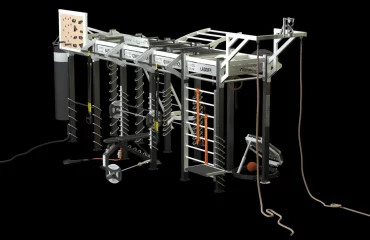
Thermal spa gym equipment: specifying for humid and chlorinated environments
Fitness equipment installed in a thermal spa or hydrotherapy centre fails for reasons that never appear in a standard club specification. Permanent high humidity, chlorinated vapour, mineral water chemistry and repeated condensation cycles all attack machines designed for dry rooms. Three decisions govern how a gym floor holds up over ten years here: the real separation between the training area and the wet zones, the material chosen for each zone, and the protection level of the electronics. A fourth factor, seasonality, is the one most operators discover too late.
Why a thermal spa is not a commercial gym
A thermal establishment uses natural mineral water for therapeutic purposes under a licence issued by the regional health authority, and delivers medically prescribed treatment courses. In France these run for 18 days of treatment over three weeks, across 12 recognised therapeutic indications, reimbursed by the statutory health insurance scheme. Most European spa countries run a comparable model under a different name, so the operating picture translates directly: a seasonal, medically supervised facility, usually housed in an older building built around a spring.
| Indicator | Figure |
|---|---|
| Thermal establishments in France | 110 |
| Patients on a reimbursed course, 2025 | 465,874 |
| Recognised therapeutic indications | 12 |
| Typical length of the thermal season | About 8 months |
Attendance for the 2025 season, published by the French national council of thermal establishments, remains roughly 19 per cent below 2019, when sites received close to 580,000 patients. The zones inside a building differ sharply: treatment rooms and balneotherapy pools sit near saturation at 32 to 34 degrees Celsius, movement studios carry intermediate humidity, and the gym floor itself is normally set apart. Separation only counts if it is real. An open training area a few metres from a pool is still exposed. Have humidity measured per zone in service, over more than one season, before anything is specified.
The four agents that attack equipment
Ambient humidity corrodes metal parts, condenses on circuit boards and oxidises connectors, and encourages mould in upholstery. The weak point is almost never the frame: it is the console and the wiring loom. Chlorine and disinfectants attack painted steel and degrade upholstery, and chloride ions are the specific cause of pitting corrosion in stainless steel, which is why the grade matters. Mineral water chemistry varies by source. Condensation cycles between heated and tempered zones fatigue seals, paint and bearings, and no fitness product standard tests for this.
| Water family | Effect on equipment |
|---|---|
| Sodium sulphurous | Sulphur compounds tarnish copper alloys and attack some elastomers. Watch seals and electrical contacts. |
| Sodium chloride | Behaves like seawater on unprotected steel. This is the case that requires 316L stainless. |
| Sodium bicarbonate | Less aggressive to metals but scale forming, leaving deposits on surfaces and circuits. |
| Weakly mineralised calcium bicarbonate | Low chemical aggression. Ambient humidity remains the dominant constraint. |
Before any decision, ask for the water analysis held in the site licence file. It is the only document that settles the question.
Material selection by zone
Describing a frame as stainless steel, without a grade, has no technical value in a chlorinated atmosphere. Corrosion resistance comes from a passive chromium oxide layer that chloride ions puncture locally. Grade 316L carries 2 to 3 per cent molybdenum, absent from 304, which markedly improves pitting resistance in chloride environments.
| Material | Behaviour | Where to use it |
|---|---|---|
| Painted steel only | Corrodes quickly once the coating is chipped | Nowhere in a thermal building |
| Hot dip galvanised plus powder coat | Good compromise in humid air, provided impacts are touched up systematically | Gym floor away from chlorinated zones |
| Stainless 304 or 304L | Holds up to humidity, vulnerable to chloride pitting | Humid zones with no chlorine exposure |
| Stainless 316 or 316L | Reference grade where chlorides are present | Pool, balneotherapy, contact with treated water |
Service life depends too heavily on measured exposure, ventilation, cleaning protocol and winterisation to be quoted as a general range. It is set project by project.
IP ratings are necessary but not sufficient
The IP code defined by IEC 60529 rates an enclosure against ingress. The second digit covers water: IPX4 for splashing from any direction, IPX5 for water jets, IPX6 for powerful jets, IPX7 for temporary immersion. The limit matters. An IP rating describes resistance to liquid water entering. It says nothing about permanent ambient humidity, internal condensation, or corrosion by vapour. Humid air enters through the same openings as cooling air and condenses as the machine cools, so an IPX5 console can oxidise from the inside. Require the IP rating, then ask the manufacturer three further questions: whether the boards are conformal coated, what the connectors are made of, and which ambient conditions the warranty actually covers. The last question separates suppliers who know this market from those who do not.
Upholstery should be high frequency welded with no through stitching, treated to limit microbial growth, low absorption, removable for cleaning, and listed in the spare parts catalogue before you order. Grips should be non porous rather than rubber foam. One contradiction to avoid: diluted bleach is common in care settings, and it is exactly what causes pitting in stainless steel. If you specified stainless to resist ambient chlorine, do not clean it with chlorine. Use chloride free disinfectants or rinse immediately with clean water, and have the protocol validated jointly by the supplier and the hygiene manager.
Seasonality and winterisation
This is the constraint with no equivalent in a club or a rehabilitation centre. With a season of about eight months, most sites close for several months. Heating drops, ventilation idles and pools may be drained. Counter intuitively, equipment often degrades fastest out of season, because condensation settles unobserved on cold, stationary machines. Write into the maintenance plan at handover: a documented winterisation protocol covering full cleaning and drying, console protection and controlled electrical disconnection; minimum ventilation or dehumidification maintained during closure, agreed with the building operator; a restart inspection before reopening, checking torque settings, early corrosion, upholstery and electrical recommissioning; and warranty terms that reflect a machine used eight months a year but exposed twelve.
Indicative budget for a thermal gym floor
| Item | Scope | Budget excl. VAT |
|---|---|---|
| Cardio suited to the environment | 3 to 5 magnetic bikes without consoles, 2 rowers, 2 treadmills with protected electronics | 15,000 to 25,000 EUR |
| Low impact strength | 3 to 5 selectorised machines with fine increments, frames matched to the zone | 12,000 to 22,000 EUR |
| Medical gymnastics and functional | Mats, bands, light dumbbells, balls, wall bars, stall bars | 2,500 to 4,500 EUR |
| Flooring | Slip resistant and draining surfaces, treated by zone | 4,500 to 8,000 EUR |
| Gym floor total, excluding pool | 34,000 to 59,500 EUR | |
| Aquabikes, if a pool exists | 4 to 8 stainless 316L aquabikes | 12,000 to 28,000 EUR, separate budget |
Ranges exclude delivery, installation and building works. Supervised medical gymnastics sessions favour simple, robust equipment: magnetic bikes with no console, semi recumbent and low step through models for older patients, wall bars, small functional kit and Pilates reformers for partially unloaded work on the spine. Simplicity is a reliability criterion here, not a compromise.
Frequently asked questions
Can standard club equipment be used in a thermal centre?
Not in high humidity zones or near chlorinated areas. Degradation accelerates markedly and the manufacturer warranty may not apply, since ambient conditions usually appear in the conditions of use. On a gym floor that is genuinely separated, ventilated and held near normal room humidity, standard professional equipment can work, with reinforced maintenance and a winterisation protocol.
Which stainless grade is required in a chlorinated atmosphere?
316L. Its 2 to 3 per cent molybdenum content, absent from 304, significantly improves resistance to chloride pitting. Grade 304 is acceptable in humid air with no direct chlorine exposure. Write the grade into the specification, not the generic word stainless, and require a material certificate.
Is a high IP rating enough on its own?
No. IEC 60529 covers ingress of liquid water. It does not cover permanent ambient humidity, internal condensation or vapour corrosion. Combine the IP rating with conformal coated boards, corrosion resistant connectors and a written warranty statement on ambient conditions.
What flooring suits a thermal environment?
Three requirements combine rarely: grip with bare wet feet, drainage, and compatibility with disinfection protocols. Clip together draining polypropylene tiles suit circulation and poolside approaches, dedicated pool surfaces handle the pool deck, and rubber tiles protect the substrate under load on the gym floor. Add an acoustic underlay above ground level.
How long is a quotation lead time?
Light In Fitness returns quotations within 24 working hours. Stock items ship in 5 to 10 working days. Warranties run from 2 to 5 years depending on the range.
Specify your thermal gym floor with Light In Fitness
Send us the humidity readings per zone and the water analysis from your licence file, and we will return a zone by zone specification with materials, protection levels and a maintenance plan. Request a quote within 24 working hours, or explore our aquatic fitness equipment and wellness equipment ranges. Delivery across France, Belgium, Switzerland and Luxembourg, with export quoted per project.
Réalisations documentées
- Dalles et sols sportifs : livraisons documentées – plusieurs chantiers
- Sol sportif extérieur, square Georges-Vallerey – Taverny (95)
- Functional Rig inox – installations sur trois continents
- iGreenMill, tapis de course extérieur – installations sur trois continents
Sources et références
- Code du sport, articles R322-4 à R322-43 – garanties d’hygiène et de sécurité applicables aux établissements d’activités physiques et sportives (Légifrance)