How to Choose Tatami Mats for a Dojo or Combat Sports Club
Specifying tatami mats for a dojo, a combat sports club or a multi-purpose training hall is a purchasing decision, not a decorating one. The surface decides how safely athletes land, how long the floor survives daily sessions, and how much time your staff spend maintaining it. Here are the criteria professional buyers actually apply, in the order that matters.
Thickness: let the discipline decide
Thickness is the first filter, and it follows the practice rather than the budget. Grappling disciplines built on repeated throws and groundwork – judo, sambo, wrestling, jiu-jitsu – call for a thicker, more resilient mat because the floor has to swallow full-body impacts hundreds of times per session. Striking disciplines practised mainly upright – karate, taekwondo, boxing footwork – work better on a thinner surface that keeps the athlete stable and responsive. Fitness, functional training and warm-up zones sit at the thin end of the range.
A club running a mixed programme rarely needs one single thickness across the whole room. The usual approach is a thicker central competition area for throws, surrounded by a thinner perimeter for technique drills, conditioning and equipment storage. Our dojo tatami range covers the full span so the two zones can share the same finish and the same colour scheme.
Density: the criterion hiding behind the thickness
Two mats of identical thickness can behave in completely different ways. Density is what separates them. A higher-density core produces a firmer surface: better foot stability for stand-up work, less energy lost when pushing off, and much stronger resistance to permanent indentation under mat edges, storage racks and daily foot traffic. A lower-density core feels softer, deforms more on impact and absorbs more of a fall, which suits beginner and youth classes learning breakfalls – but it makes fast footwork tiring and pivoting less precise.
The practical rule: choose density for the way the mat is used standing up, and thickness for what happens when someone hits it. A club training children on falls will accept a softer, thicker mat. A competition club will normally go firmer and let the thickness handle the absorption.
Puzzle tiles or roll-out mats
Both formats are professional. They simply solve different problems.
| Criterion | Interlocking puzzle tiles | Roll-out mats |
|---|---|---|
| Installation | Assembled by hand, no tools, no adhesive | Unrolled and joined, fewer seams across the surface |
| Reconfiguration | Area resized tile by tile as the club grows | Fixed working width, repositioned as a whole |
| Daily handling | Stacked and stored by one person | Rolled up, ideal for halls shared with other activities |
| Repair | A damaged tile is replaced individually | The damaged section is replaced |
| Typical use | Permanent dojo, club, school, rehabilitation room | Multi-purpose hall, gymnastics, seasonal or shared venues |
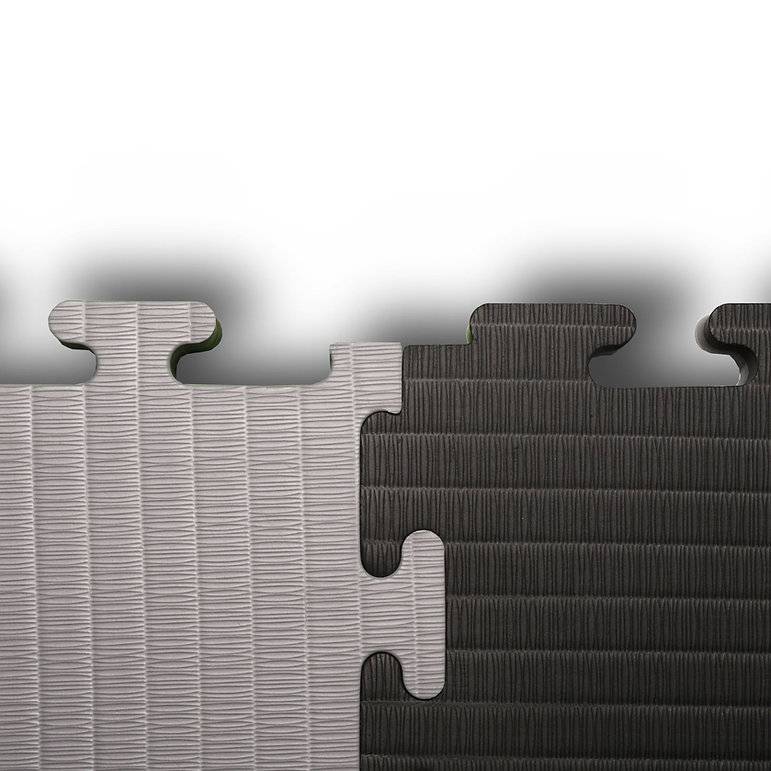
If the room hosts other activities between sessions, a roll-out tatami mat is usually the faster answer: it is deployed and cleared in minutes without dismantling a jigsaw. If the mat stays down permanently and the club expects to extend the area later, interlocking tiles such as the 40 mm dojo puzzle tatami are the more flexible investment.
Surface finish and hygiene
The classic embossed rice-straw texture is not decoration. It gives grip for bare feet while staying smooth enough to let a body slide on a controlled fall instead of catching and twisting a joint. A closed-cell surface is the second requirement in a shared facility: it does not absorb sweat, it is wiped down between classes and it does not become a reservoir for bacteria or dust mites.
Where mats are supplied with a removable cover, specify a washable, hypoallergenic fabric and check that the seams are stitched rather than heat-sealed at the wear points. The cleaning protocol matters as much as the material: a neutral detergent and a damp mop, no solvents, and full drying before the next session.
Colour and zoning
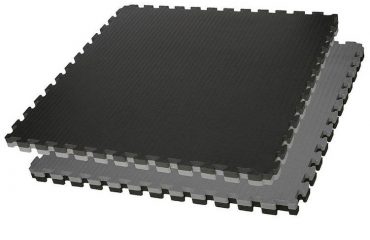
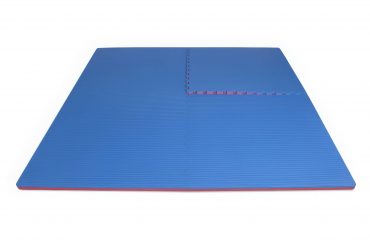
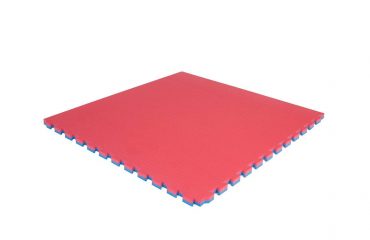
Two-tone reversible mats are the standard specification for clubs, and for a reason: turning the tiles over changes the visible colour and lets you mark a competition square, a safety perimeter or separate age groups without buying a second floor. Black and grey suits multi-purpose rooms and photographs well for club communication; red and blue follows the visual codes of competition mats and helps young athletes orient themselves during randori.
Five checks before you sign the order
- Ask for the reaction-to-fire classification stated on the technical data sheet, and check it against the requirements applicable to your building.
- Check the flatness of the subfloor: a mat cannot compensate for an uneven screed, and hollow points destroy tiles from underneath.
- Order the edge borders at the same time as the mats, so the perimeter is finished and nobody catches a foot on a raw edge.
- Plan the storage: a mat that has nowhere to go at the end of the session gets dragged, folded and damaged.
- Order a margin of spare tiles from the same production batch, so a later replacement matches in colour and density.
Frequently asked questions
Which thickness should a judo club choose?
A club that trains throws needs the thicker end of the range across the whole working area, not only in the centre. Falls do not stay inside the marked square, and a thin perimeter is exactly where injuries happen.
Can tatami be laid over an existing rubber floor?
Yes, provided the existing floor is flat, dry and firmly bonded. Laying a mat over a loose or cupped rubber surface transfers every defect to the tatami and shortens its life.
Do puzzle tiles move during training?
Correctly assembled and fitted wall to wall or held by edge borders, they do not. Movement almost always comes from an undersized area with room to creep, or from tiles from different batches that do not interlock tightly.
How long does a professional tatami floor last?
It depends on hours of use, not on years. The wear indicators to watch are permanent indentation that no longer recovers overnight, opening seams and a surface texture that has gone smooth and slippery.
Talk it through before you buy
Thickness, density and format are decided together, from the disciplines you actually teach and the hours the room is used. Send us your floor plan, your disciplines and your weekly schedule and we will come back with a specification and a costed layout: request a quote.