Professional Tatami Mats: Materials, Thicknesses and Certifications — the Decision Grid
Choosing a professional tatami comes down to three technical parameters, not the price per square metre: the material (EVA foam by density, vinyl over polyurethane foam, or specialised composites), the thickness matched to the falls of the discipline (20 mm for floor fitness up to 60 mm for competition judo and MMA), and the applicable certifications (EN 12503 for sports mats, IJF homologation for competition judo, fire classification for publicly accessible premises). This decision grid crosses the three dimensions so clubs, dojos, schools, care homes and municipalities can specify correctly the first time.
Why the three dimensions matter
- A mat too thin for the discipline multiplies injury risk under repeated falls.
- A mat over-specified for the use costs 30–50 percent too much with no added safety.
- Certifications are routinely demanded in public tenders and rarely understood.
- Material density decides whether the mat lasts five years or fifteen.
Dimension 1: the three material families
High-density EVA foam
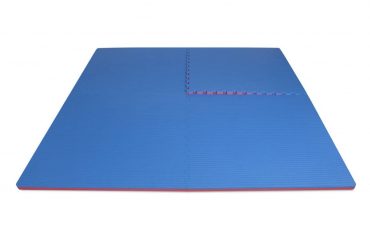
The most widespread material for modular puzzle tatami. Light (100–250 kg/m3), non-slip, waterproof, glue-free installation. The critical figure is density: at least 170 kg/m3 for regular club use, 220 kg/m3 and above for intensive use. A 100 kg/m3 budget tile collapses within 3–5 years of intensive use, while dense EVA holds 8–15 years. Best for recreational martial arts, children’s gymnastics, fitness floors, adapted-activity and wellness spaces.
Vinyl over polyurethane foam (competition / dojo tatami)
A sandwich of reinforced PVC vinyl over high-density PU foam — the reference for federation and competition mats. Smooth throw-friendly surface, calibrated absorption, 15–20 years of club service, hygienic covering, and the only build that can carry IJF homologation. It costs two to three times EVA puzzle, comes as full mats or rolls rather than interlocking tiles, and needs two people to handle. Best for competition dojos, intensive judo and jiu-jitsu clubs, and federal training centres.
Specialised composites (MMA, intensive grappling)
Proprietary builds of dense foam with synthetic felt or cellular cores, sized for permanent ground work and dynamic throws. High absorption without the softness that degrades striking footwork; higher cost and narrower ranges. Best for dedicated MMA and grappling academies.
Dimension 2: thickness by discipline
| Discipline / use | Recommended thickness | Material and density |
|---|---|---|
| Yoga, Pilates, stretching | 20 mm | EVA 120–150 kg/m3 |
| Fitness, floor classes | 20–30 mm | EVA 150–180 kg/m3 |
| Children’s gymnastics | 30–40 mm | EVA 150–180 kg/m3 |
| Rehabilitation, adapted activity, care homes | 25–40 mm | EVA 150–200 kg/m3 |
| Recreational martial arts (karate, taekwondo) | 30–40 mm | EVA 180–220 kg/m3 |
| Recreational judo, beginner BJJ | 40 mm | EVA 200–250 kg/m3 or vinyl |
| Regular / intensive club judo | 40–50 mm | Vinyl over PU foam |
| Competition judo (IJF) | 50–60 mm | Vinyl over high-density PU |
| BJJ and grappling clubs | 40–50 mm | Dense EVA 250+ kg/m3 or composite |
| Professional MMA | 50–60 mm | Specialised composite or dense vinyl |
The rule works both ways: too thin fails to protect, too thick degrades technical footing. For finish and surface texture selection, see our guide to tatami thickness and finishes.
Dimension 3: certifications and homologations
- EN 12503 — sports mats: the European standard series for sports mats, covering shock absorption, slip resistance and dimensional requirements by mat type. The baseline reference to cite when specifying tatami for clubs and schools.
- EN 1177 — impact-attenuating surfacing: relevant where free fall height exceeds 60 cm — children’s ninja structures, school gymnastics circuits, jump zones. For classic martial-arts falls the federation homologation, not EN 1177, is the primary reference.
- IJF homologation: the competition judo reference, covering dimensions (2 x 1 m mats, 8 x 8 to 10 x 10 m combat areas plus safety zones), thickness, density, absorption and friction. Required for venues hosting official federation competitions; unnecessary for recreational clubs and schools, where it inflates the budget by 40–70 percent with no functional gain.
- Fire behaviour — EN 13501-1: mats installed in publicly accessible premises must carry an appropriate reaction-to-fire classification, typically Cfl-s1 for floor coverings. Ask the supplier for the classification report.
- CE marking and emissions: CE marking is required for the EU market; low-VOC and phthalate documentation is a justifiable requirement for schools, care homes and health settings.
The quick decision grid
| Your project | Material | Thickness | Certifications to require |
|---|---|---|---|
| Fitness / yoga / Pilates studio | EVA puzzle | 20–30 mm | CE, fire classification |
| Care home / adapted activity | EVA 180+ kg/m3 | 25–40 mm | CE, fire classification, low-VOC |
| Recreational martial arts club | EVA puzzle 220+ kg/m3 | 30–40 mm | CE, EN 12503, fire classification |
| Competition judo dojo | Vinyl over PU foam | 50–60 mm | CE, fire classification, IJF |
| BJJ / MMA facility | Dense vinyl or composite | 40–60 mm | CE, EN 12503, fire classification |
| School / municipal hall | EVA or vinyl | 30–50 mm by practice | CE, fire classification, EN 1177 if gym circuits |
Tatami within a multi-zone flooring plan
Complete facilities usually combine floors by zone: 30–40 mm rubber tiles in strength areas, discipline-matched tatami in combat areas, and outdoor-rated surfaces outside. For arbitrating between tile, roll and tatami zone by zone, use our sports flooring decision matrix; for the combat-room context around the mats, see our combat gym equipment guide.
Frequently asked questions
What density should EVA tatami have for club use?
At least 170 kg/m3 for regular club use and 220 kg/m3 or more for intensive daily use. Density, more than thickness, is what separates a mat that lasts fifteen years from one that hollows out in three.
Do I need IJF-homologated mats?
Only if you host official judo competitions or operate a federal training centre. For recreational judo, standard vinyl-over-foam or dense EVA at 40 mm serves fully at a much lower cost.
Which standard applies to tatami in a public tender?
Cite EN 12503 for the mats themselves, the fire classification under EN 13501-1 for the premises, EN 1177 only where fall heights exceed 60 cm, and the federation homologation where competition hosting is intended. Justify the thickness by the discipline actually practised.
Puzzle tiles or full mats — which install better?
Puzzle EVA installs glue-free in hours and reconfigures at will — ideal for shared halls. Vinyl full mats give the homogeneous competition surface but need planning and two-person handling. Mixed halls often zone both.
How should tatami be maintained?
Daily disinfection with a covering-compatible product, weekly joint checks on puzzle assemblies, and immediate replacement of any tile with visible compression set. Aggressive chlorinated products shorten vinyl life — agree the cleaning protocol with your supplier at delivery.
Specify your mats with us
Light In Fitness supplies professional tatami across all three material families, with certification documentation for public tenders and installation across Europe. Send us your disciplines, floor area and competition ambitions and we will return a specification and itemised quotation within 24 working hours. Request your free quote.
Réalisations documentées
- Dalles et sols sportifs : livraisons documentees – plusieurs chantiers
- Sol sportif exterieur, square Georges-Vallerey – Taverny (95)
Sources et références
- Arrêté du 19 avril 2011 – étiquetage des produits de construction ou de revêtement de mur ou de sol sur leurs émissions de polluants volatils (Légifrance)
- Ministère de la Transition écologique – étiquetage des produits de construction : classes d’émission A+ à C
- Décret n° 96-1136 du 18 décembre 1996 – prescriptions de sécurité relatives aux aires collectives de jeux (Légifrance)
- NF EN 1176-1 – Équipements et sols d’aires de jeux, partie 1 : exigences de sécurité et méthodes d’essai générales (AFNOR)